




Team Building and Psychological Safety: Creating a Team Where It’s Okay to Make Mistakes
What you’ll discover in this news article
-
What psychological safety is and why it is essential for teamwork.
-
How to turn mistakes into learning opportunities.
-
Which team-building activities foster trust, listening, and communication.
-
How to develop a workplace where everyone can express ideas and concerns without fear of judgment.
-
How to integrate psychological safety into company culture through shared experiences and everyday behaviors.
When Making Mistakes Is No Longer Scary: The Value of Psychological Safety
Imagine a company meeting. A group of colleagues is working on an important project, the deadline is approaching, and every decision could affect the final result. At a certain point, one of the team members realizes that she has made a mistake. She has spotted incorrect information that could compromise part of the work, but she hesitates to mention it.
She is afraid of being judged, losing credibility with her colleagues, or disappointing her manager. So she decides to wait, hoping she can solve the problem on her own.
Meanwhile, the group continues working with incorrect data, and a difficulty that was initially easy to address risks becoming a bigger problem.
Now imagine the same situation in another team. The team member reports the mistake immediately. Her colleagues stop, analyze what happened together, and find a solution. No one downplays the situation, but no one turns the mistake into a judgment about the person.
The difference between these two groups does not necessarily depend on the participants’ technical skills or experience. It also depends on the quality of their relationships, mutual trust, and the opportunity to speak openly without fearing humiliating consequences.
This is the very essence of psychological safety.
The concept, explored in depth by researcher Amy C. Edmondson of Harvard Business School, concerns the shared belief within a group that it is safe to take interpersonal risks: ask questions, admit a difficulty, propose different ideas, and acknowledge a mistake without fear of being devalued for it.
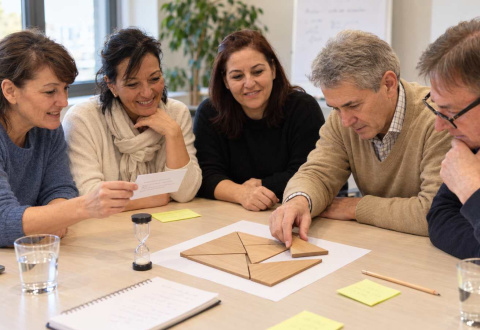
Team building can become a practical tool for developing this aspect through experiential activities that allow people to try new ways of collaborating, handling unexpected challenges, and learning from outcomes.
The goal is not to create a team where no one makes mistakes, but a team where no one needs to hide a mistake to feel accepted.
What Is Psychological Safety and Why Does It Matter at Work?
Psychological safety is a condition in which people feel sufficiently free to express themselves, participate, and contribute to shared work without fearing that every contribution could damage their reputation.
In a psychologically safe environment, an employee can:
-
Ask for clarification when they do not understand a procedure.
-
Admit that they do not know the answer.
-
Report a mistake promptly.
-
Suggest an alternative solution.
-
Express disagreement respectfully.
-
Ask for help when facing a difficulty.
-
Share an insight even when it differs from the prevailing opinion.
These behaviors may seem natural, but they are not always a given. In many organizations, fear of judgment leads people to avoid asking questions, withhold information, or go along with group decisions even when they have identified potential problems.
Psychological safety helps overcome these barriers by encouraging information sharing, constructive discussion, and the ability to learn from experience.
It is no coincidence that Google’s project on team effectiveness identified psychological safety as one of the important factors in how the teams studied functioned.
So for a company, it is not enough to hire skilled professionals and set ambitious goals. It is just as important to create the conditions that allow people to truly contribute their knowledge and abilities to the group.
Psychological Safety Does Not Mean That Anything Goes
A common misconception is that a psychologically safe environment is one where no one is ever challenged, all opinions are considered equally valid, and mistakes have no consequences.
The reality is different.
A group can be psychologically safe while maintaining high standards, following procedures, and requiring individual accountability.
The difference lies in how difficulties are addressed.
Criticizing a proposal does not mean humiliating the person who made it. Asking for improvement does not mean questioning someone’s professional worth. Reporting a mistake does not automatically mean turning it into a matter of blame.
Psychological safety makes it possible to address even the most difficult conversations while keeping the discussion focused on facts, decisions, and observable behaviors.
An unintentional mistake, an experiment that did not produce the expected result, and a deliberate violation of a rule are not equivalent situations. Each requires an appropriate response.
The goal is to make sure people can speak openly about what happened, so they can understand the causes, correct any problems, and improve future work.
Fear of Making Mistakes: The Invisible Enemy of Collaboration
A group in which people are afraid to speak up is not necessarily one characterized by obvious conflict.
Sometimes meetings seem calm, decisions are approved quickly, and no one raises objections. Yet behind this apparent harmony may lie doubts, unspoken ideas, and problems that no one wants to bring to others’ attention.
Silence, after all, does not necessarily mean agreement.
When Important Information Remains Hidden
Imagine an employee who identifies a risk in a project but decides not to report it for fear of being seen as uncooperative. Or a new colleague who avoids asking for an explanation because they are afraid of seeming inexperienced.
In both cases, the group loses potentially useful information.
The consequences can include:
-
Decisions made without considering all available perspectives.
-
Problems identified too late.
-
Less participation in meetings.
-
Difficulty asking for support.
-
Less willingness to try innovative solutions.
-
Collaboration limited to simply carrying out assigned tasks.
When people feel free to speak up, it becomes easier to share concerns, adjust a strategy, and identify potential problems early.
Trust Grows Through Everyday Reactions
Trust is not built only through social gatherings. It develops above all by observing how others react when something goes wrong.
If an employee reports a problem and is listened to, they are more likely to continue communicating openly in the future. If they admit a difficulty and receive help rather than ridicule, they can see that asking for support is useful behavior.
On the other hand, an aggressive or humiliating reaction can lead people to remain silent in similar situations later.
Psychological safety is therefore built through consistent behaviors, repeated over time. It is not enough to say that everyone in the company can speak freely: this must be demonstrated in meetings, in the way mistakes are handled, and in everyday relationships.
Team Building and Psychological Safety: Learning by Doing
How can psychological safety be developed through a team-building activity?
It is not enough to organize a fun game or suggest a day away from the office. To achieve this goal, the experience must be designed to encourage collaboration, discussion, and reflection.
When people face a new challenge, they need to communicate, make decisions, share information, and manage unexpected events. These situations can bring interesting dynamics to light: who always suggests solutions, who tends to stay quiet, who asks for help, who listens to others’ ideas, and who finds it difficult to accept a change in strategy.
Team building allows these behaviors to be observed in a setting different from the workplace and discussed without turning them into personal judgments.
1. Collaborative Problem-Solving: Analyzing Mistakes Without Looking for Someone to Blame
One of the most suitable activities involves setting a challenge in which the group must find a solution while working within certain constraints.
Participants may be given materials, incomplete information, limited resources, and a goal to achieve within a set time.
To succeed, they will need to share the information available, assess possible approaches, and change their plan when a solution does not work.
If the first attempt fails, the facilitator can invite the group to pause and reflect.
What information was missing? Which decision proved ineffective? Did anyone identify a risk that was not heard? How can we improve our approach?
The focus thus shifts from finding someone responsible to analyzing the process.
The activity allows participants to experience a fundamental principle: identifying a difficulty early can be more useful than defending a bad decision at all costs.
2. Corporate Escape Room: Learning to Ask for Help
An escape room is a particularly engaging experience for working on communication and mutual trust.
Participants must solve puzzles, connect clues, and share information to achieve a common goal. No one necessarily has all the answers, and each person’s contribution may prove decisive.
A carefully designed challenge can help reveal whether participants feel free to say “I don’t understand,” whether they listen to less obvious insights, and whether they are willing to change strategy when new information comes to light.
At the end of the activity, the group can discuss a few questions: Did we ask for help when we needed it? Did we listen to every suggestion? How did we respond to mistakes? Did we make room for people who are less inclined to speak up?
In this way, the game becomes an opportunity to reflect on the dynamics that influence everyday collaboration.
3. Creative Challenge: Making Room for Unusual Ideas
Creative activities provide an ideal setting for trying out the freedom to propose different ideas.
The group can be invited to invent a product, design a service, build a prototype, or develop an original solution to a problem.
During the first phase, it is helpful to gather suggestions without judging them immediately. Only later should the group move on to assessing their feasibility.
This distinction is important because premature judgment can stifle participation. If every idea is criticized as soon as it is expressed, people quickly learn not to suggest anything that breaks the mold.
By contrast, allowing room for experimentation makes it possible to explore more possibilities and identify solutions that might otherwise have gone unexplored.
The goal is not to prove that every idea is valid, but to create an environment in which everyone can contribute without fear of being ridiculed.
4. Collaborative Construction: Turning a Failed Attempt into Learning
Building activities with simple materials, creative engineering exercises, and design challenges make it possible to see the effects of decisions firsthand.
The group must plan, distribute tasks, check the result, and step in when something does not work.
If a structure collapses or a prototype fails to meet its goal, the facilitator can invite participants to retrace the steps they took.
Which choice could have been different? Did we test our assumptions? Did we listen to concerns raised during construction? How can we improve the design?
In this way, a mistake becomes something to analyze, not a reason to question the worth of those who took part.
5. Active Listening and Discussion: Learning to Disagree
Psychological safety also depends on the quality of conversations.
An effective activity is to suggest a problem for discussion and invite participants to share different points of view. Before expressing their own opinion, each person must restate a colleague’s position to check that they have understood it.
Afterward, the group can compare the alternatives and find a solution.
The exercise helps distinguish genuine listening from simply waiting for one’s turn to speak. It also gives participants the chance to practice respectful disagreement, where it is possible to question a proposal without attacking the person who made it.
An effective team is not one where everyone thinks alike, but one that can use its differences to make better decisions.
Rome as a Collaboration Lab: Choosing Places That Encourage New Perspectives
The setting in which an experience takes place can also help make it meaningful.
Stepping outside familiar spaces, breaking routine, and sharing an activity in an environment different from the office can help people see their ways of collaborating from a new perspective.
Rome offers many opportunities to design team-building experiences that combine collaborative activities, exploration of the area, and moments of reflection.
Villa Borghese: Problem-Solving and Outdoor Collaboration
The setting of Villa Borghese, one of Rome’s great historic parks, can provide an interesting backdrop for outdoor activities, orienteering games, and team treasure hunts.
An activity might include clues distributed among participants, checkpoints to reach, and problems to solve collectively. To find the solution, the group will need to share information, listen to suggestions, and change its strategy when necessary.
The result should not be assessed solely on the basis of speed. It is also important to observe how decisions are made, whether everyone is able to contribute, and how the team responds to unexpected challenges.
Any use of specific areas should, of course, be checked against the park’s rules and the necessary permits.
Rome’s Botanical Garden: Observation, Patience, and Valuing Everyone’s Contribution
Sapienza University of Rome’s Botanical Garden is an interesting setting for experiences that connect nature, observation, and collaboration, subject to the applicable access conditions and permits.
A themed route could invite participants to identify details, gather information, and work together on a creative proposal.
The connection to psychological safety is immediate: a solution may emerge thanks to a detail noticed by someone who, in other circumstances, might have had less opportunity to speak up.
The group can learn to value different contributions without confusing how confidently someone speaks with the actual quality of their ideas.
MAXXI: Creativity, Interpretation, and Comparing Points of View
MAXXI, the National Museum of 21st-Century Arts, can provide ideas for corporate experiences focused on creativity, communication, and comparing different interpretations, subject to checking the availability of spaces and the rules for organized activities.
In front of a contemporary artwork, for example, different people may notice different meanings and details. Discussion becomes interesting when everyone can express their interpretation and listen to those of others.
An activity of this kind can help the group experience the value of multiple perspectives, ask questions without prejudice, and distinguish disagreement from personal conflict.
The choice of venue should, however, be consistent with the experience’s goals, the participants’ needs, accessibility, and organizational requirements.
How to Design a Team-Building Experience Focused on Psychological Safety
Not every collaborative activity automatically creates a safer environment. Excessively aggressive competition, an exercise that exposes someone to ridicule, or a challenge that systematically excludes some participants can reinforce the very dynamics it is meant to overcome.
For this reason, planning must start with the goals and characteristics of the group.
Identify the Team’s Real Challenges
Before choosing an activity, it is helpful to understand which behaviors you want to improve.
Is the main problem difficulty asking for help? Are meetings dominated by a few people? Do employees avoid reporting mistakes? Are decisions accepted without genuine discussion?
A group that struggles to share information might benefit from a challenge where each participant has only part of the clues. A team that avoids disagreement could work on discussion and decision-making exercises. A newly formed group might need to build familiarity and mutual trust.
Give Everyone the Opportunity to Participate
The facilitator must pay attention to the dynamics that emerge, making sure that competition or differences in roles do not prevent some people from contributing.
It is important to make it clear that the goal is to collaborate and learn, not to prove who is the best. Activities should offer different ways to participate and make room for questions, suggestions, and different points of view.
End with a Structured Debrief
The debrief is the moment when the experience is connected to the workplace.
At the end of the challenge, the group is invited to reflect not only on the result achieved but, above all, on how it worked together.
Some useful questions are:
-
Did we feel free to suggest different ideas?
-
How did we react when something did not work?
-
Did we ask for help when we needed it?
-
Which contributions improved the result?
-
Did we listen to people who are less inclined to speak up?
-
What can we change in our meetings and projects?
The final discussion makes it possible to turn observations into concrete commitments to put into practice every day.
The Role of Managers: Lead by Example and Maintain Accountability
Psychological safety cannot be delegated exclusively to Human Resources or a single team-building day.
Managers play a fundamental role because their reactions help define what people consider acceptable within the group.
A manager who admits their own mistake, asks for input before making a decision, or acknowledges that they do not have all the answers shows that competence does not mean being infallible.
Likewise, a leader who thanks someone for promptly reporting a problem communicates that transparency matters to the team.
This approach does not require giving up authority. It means exercising it in a way that encourages people to contribute while keeping goals and responsibilities clear.
Meetings can also become opportunities to build psychological safety: asking for input from people who have not yet spoken, separating brainstorming from evaluating proposals, and checking objections before finalizing a decision are simple but meaningful behaviors.
Team building can help managers recognize these dynamics and try different approaches. However, to achieve lasting results, what is learned during the experience must be incorporated into everyday practices.
How to Measure Progress in Psychological Safety
Psychological safety cannot be measured solely through satisfaction ratings collected at the end of an event. It is more useful to observe whether people’s behaviors change over time.
A company can use anonymous questionnaires, structured interviews, retrospective sessions, and qualitative indicators to understand how discussion is experienced within the group.
Some questions can help explore the situation:
-
Do I feel free to ask for clarification when I do not understand a task?
-
Can I report a problem without fearing that I will be humiliated?
-
Are different opinions heard before a decision is made?
-
When I make a mistake, can I talk about it openly?
-
Can I ask my colleagues for support?
-
Do I feel that my skills are recognized and put to use?
It is also helpful to observe concrete behaviors: Are problems reported earlier? Do more people participate in meetings? Are requests for help made sooner? Are difficulties analyzed to identify corrective actions?
No single indicator can capture the full complexity of psychological safety. That is why it is important to combine listening, observation, and consistency while protecting the confidentiality of responses.
From Experience to Company Culture: The Real Goal of Team Building
A team-building activity can be a starting point, but it is not enough on its own to transform professional relationships.
If people experience open discussion during a game but are penalized the next day for reporting a difficulty, that learning may not take hold.
To make the results last, it is helpful to connect the experience to everyday practices: brief retrospectives after projects, meetings with a dedicated space for objections, opportunities to share lessons learned from mistakes, and feedback focused on observable behaviors.
Recognizing people who report a risk promptly can also help strengthen a culture of transparency.
The goal is not to celebrate every mistake, but to learn to distinguish between avoidable difficulties, problems caused by complex systems, and well-considered attempts that do not produce the expected result.
As explored in Harvard Business Review’s article on misconceptions about psychological safety, this concept is often misunderstood when it is simply associated with an absence of tension or the desire to keep everyone comfortable.
In reality, its importance becomes clear when it enables people to address difficult issues openly, express concerns, and question decisions that could be improved.
A mature team is not one that never encounters obstacles, but one that can recognize them, talk about them, and find a way to overcome them together.
Conclusion: A Team Grows When No One Has to Pretend to Be Infallible
Let’s return to the opening meeting. In one team, the mistake is hidden and the group loses valuable time. In the other, the difficulty is shared, analyzed, and addressed through collaboration.
Psychological safety does not eliminate the possibility of making mistakes or guarantee that every idea is right. Rather, it creates better conditions for people to contribute honestly, pool their skills, and address problems before they become more complex.
Team building can provide a practical setting in which to try out these behaviors, observe group dynamics, and open new conversations about how to work together.
Through collaborative challenges, creative activities, outdoor experiences, and guided reflection, participants can discover that asking for help is not a weakness, disagreeing does not mean being hostile, and admitting a mistake can be an act of accountability.
Because a truly effective team is not one where no one ever makes a mistake.
It is one where no one has to hide a mistake to feel part of the group.
If you would like to design a tailored experience for your organization, you can request a quote and explore the activities best suited to your goals for collaboration, communication, and team development.