













































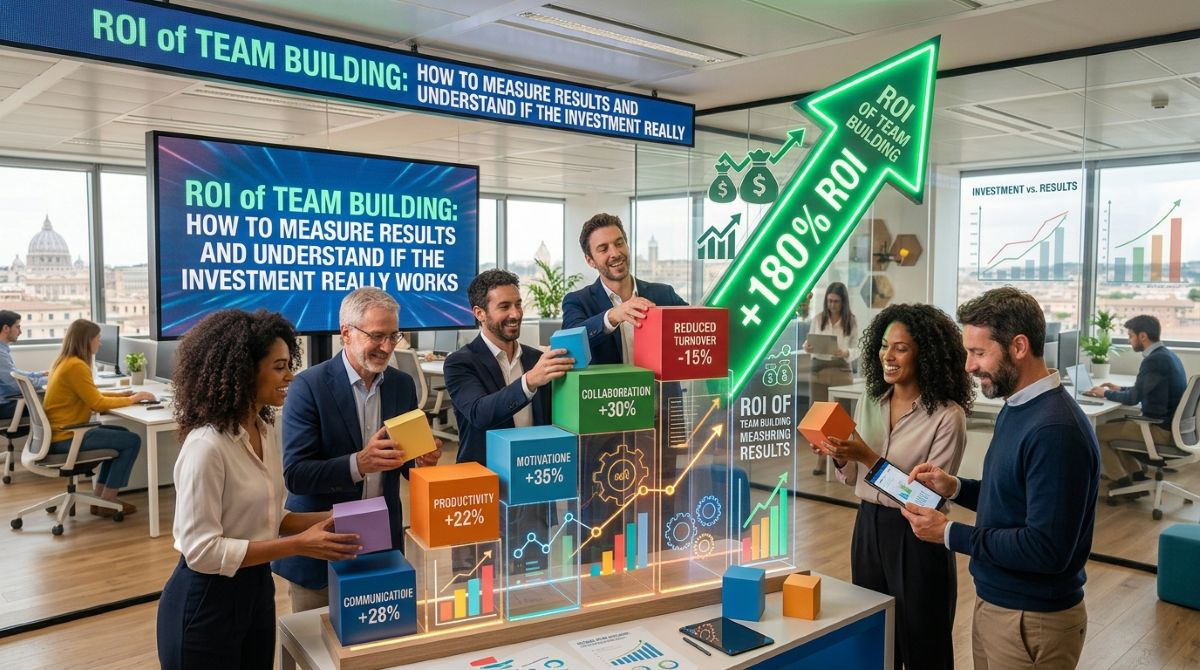
Team Building ROI: how to measure results and understand if the investment really works
A Team Building can be fun. It can be exciting. It can give you photos, laughter, and shared memories.
But once the experience is over, one question arrives that every company must ask sooner or later:
what has actually changed?
The day after a corporate activity, participants go back to their desks, resume meetings, reopen emails, and deal again with deadlines, goals, and day-to-day problems.
Did the Team Building leave anything behind?
Has communication improved? Do people collaborate differently? Are new colleagues more integrated? Have conflicts decreased? Has the group become more effective?
In other words: what is the Team Building ROI?
Measuring the return of a Team Building experience is one of the most interesting challenges for companies, HR leaders, and managers. Because not everything that matters can be immediately measured with a single number, but that doesn’t mean it can’t be evaluated.
A well-designed Team Building can produce observable results through indicators, feedback, behaviors, and data collected over time.
The key is to stop treating the activity as an isolated event and start integrating it into a broader journey.
What is Team Building ROI?
ROI stands for Return on Investment, meaning return on investment.
Traditionally, it’s used to assess the relationship between resources invested and results obtained.
When it comes to Team Building, however, the concept needs a broader perspective.
We’re not only measuring how much money the company invested in an activity against an immediate return.
We’re trying to understand whether the experience helped improve elements that directly or indirectly influence the organization’s performance.
For example:
-
communication quality;
-
collaboration across departments;
-
problem-solving capability;
-
mutual trust;
-
engagement;
-
integration of new employees;
-
conflict management;
-
motivation;
-
ability to work toward shared goals;
-
sense of belonging.
So, Team Building ROI shouldn’t be assessed only through a question like:
“Did you like the activity?”
The more useful question is:
“What change did we want to achieve, and what signals allow us to understand if we’re moving toward that goal?”
From the Colosseum to the KPI: Team Building as a strategic investment
Let’s imagine an international company bringing together in Rome people from different locations.
In the morning, the group meets for a challenge that cuts through the historic center. Teams must collaborate, make decisions, and share information to reach a series of objectives.
Some people are used to making decisions quickly.
Others prefer to analyze every possible option.
There’s someone who naturally takes the lead, and someone who at first stays quiet and observes.
But during a mission near the Colosseum, the group gets stuck.
The solution doesn’t come.
To move forward, they have to change their approach.
Someone who up until that point has talked very little notices a decisive detail. A colleague listens to them. The team reorganizes the information and finds the answer.
The mission continues.
At the end of the day, it might seem like just a fun episode.
But for a careful observer, that situation tells something far more important.
How does the team make decisions? Who is listened to? How are mistakes handled? Does the group truly share information?
That’s why the ROI of a Team Building doesn’t start at the end of the activity.
It starts much earlier.
Before measuring ROI, you need to define the objective
The first mistake: organizing an activity without knowing what you want to improve
There is no single KPI that works for every Team Building.
One company might want to improve collaboration between two departments. Another might need to integrate new employees. Another might want a sharing moment after months of intense work.
If the goal changes, the evaluation criteria must change too.
That’s why, before organizing an activity, it’s useful to define a specific question.
For example:
-
do we want to improve internal communication?
-
do we want to encourage integration between people who work in different locations?
-
do we want to develop problem-solving skills?
-
do we want to increase the sense of belonging?
-
do we want to help a new team get to know each other?
-
do we want to work on leadership?
-
do we want to reduce collaboration difficulties between departments?
The clearer the objective is, the easier it will be to identify the indicators to observe.
From a generic desire to a measurable outcome
Saying “we want to improve teamwork” is a great starting point, but it’s still too generic.
To measure the result, the goal needs to be turned into observable behaviors.
For example:
Goal: improve communication.
Possible indicators:
-
greater participation in meetings;
-
reduced misunderstandings;
-
greater sharing of information;
-
faster times in resolving problems;
-
improved perception of collaboration among colleagues.
So, Team Building becomes part of a process.
Not a detour.
How to measure Team Building ROI
1. Measure the situation before the activity
To understand whether something has changed, you first need to know the starting point.
Before the Team Building, different tools can be used:
-
internal questionnaires;
-
employee climate surveys;
-
individual interviews;
-
focus groups;
-
observation of team dynamics;
-
data related to turnover or absenteeism;
-
performance indicators;
-
manager feedback.
You don’t always need to build a complex system.
Even a few questions, asked before and after the experience, can provide interesting insights.
For example:
“How effective do you think communication is within your team?”
Or:
“How free do you feel to ask a colleague for help?”
If the same questions are repeated after a period of time, the company can compare results.
2. Collect immediate feedback
The first level of evaluation relates to the experience itself.
Did participants find the activity engaging? Did they feel included? Did they perceive a connection with company goals?
This data is useful, but not enough.
An activity can be highly appreciated without producing lasting changes.
At the same time, a particularly challenging experience might generate less immediately enthusiastic feedback, but still offer important growth insights.
That’s why satisfaction is only one of the elements to consider.
3. Observe behaviors during the Team Building
One of the most interesting aspects of an experiential activity is the chance to observe the team outside the everyday context.
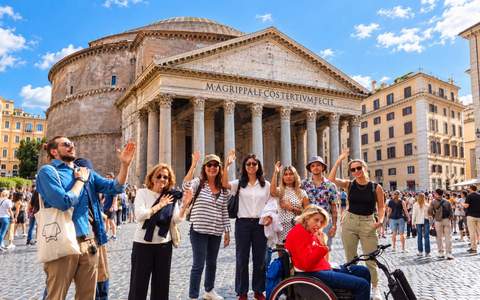
During a treasure hunt between the Pantheon, Piazza Navona, and the streets of the historic center, for example, dynamics emerge that might be less visible in the office.
Who takes leadership spontaneously?
Who listens?
Who tends to make decisions without consulting others?
Who manages to involve the most silent people?
Who stays calm when something doesn’t work?
These observations can provide extremely useful qualitative indications.
4. Measure what happens after
The real evaluation shouldn’t stop at the end of the event.
It’s in the days and weeks that follow that you can verify whether the experience left concrete traces.
Depending on the objective, the company can monitor:
-
collaboration quality;
-
meeting participation;
-
problem-resolution speed;
-
number of reported conflicts;
-
engagement level;
-
peer feedback;
-
ability to work across different departments;
-
achievement of shared goals.
So, the most important moment isn’t the questionnaire filled out right after the activity.
It’s what happens when the group returns to normal.
Team Building KPIs: which indicators to choose?
Quantitative KPIs
Some results can be observed through numerical data.
Depending on company objectives, the following may be considered:
-
absenteeism rate;
-
turnover;
-
team productivity;
-
project completion times;
-
number of errors or rework;
-
meeting deadlines;
-
participation in internal initiatives;
-
level of involvement in employee surveys.
Of course, it would be wrong to automatically attribute every change to Team Building alone.
Organizations are complex systems, and many factors can influence results.
So, Team Building should be considered within a broader framework.
Qualitative KPIs
Other results, instead, require more careful observation.
Among them:
-
trust among colleagues;
-
communication quality;
-
listening ability;
-
sense of belonging perception;
-
openness to discussion;
-
collaboration between people or departments;
-
willingness to share ideas.
These elements can be detected through questionnaires, interviews, and moments of discussion.
A simple formula to start thinking about ROI
When results can be translated into economic value, a classic ROI calculation formula is:
ROI = (Benefits obtained - Cost of the investment) / Cost of the investment × 100
However, for Team Building, the most complex part is defining the benefits.
What is better collaboration worth?
How much does it cost to solve a problem faster?
What’s the economic impact of a more integrated team?
It’s not always possible to assign a precise value to every change.
For this reason, it can be useful to pair economic ROI with other indicators, building a comprehensive assessment of the overall impact.
The model: before, during, and after
Before: establish the starting point
Before the experience, it’s useful to collect data and define goals.
This allows you to build a comparison baseline.
During: observe the dynamics
During the activity, you can observe behaviors, decision-making styles, collaboration skills, and reactions to difficulties.
A mission through the alleys of Trastevere or a problem-solving challenge can become a concrete situation in which the group’s skills and dynamics come to the surface.
After: verify the transfer
The decisive question is:
what we experienced during the Team Building is also used in day-to-day work?
To answer, it can be helpful to organize a short follow-up after a few weeks.
The team can reflect on what happened during the activity and identify one or more concrete behaviors to maintain over time.
For example:
-
listen before making a decision;
-
share information more effectively;
-
involve people who are less used to speaking up;
-
ask for support before a problem becomes bigger.
From Team Building to real change
Experience alone isn’t enough
A Team Building, even if perfectly organized, can’t solve the company’s structural problems on its own.
It can’t replace ineffective leadership.
It can’t compensate for nonexistent internal communication.
It can’t automatically eliminate conflicts that have deep roots.
But it can become a powerful starting point.
A shared experience creates a common language.
It allows people to experience situations in which problems emerge more clearly and with less conflict.
A team may remember, for example, the time they wasted time because no one listened to the other person during a challenge.
That episode can become a useful metaphor even months later.
“We’re doing again what happened during that test.”
Sometimes, a shared memory can help a group recognize its own behaviors more quickly.
A measurable Team Building starts with design
Not all activities produce the same impact
The choice of activity should be linked to the objective.
If a company wants to work on problem-solving, it’s useful to design challenges that require analysis, sharing information, and collective decision-making.
If the goal is integration, it might be more effective to build mixed teams and activities that encourage mutual knowledge.
If you want to work on creativity, a collective artistic project can offer completely different dynamics.
So Team Building shouldn’t start from the question:
“Which activity do we choose?”
But from another question:
“Which result do we want to foster?”
Only after that do you choose the format.
Rome as a lab to measure collaboration
Rome offers particularly interesting scenarios to turn a Team Building into an observable experience.
A treasure hunt in the historic center requires navigation, communication, and the ability to make decisions.
A route between the Campidoglio, the Imperial Forums, and Castel Sant’Angelo can become a sequence of missions in which each team must use different skills.
A creative activity can be organized in a corporate location or in a space dedicated to events.
A Cooking Team Building can test coordination, time management, and role distribution.
Every experience can become a small laboratory.
The difference lies in the design and in the ability to connect what happens during the game to the team’s real objectives.
The real return is not always immediate
Team Building rarely produces a measurable transformation the next day.
Its value can emerge over time.
In a meeting handled differently.
In a colleague who decides to ask for help.
In a department that starts sharing more information.
In a new employee who stops feeling “new.”
In a group that, in front of a problem, remembers that they’ve already faced together a complex situation.
The most interesting ROI of Team Building is often exactly this.
Not the memory of a great day, but what that day manages to generate afterward.
How to know if the Team Building really worked
An effective Team Building leaves questions, tools, and shared memories.
To understand whether it created value, a company can ask itself:
-
did the team develop greater awareness of its own dynamics?
-
do people collaborate more effectively?
-
did behaviors or problems that weren’t visible before emerge?
-
was the experience connected to a concrete company objective?
-
were data collected before and after?
-
did management plan a follow-up moment?
-
are there observable signals of change?
If the answer is yes, the Team Building has already gone beyond the simple dimension of the event.
It has become a tool.
FAQ – Team Building ROI and measuring results
What is Team Building ROI?
Team Building ROI indicates the value and return generated compared to the resources invested. It can be assessed through economic, quantitative, and qualitative indicators related to communication, collaboration, engagement, and performance.
How do you measure the success of a Team Building?
It’s useful to define objectives before the activity, collect baseline data, observe the dynamics during the experience, and compare results through surveys, feedback, KPIs, and subsequent follow-ups.
Which KPIs should you use for Team Building?
It depends on the objectives. You can analyze engagement, turnover, absenteeism, productivity, project completion times, communication quality, collaboration, and perceptions of the company climate.
Can a Team Building improve productivity?
It can help improve some dynamics that influence productivity, such as communication, coordination, trust, and problem-solving ability. To evaluate its impact, it’s important to analyze results over time.
After how long can results be measured?
Immediate feedback can be collected at the end of the activity, but to observe any changes in behaviors, it’s advisable to plan follow-up moments in the weeks or months that follow.
Is it possible to customize a Team Building based on company objectives?
Yes. An activity can be designed according to the company’s needs, the number of participants, the skills to develop, and the results you want to observe.
Is participant satisfaction enough to measure ROI?
No. Satisfaction is an important indicator, but it isn’t enough. A highly appreciated experience doesn’t necessarily create a concrete change. It’s useful to evaluate behaviors, dynamics, and subsequent results as well.
If you want to live this experience or others like it, click here, you’ll find our proposals:
Request a free quote and get all the information about your Team Building experience.
Request a quote




