


























Street Art & Brainstorming: expressing the company’s Vision through Rome’s murals
When a wall becomes a blank page
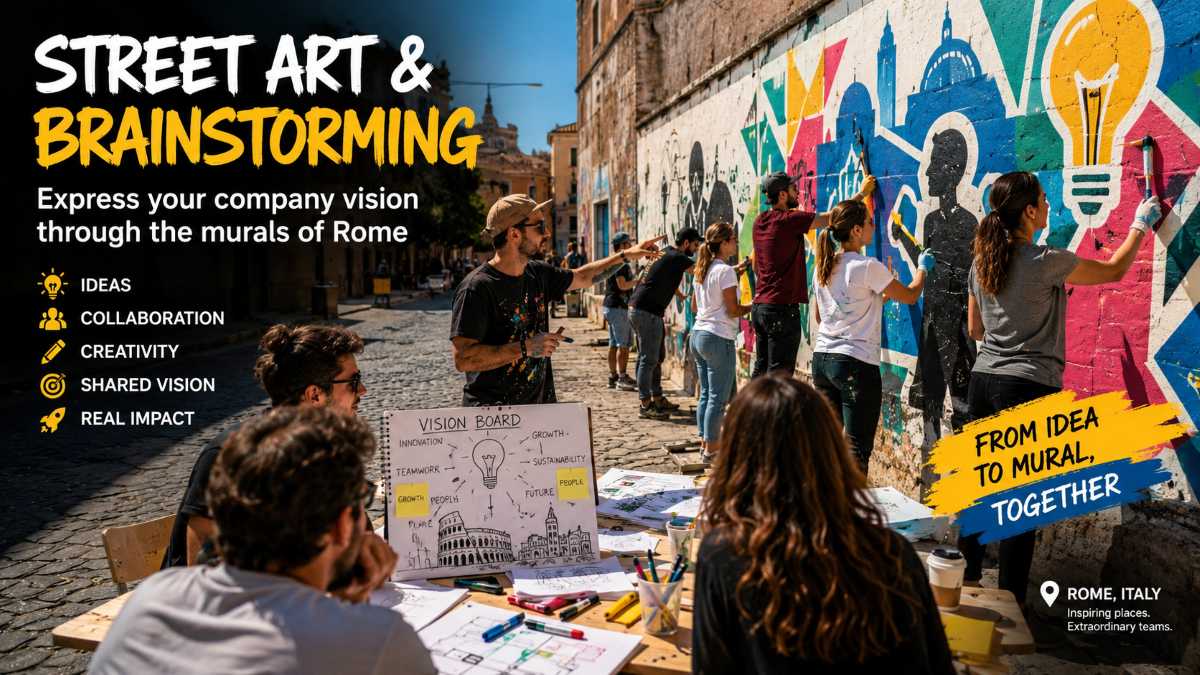
Imagine bringing a team in front of a large wall in Rome.
There are no slides to present, no meeting room, no whiteboard full of post-it notes. There’s only a surface that looks empty—and a question:
“If this wall had to tell who we are as a company, what would we want to see?”
It’s from this apparently simple question that a surprisingly effective team-building experience can begin.
Street Art in Rome is not only a contemporary art event. In many neighborhoods across the Capital, it has become an instrument of urban transformation—able to change how a place is perceived and to build new shared narratives. Ostiense, Tor Marancia, Pigneto, Quadraro, and other neighborhoods show how a wall can become a space for expression, discussion, and identity. (VisitLazio)
And it’s here that street art meets business brainstorming.
Why designing a mural and designing a Vision have something in common: both require starting from an idea, shaping it, confronting it with others, and turning it into something that can be seen, recognized, and shared.
The company Vision is not a sentence on the wall
Many companies have a Vision.
It’s written on the corporate website, in institutional documents, in commercial presentations, or in the meeting room.
But how truly shared is it by the people who work within the organization?
This is one of the most interesting questions a creative team-building activity can help address.
An effective Vision shouldn’t be only a statement created by management. It should become a direction the group can recognize.
Street Art can transform this abstract concept into a concrete experience.
A team observes an image. Another interprets its meaning. Someone identifies a symbol. Another suggests a color. One participant thinks about the company’s present, while a colleague imagines where it should be in five years.
In just a few minutes, something fundamental emerges:
people can share the same goal and imagine it in completely different ways.
Brainstorming is precisely meant to turn these differences into value.
Rome as a laboratory for business creativity
Rome is especially suited to this kind of experience because it allows different eras, languages, and identities to be brought into dialogue.
Alongside archaeological and monumental heritage, there is a contemporary Rome made of neighborhoods, walls, former industrial areas, and urban regeneration projects.
It’s a city that doesn’t tell a single story.
It tells thousands.
And this feature becomes a powerful metaphor for a work group.
A company, just like a city, is made up of different people, different skills, experiences, perspectives, and languages that must find a way to coexist.
Ostiense: from a factory to creativity
One of the most interesting places to start this journey is Ostiense.
The neighborhood preserves a strong industrial identity, now paired with a lively cultural and artistic scene. The surfaces of buildings, warehouses, and former industrial structures have become canvases for numerous Street Art works. Among them, Turismo Roma also highlights Hunting Pollution by Iena Cruz on via del Porto Fluviale and Black & White Power by Sten & Lex on via dei Magazzini Generali. (Turismo Roma)
The result is particularly interesting for a business activity.
A place created to produce becomes a place capable of producing ideas.
It’s a perfect metaphor for talking about innovation.
The question to ask the group could be:
“What transformation should tell the next chapter of our company?”
That’s where brainstorming can begin.
The Gazometro: seeing beyond function
The Gazometro of Rome is another extremely powerful visual element.
For decades, it was a symbol of the city’s industrial function. Today, it has also become a recognizable element of Ostiense’s contemporary identity.
During a team-building activity, it can become the starting point for reflection:
An object can change meaning without losing its history.
The same thing can happen to a company.
A business can evolve without rejecting what it has been.
It can change tools, markets, technologies, and organization—while still keeping some core values.
This is the key step that makes Vision brainstorming particularly interesting: it’s not only about imagining the future, but about understanding which elements from the past deserve to be carried forward.
Tor Marancia: when a neighborhood becomes a collective canvas
If Ostiense tells the story of transformation, Tor Marancia tells above all the value of collaboration.
The project Big City Life, created in 2015, transformed the facades of a residential complex into a real open-air museum of contemporary art. Turismo Roma describes the project as an intervention in which international artists created large works on the building facades, involving the neighborhood’s residents. (Turismo Roma)
It’s precisely this element that makes it especially interesting from a team-building perspective.
A mural doesn’t come only from the artist’s idea.
It arises from the interaction between:
-
artist;
-
space;
-
community;
-
project;
-
message;
-
audience.
Just like a business project.
From the artist to the team
In a creative workshop inspired by Street Art, the artist’s role can become, metaphorically, that of the team.
The group receives a mission:
represent the company’s Vision through an image.
At the beginning, there will probably be many ideas.
Someone will propose an abstract symbol.
Someone will think of a word.
Someone will want to represent the future.
Another person will insist on the past.
Someone will immediately think about the customer.
And this is where the real team-building exercise begins.
You don’t simply need to find “the great idea.”
You need to find the idea that everyone can recognize as their own.
From brainstorming to the mural: how the experience works
A Street Art Team Building in Rome activity can be structured as a real creative journey.
1. Observe
The group is invited to observe the surrounding environment.
Not only the artworks.
Also the buildings, colors, people, architectures, and neighborhood transformations.
The goal is to practice a skill often underestimated at work:
learning to look before starting to speak.
2. Interpret
Each participant chooses an element they consider meaningful.
A color.
A shape.
An image.
An architectural detail.
A message.
From there, a first set of associations is created.
There are no right or wrong answers yet.
There are perspectives.
3. Share
Individual ideas are brought together.
This is the moment when brainstorming becomes truly collaborative.
The group discovers that some words come up more often.
Innovation.
People.
Growth.
Future.
Sustainability.
Courage.
Relationship.
Quality.
These words form the first vocabulary of the Vision.
4. Synthesize
This is probably the most interesting phase.
Not all ideas can fit into the mural.
The team must choose.
It must set priorities.
It must eliminate elements.
It must combine concepts.
It must transform a large number of thoughts into a simple, recognizable visual message.
In other words, it must do creative problem solving.
5. Create
Finally comes the realization stage.
The project takes shape.
The wall becomes a shared surface.
Each participant can contribute an element, but the result must be coherent.
And it’s precisely here that one of the strongest metaphors of the experience comes to life:
A good team isn’t the one where everyone does the same thing, but the one where different contributions manage to build a shared result.
Street Art as an exercise in leadership
An activity like this can be especially interesting for managers too.
Because in front of a canvas or a wall, there is no automatic hierarchy.
The director can have a great idea.
But the person who just joined the company can have one too.
A manager can propose a solution.
But the team can modify it.
The creative can imagine the concept.
The more analytical colleague can help make it coherent.
This creates an environment where collaborative leadership can naturally emerge.
Leadership also means knowing how to make room
One of the main lessons from visual brainstorming is that guiding doesn’t necessarily mean having all the answers.
It often means:
-
asking the right questions;
-
listening;
-
selecting;
-
giving trust;
-
coordinating different skills;
-
allowing others to contribute.
So the mural becomes a visual representation of how the group makes decisions.
Pigneto and Quadraro: identity, memory, and new languages
Roman Street Art doesn’t focus on a single neighborhood.
Pigneto, Tor Pignattara, and Quadraro are also important areas for artistic and cultural experimentation. Contemporary routes dedicated to urban art include these neighborhoods, along with Tor Marancia, Ostiense, San Basilio, and other areas of the Capital. (Turismo Roma)
This variety makes it possible to build different experiences.
In Pigneto, for example, the relationship between urban art, the neighborhood’s identity, and cultural memory can become a starting point to work on the theme:
“Where do we come from?”
In Quadraro, on the other hand, the dimension of memory and urban transformation can introduce a different question:
“What story do we want to tell about ourselves?”
These are questions that seem artistic at first glance.
In reality, they are deeply strategic questions.
From the mural to the Vision: the real goal of team building
The value of this experience isn’t necessarily about producing a perfect work of art.
The real outcome is the path that leads to its creation.
During the activity, the team can practice fundamental skills for today’s work.
Communication
People need to explain their ideas in a way that others can understand.
Listening
To build a shared image, you must understand the perspectives of others.
Creativity
The group must find solutions that go beyond usual patterns.
Problem solving
Not all ideas can be used: you have to select and synthesize.
Decision making
At some point, a choice must be made.
Collaboration
The final result belongs to the group, not the individual.
Leadership
Coordinating the process without stifling creativity becomes a real leadership test.
Identity
The final product can become a symbolic representation of shared values.
The strategic value of creative team building
Companies increasingly organize team-building activities in search of something that goes beyond a simple recreational moment.
The question has become:
“What will people bring to the office the day after?”
A Street Art activity can leave a mark precisely because it works simultaneously on the emotional dimension and the organizational one.
The team has fun.
But at the same time, it observes its own way of operating.
Who takes the initiative?
Who listens?
Who tends to impose themselves?
Who stays silent?
Who manages to mediate?
Who finds solutions?
Who thinks about aesthetics?
Who thinks about functionality?
Who can turn ten different ideas into one?
So the wall becomes a sort of mirror of the team.
Why choose Rome for a Street Art Team Building
Rome offers an advantage that few other destinations can guarantee: it allows you to combine historical heritage, contemporary art, and urban identity within the same experience.
In just a few hours, it’s possible to move from archaeological Rome to industrial Rome, from monumental Rome to creative Rome.
A route can connect—according to the chosen concept—areas such as Ostiense, Testaccio, Garbatella, Tor Marancia, Pigneto, or Quadraro, turning the urban setting into an integral part of the activity.
So it’s not just about “going to see murals.”
It’s about reading the city like a big creative whiteboard.
And in this sense, Rome is an extraordinary laboratory.
Street Art & Brainstorming: when the Vision takes shape
At the end of the experience, the group comes back in front of its own work.
Maybe the mural isn’t perfect.
Maybe some element is different from what was imagined.
Maybe an initial idea has been completely transformed.
But for exactly this reason, the result is interesting.
Because it tells a process.
Because it tells the discussion.
Because it tells the ability to change one’s mind.
Because it tells compromise.
Because it tells creativity.
And above all, it tells something that a company Vision should always be able to do:
give people an image of the future in which they can recognize themselves.
So a wall can become much more than a surface.
It can become a question.
Brainstorming can become much more than a meeting.
It can become an experience.
And team building can become much more than a day out of the office.
It can become the moment when a group discovers—through art—how it wants to build its future together.
Street Art and Team Building: a concrete metaphor for innovation
Innovation rarely comes from a single perfect idea.
It comes from the meeting of different ideas.
Street Art proves it in a highly visual way: a wall changes when someone decides to look at it not as a simple wall anymore, but as a space still to be imagined.
The same is true for a company.
An innovative team doesn’t just use what already exists.
Imagine what doesn’t exist yet and find a way to build it together.
And this is precisely the deepest connection between Street Art and brainstorming:
before changing the world, you must learn to imagine it differently.