
























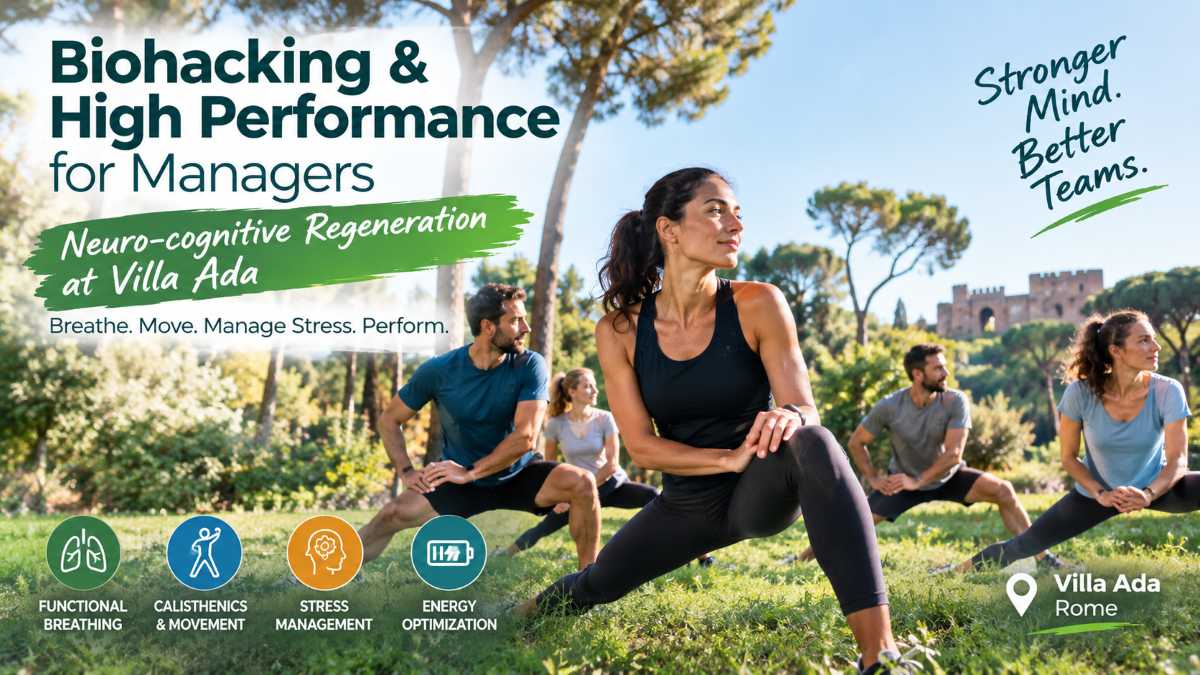
Biohacking and High Performance for Managers: neuro-cognitive regeneration at Villa Ada
For a manager used to living between meetings, quick decisions, notifications, deadlines, and responsibilities, stopping can feel like almost a waste of time.
And yet, precisely the ability to pause, recover, and consciously manage one’s own energy is becoming one of the most interesting skills for those who work in high-pressure environments.
From this need comes a new concept of team building for managers in Rome: a biohacking and high-performance experience immersed in the greenery of Villa Ada Savoia, where functional breathing, movement, calisthenics, stress management, and recovery techniques are transformed into an experiential path dedicated to wellbeing and performance.
The term biohacking is often used to refer to strategies aimed at optimizing habits, environment, and behaviors related to wellbeing and performance. In this context, however, we are not talking about miracle formulas or medical treatments: the goal is to create a guided experience in which participants learn to better observe their own psycho-physical state and manage their resources.
So Villa Ada becomes something more than just a location.
It becomes an open-air laboratory.
Why talk about High Performance with managers
In the business world, the word performance is often associated exclusively with results.
More productivity.
More speed.
More goals.
More decisions.
But there is another dimension of performance: the ability to maintain clarity, energy, and decision-making quality over time.
A manager can be extremely competent and, at the same time, find themselves in a state of overload.
The problem isn’t necessarily the amount of work. It’s also how the body and mind react to the constant exposure to stimuli, pressure, and responsibility.
That’s why a high-performance path can start with a seemingly simple question:
how aware are we of our energy during a workday?
Performance doesn’t mean pushing harder all the time
An athlete doesn’t train continuously at the maximum intensity.
They alternate load and recovery.
They progressively build the capacity to sustain effort.
They learn to listen to the body’s signals.
For a manager, the principle may be similar, even though the objectives and tools are completely different.
Team building can therefore become an opportunity to try out a sequence made up of activation, focus, movement, recovery, and reflection.
Not to turn participants into athletes, but to show concretely how changing pace can alter the quality of the experience.
Villa Ada: the ideal setting to get out of “office mode”
The choice of Villa Ada Savoia is not accidental.
The large urban park in the northern quadrant of Rome covers about 160 hectares and is characterized by holm oak woods, cork oaks, pine groves, and meadows. The Municipality of Rome lists several entrances, including Via Salaria, Via di Ponte Salario, Via di Monte Antenne, and Via Panama. (Comune di Roma)
The landscape allows for a clear psychological separation from everyday life.
Participants arrive from the city, but gradually enter an environment where noise, movement, and vegetation change the perception of space.
The pace slows down.
Attention changes.
The group moves.
And it is precisely in this transition that the experience can begin.
The park as a natural gym
Villa Ada also has sports areas and equipment and offers numerous natural spaces suited to walks and outdoor activities. (Turismo Roma)
The route can therefore alternate moments of movement with moments of recovery.
A mindful stretch of walking can come before a breathing session.
A calisthenics practice can be followed by a relaxation activity.
A group challenge can end with a few minutes dedicated to listening and reflection.
The structure of the experience becomes part of the message: performance isn’t just pushing—it’s also the ability to recover.
Functional breathing: the first tool always available
Among the most interesting elements of the format is the work on breathing.
Breathing is automatic, but the way we breathe can be observed—and, in certain practices, consciously modified.
Scientific literature has begun to systematically study the relationship between breathing exercises and stress. A meta-analysis published in Scientific Reports found an association between breathwork practices and a reduction in perceived stress, while also emphasizing the need for further studies and to interpret results with caution. (Nature)
A systematic review published on PubMed also analyzed interventions based on breathing exercises for anxiety and stress in adults, finding generally favorable results while also highlighting the need for larger randomized studies. (PubMed)
The interesting point for team building is therefore not to promise instant “regeneration.”
It’s about teaching participants to pay attention to their own breath and to experience a simple, guided technique that for some people can become a tool for self-regulation.
From breath to concentration
Let’s imagine a group of managers just arrived at Villa Ada.
First test: everyone walks quickly.
Second test: everyone stops.
The instructor proposes a brief breathing exercise.
The group starts again.
The distance covered is the same.
But the experience is different.
This small experiment helps introduce a fundamental concept: before we change the environment, we can learn to observe our inner state.
Calisthenics: the body as a tool for awareness
The second element of the format is movement.
Calisthenics, understood as bodyweight training, makes it possible to design exercises adaptable to different experience levels.
You don’t need to turn the group into an competitive team.
The goal can be much more interesting: using movement to work on coordination, control, balance, relative strength, and collaboration.
Individual exercises and partner trials
The path can begin with simple, progressive exercises.
Squats.
Lunges.
Plank.
Balance exercises.
Mobility.
Coordinated movements.
After that, the work can become pairs or small groups.
This is where team building comes into play.
One participant may have to guide their partner through a sequence.
Another can observe and provide instructions.
A third can control the timing.
Individual performance thus becomes a collective matter.
The concept of “useful strength”
In a managerial context, it can be useful to introduce the concept of functional strength.
You don’t need to prove who is the strongest.
You need to understand how best to use your own resources.
It’s an extremely effective metaphor for work as well.
A team doesn’t need everyone to do the same thing.
It needs each person to know when to step in, when to support, when to make space, and when to ask for help.
Stress management: turning pressure into a manageable variable
The third component of the format is stress management.
Here, team building can be especially interesting for a managerial audience.
One challenge can be designed with a time limit.
A second one with incomplete information.
A third one with an sudden change in the rules.
The group is therefore exposed to a small dose of controlled pressure.
Not to generate real stress, but to observe reactions.
Who takes the lead?
Who freezes?
Who communicates?
Who listens?
And who keeps executing the plan even when the plan no longer works?
The unexpected challenge
One of the most effective activities can be built around the unexpected.
The team receives an objective.
A time frame is set.
Some tools are provided.
Then, halfway through, a condition changes.
The initial strategy is no longer enough.
At that point, the group must stop, breathe, reassess the situation, and decide.
The connection to managerial life is immediate.
Markets change.
Priorities change.
People change.
Customers change.
Information changes.
The ability to adapt without losing clarity is therefore an essential component of performance.
Neuro-cognitive regeneration: a concept to live, not a promise
The phrase “neuro-cognitive regeneration” is particularly effective from a narrative standpoint, but it must be used carefully.
It doesn’t mean promising to “regenerate the brain” in just a few hours.
In a team-building context, it rather refers to a structured break shaped by normal cognitive stimuli, where the participant alternates movement, breathing, nature, attention, and recovery moments.
The value of the experience is therefore mainly behavioral and experiential.
The manager doesn’t receive a magic formula.
They get the chance to try a different relationship between attention, body, movement, and recovery.
Villa Ada and its POIs: when the landscape becomes part of the experience
Another strength of the format is the possibility of using the park’s POIs as narrative elements.
Villa Ada isn’t only greenery.
It’s a place where nature, history, and archaeology coexist.
Monte Antenne and the ancient Antemnae
One of the most interesting points is Monte Antenne.
Here were the remains of the ancient Antemnae, a pre-Roman settlement linked to the origins of Rome. The Municipality of Rome has also organized recent guided visits and archeotrekking activities dedicated to the archaeological area. (Comune di Roma)
This POI can become a perfect metaphor for an activity dedicated to managers.
Before building the future, you need to know where you’re starting from.
A short walk toward Monte Antenne can therefore be used as a moment for observation and historical storytelling.
The pond at Villa Ada
The pond, instead, represents a natural reference point for a slower phase of the experience.
Here it’s possible to organize a breathing moment, mobility work, or a mindful walk.
The shift from dynamic practice to a pause allows participants to concretely experience the concept of recovery.
The Temple of Flora
The Temple of Flora, on the other hand, introduces a scenic and architectural element into the route.
It can become a narrative stop for reflection on the relationship between environment, perception, and wellbeing.
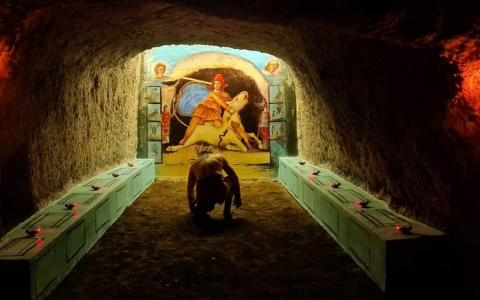
Priscilla’s Catacombs
Not far away are the Catacombs of Priscilla, one of Rome’s most important catacomb complexes, with a network of galleries that runs along Via Salaria. (Turismo Roma)
Not necessarily as part of the sports session, but as a possible cultural element of a broader program, this POI adds an entirely different dimension to the route.
The contrast is significant:
greenery, light, and movement outdoors; silence, history, and introspection underground.
A five-stage journey
The format can be built as a real progressive experience.
1. Reset
The group arrives at Villa Ada and temporarily leaves smartphones, meetings, and the agenda behind.
A brief introduction sets the goals for the day.
2. Breathe
A guided session introduces breathing and attention exercises.
The pace is slowed down.
3. Move
Mobility, calisthenics, and bodyweight trials take center stage.
The body becomes the protagonist.
4. Challenge
Teams face a series of challenges that combine movement, strategy, communication, and time management.
Here, the truly team-building dimension emerges.
5. Recover
The experience ends with a recovery and reflection phase.
Not just “How did it go?”, but:
what did we discover about how we react to pressure?
Biohacking and technology: fewer gadgets, more awareness
Biohacking is often associated with wearables, apps, biometric data, and technological devices.
These tools can also be used, when appropriate, but they shouldn’t become the center of the experience.
For corporate team building, it can be much more interesting to use technology as an observation tool.
For example, participants could compare certain activity parameters before and after a session, when the tools and detection methods allow it.
The message shouldn’t become: “the device tells you how you’re doing.”
The message should be:
“learn to better observe how you’re doing.”
High Performance and leadership: the manager who knows how to recover
One of the most interesting themes in the format concerns leadership.
Traditionally, the leader is associated with the ability to guide, decide, and support others.
But there is also less visible leadership: that of self-regulation.
A leader who maintains clarity in a complex situation can help the group not to amplify the problem.
A leader who knows how to pause before making a decision can prevent a mistake.
A leader who recognizes their own fatigue can manage their resources better.
Team building can turn these abstract concepts into concrete situations.
When wellbeing becomes team building
The risk with many corporate wellbeing programs is that they propose an individual activity alongside work.
An hour of yoga.
A fitness session.
A relaxing break.
The added value of this format, instead, is to turn wellbeing into a collective experience.
The participant isn’t alone.
They breathe with the group.
They move with the group.
They take on a challenge with the group.
They observe the group’s reactions.
And at the end, they reflect together with others.
That’s where wellbeing becomes team building.
A new way to design corporate events in Rome
The growing focus on wellbeing, sustainable performance, and energy management is also changing how corporate events are designed.
Not everything has to be competition.
Not everything has to be adrenaline.
Not everything has to be a dinner.
There’s an in-between space where movement, nature, play, and awareness can coexist.
The website of Team Building Rome already offers various outdoor experiences, adventure, sports, and team experiences that can be used as references to build tailored programs.
Among the proposals closest in philosophy, we find, for example, sports and adventure activities such as Forging the Warriors and formats in which movement, strategy, and collaboration become central to the experience.
The new concept of Biohacking & High Performance can fit precisely into this evolution: not only doing something together, but learning something about how we work together.
Why choose Villa Ada for manager-oriented team building
Villa Ada allows you to build an extremely flexible event.
It can host a morning dedicated to breathing and movement.
It can become a starting point for an archeotrekking journey.
It can accommodate a combination of calisthenics, team games, and stress management activities.
It can be integrated into a broader corporate wellbeing program.
And above all, it offers a feature that’s hard to replicate in a conference room:
the feeling of truly getting out of your routine.
Real performance is knowing when to accelerate and when to recover
At the end of the day, the group heads back toward the city.
But something has changed.
Managers ran, breathed, observed, collaborated, and faced small pressure situations.
They may have discovered that the colleague who seems most competitive is also the one who knows how to encourage others.
That the person who talks less can be the best observer.
That a team under pressure tends to communicate less.
That stopping for a few minutes doesn’t necessarily mean losing time.
And perhaps this is the most interesting message of a Biohacking and High Performance experience at Villa Ada.
Performance isn’t about staying at maximum all the time.
It’s about knowing when to push, when to change strategy, and when to recover your energy.
For a manager, this can be a valuable skill.
For a team, it can become an experience to remember.
FAQ – Biohacking and High Performance at Villa Ada
What is a Biohacking & High Performance team building?
It’s an experiential format that combines breathing, movement, bodyweight activities, stress management, nature, and group dynamics.
Is biohacking a therapy?
No. In this context, the term refers to experiential strategies and practices related to energy and habit management. It does not replace medical assessments or treatments.
Do you need to be trained?
No. The activities can be designed across different difficulty levels, with exercises adaptable to the group’s characteristics.
Why choose Villa Ada?
The park offers ample green spaces, trails, natural areas, and important historical and archaeological POIs, creating an environment particularly suited to an outdoor experience. (Comune di Roma)
Is the program suitable for managers?
Yes. The format can be built around themes such as stress management, leadership, communication, decision-making ability, focus, and recovery.
Can the experience be customized?
Yes. The structure can be adapted based on the number of participants, available time, business objectives, and the desired level of physical activity.