






















Team Building between historic markets and typical products: Rome is discovered through taste
Rome can be known through its monuments, its squares, and its museums. But there is another way, just as authentic and engaging, to connect with the city’s soul: to walk through its historic markets, talk to those who sell local products, recognize aromas and ingredients, and turn food into an opportunity for collaboration.
From this idea comes Team Building between historic markets and typical products, an experiential format that takes business groups into the heart of Roman daily life, transforming a simple food walk into a true team activity.
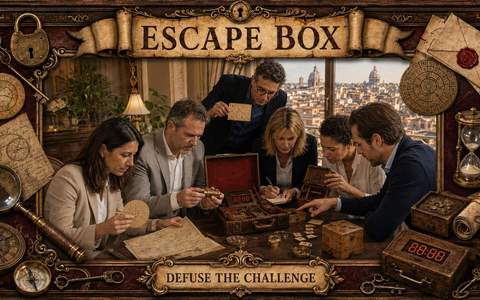
That’s how the market becomes a large play environment: participants must observe, choose, communicate, negotiate, solve small puzzles, and make shared decisions. The result is not only a food experience, but a path capable of fostering teamwork, communication, problem solving, creativity, and mutual knowledge.
When the market becomes a gym for the team
A historic market has a feature that is hard to find in a traditional business activity: it is an authentic, dynamic, and unpredictable place.
People moving around, stalls full of color, different scents, voices, products to recognize, and situations that constantly change. For a group of colleagues, all of this can become an ideal ground to try new ways of working together.
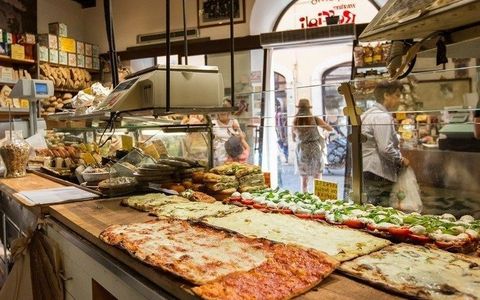
The team can, for example, receive a series of food missions: identify certain ingredients, reconstruct the history of a product, find the best stall for a given recipe, or put together, with a pre-set budget, the perfect “Roman basket.”
The one who wins is not necessarily the person who knows gastronomy best.
Wins the group that manages to organize itself better.
From competition to collaboration
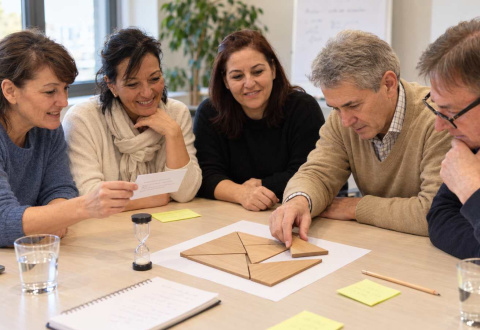
Each participant can take on a different role.
There are those who observe, those who take notes, those who talk to shopkeepers, those who control the budget, those who interpret clues, and those who coordinate decisions.
It is precisely this spontaneous distribution of roles that makes the experience particularly interesting from a business perspective.
A person who is usually quiet can become the group’s best observer. A colleague used to leading can discover the importance of delegating. Someone who tends to decide quickly can learn to listen before choosing.
The market therefore becomes a small simulation of professional life: incomplete information, limited time, shared goals, and the need to reach a common decision.
Rome’s historic markets as the setting for Team Building
Rome offers numerous locations capable of turning a food activity into a narrative experience.
Among the most interesting is the Testaccio Market, one of the most representative places of Roman popular culture. Today, the market is an important meeting point for food lovers and has a truly unique feature: beneath the structure, archaeological remains are linked to the commercial history of ancient Rome.
Its relationship with the area is even more evident when considering the neighborhood’s history. Testaccio was indeed born in close relation to the ancient Emporium harbor and to the activities of storing and trading goods. The nearby Monte Testaccio, formed by the accumulation of amphora fragments, still tells the importance that the oil trade had in Imperial Rome.
This combination of archaeology, gastronomy, and everyday life makes Testaccio especially suitable for an experiential Team Building.
Campo de’ Fiori: the market in the heart of historic Rome
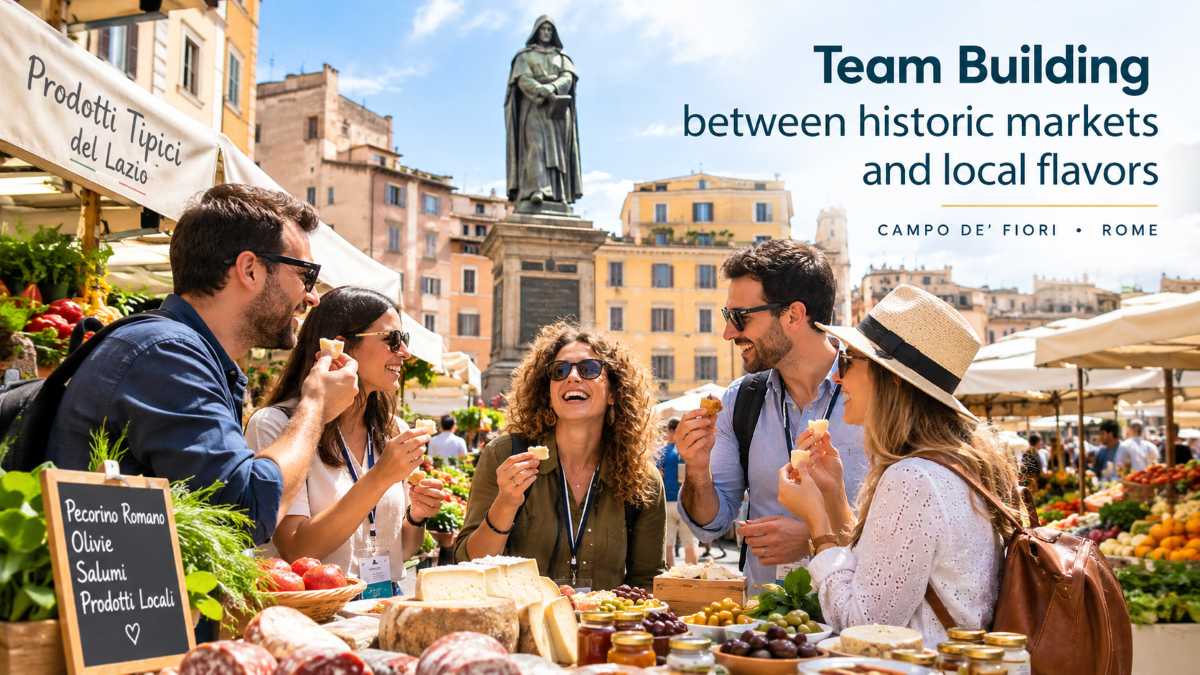
Another possibility is Campo de’ Fiori, one of the most recognizable settings in the historic center.
The market occupies a square with a special history, located between Piazza Navona and Piazza Farnese, and it still represents a place characterized by the presence of stalls dedicated to food products and other goods.
Here, the Team Building can take on a more urban and narrative dimension.
Teams can start from the square and receive a map with a set of missions: find certain ingredients, identify products connected to Roman tradition, gather information, and gradually build a gastronomic story of the city.
The route can then develop through the surrounding streets, turning the search for products into a true urban experience.
Trionfale Market: over 270 stalls for a food challenge
For groups who want an even more immersive experience, the Trionfale Market is a particularly interesting setting.
With more than 270 stalls, it is one of the largest markets in Italy and Europe and has a structure organized by product categories: fruit and vegetables, fish, meat, and other product groups.
Its history is also linked to Rome’s urban transformation: born at the end of the 19th century, the market has gradually adapted to the city’s growth.
During a business activity, this wealth can be turned into a big “food mission.”
Each team can receive a virtual budget and a list of objectives. To complete them, they will have to move among the stalls, identify the correct products, compare information, and build a gastronomic proposal.
Time becomes an important variable, and communication within the group becomes decisive.
Typical products become protagonists of the challenge
But the real value of the format is not only the market.
It’s what the market tells through its products.
Lazio’s gastronomy offers a particularly rich heritage of specialties that are recognizable and certified. Among these we find Pecorino Romano DOP, Ricotta Romana DOP, the Romanesco artichoke of Lazio, Porchetta di Ariccia IGP, Pane di Genzano IGP, and Abbacchio Romano IGP.
Each product can become an element of the narrative.
One team may have to recognize an ingredient by its appearance or scent; another may have to reconstruct its origin; and another may associate the product with the Roman recipe where it is traditionally used.
The Romanesco artichoke: recognizing a true excellence
The Carciofo Romanesco, also known as mammola or cimarolo, can become one of the protagonists of one of the tests.
Its presence in Roman food culture is particularly significant and offers the chance to connect product, territory, and tradition.
A test might ask participants to distinguish the correct product from other vegetables, identify the characteristics that make it recognizable, and then discover the difference between traditional preparations.
So the game also becomes a small journey through Lazio’s food culture.
Pecorino, guanciale, and the ingredients of Roman cuisine
Another mission can be built around the ingredients that characterize some of the best-known dishes in Roman tradition.
Pecorino Romano, guanciale, pepper, and other ingredients can become the pieces of a gastronomic puzzle.
The team receives the ingredients and must reconstruct the correct recipe, identifying the most consistent combinations.
In this way, culinary knowledge is not presented as a lesson, but as a team game.
Gricia, for example, offers a perfect example of how a few ingredients can build a very strong gastronomic identity: guanciale, pepper, and Pecorino Romano DOP are enough to tell an important part of Roman culinary tradition.
From the market to the table: the final phase
Every gastronomic Team Building should include a concluding moment.
After the search, the competition, and the discovery comes the moment of sharing.
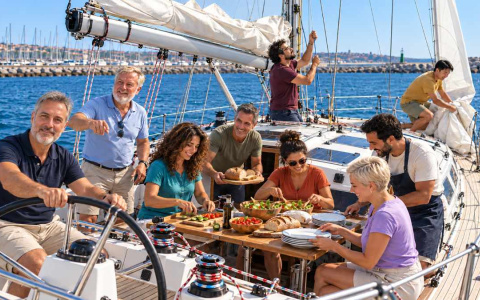
The group can gather in a dedicated location and use the products identified during the activities for a tasting, an aperitif, or a true culinary experience.
A particularly engaging option is to turn the material collected by the teams into a small shared Roman menu.
Each team presents its choices, describes the difficulties they encountered, and explains why certain products were selected.
At that point, competition makes room for conviviality.
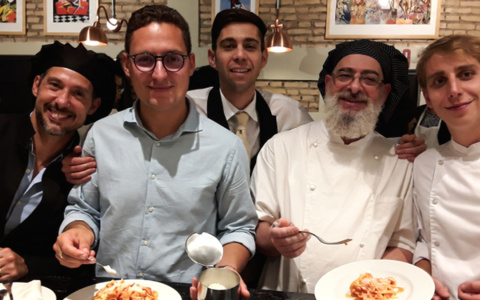
It’s the moment when the group stops being a collection of individual participants and becomes a team again.
Gastronomic Team Building and business skills
Behind an apparently simple activity like a market visit, numerous skills can be hidden—useful even in the professional environment.
Communication
Information must be shared quickly and in a clear, understandable way.
A vague indication can lead the group to the wrong stall or waste precious time.
Leadership
Each test can bring out different leaders.
Leadership is not assigned formally, but emerges from the ability to take responsibility, coordinate others, and facilitate a decision.
Problem solving
The group may find itself facing incomplete information, limited budgets, or seemingly contradictory objectives.
The solution must be built together.
Time management
One of the most interesting variables is time.
Having many possibilities available does not necessarily mean being able to use them all. The team must set priorities and understand which activities are truly strategic.
Listening and negotiation
Talking with shopkeepers and producers, asking questions, and comparing information develops listening and negotiation skills in an informal setting.
Why choose a Team Building between markets and typical products
Compared to a business activity carried out exclusively in a meeting room, the gastronomic route introduces real and unpredictable elements.
The group walks, observes, interacts with the environment, makes decisions, and lives a story.
Also, food has an extraordinary ability to bring people together.
You don’t need to be a cooking expert to take part. Curiosity is enough.
One person may know the history of Roman cuisine perfectly; another may have stronger organizational skills; and another may be particularly intuitive when choosing ingredients.
So the format makes it possible to value different skills within the same group.
Rome through the five senses
The added value of this kind of experience is above all sensory.
You observe the colors of vegetables, recognize the aromas of herbs, listen to the market voices, touch the ingredients, and finally taste the products.
It’s a way of knowing Rome different from a traditional sightseeing tour.
Rome isn’t just observed: it’s experienced.
And it is precisely this dimension that can turn a normal business event into a shared memory.
A customizable format for every company
The Team Building between historic markets and typical products can be designed based on the company’s goals and the characteristics of the group.
For a small team, it can become a food walk with observation and tasting trials.
For larger groups, it can turn into a real food treasure hunt, with teams, maps, clues, budgets, photo challenges, and leaderboards.
For an international company, it can also become an original way to introduce Rome to employees coming from other countries.
The guiding thread always remains the same: discover the territory through food and discover your team through the experience.
From the market to memory: the true result of Team Building
At the end of the day, probably no one will remember every single clue.
Instead, they will remember the laughter created in front of a stall, the colleague who recognized an ingredient at first glance, the team that seemed to be struggling and then found the solution, or that product they tasted for the first time.
That’s the value of gastronomic storytelling applied to Team Building.
An effective business activity shouldn’t just fill a few hours on the calendar. It must create experiences that people keep telling about even after they’ve returned to the office.
And Rome, with its markets, its shops, its products, and its millennia-old history, offers an extraordinary setting to make it happen.
Conclusion
The Team Building between historic markets and typical products is one of the most authentic ways to combine experiential training, local culture, and conviviality.
From the Testaccio Market to Campo de’ Fiori, from the Trionfale Market to the symbolic products of Roman cuisine, each stop can become a challenge, a story, or an opportunity to collaborate.
The result is a dynamic and customizable experience in which the territory doesn’t simply serve as a backdrop: it becomes an integral part of the game.
Because often the best way to get to know a city is to taste it.
And the best way to get to know a team is to experience it together.
If you want to live this experience or something similar, click here, you’ll find our proposals:
Request a free quote and get all the information about your Team Building experience.
Request a free quote and get all the information about your Team Building experience.