































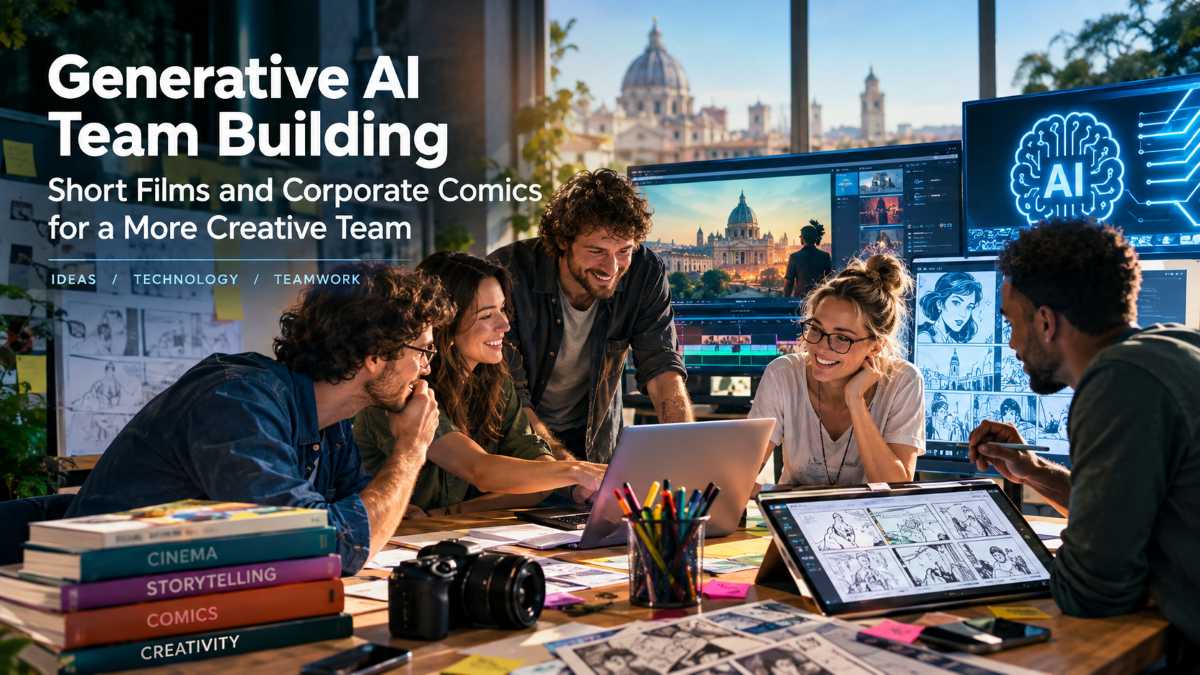
Generative AI in gaming: team-building short films and corporate comics for a new Team Building
Imagine walking into a room and finding a single question on the table:
“If your company were a film, what story would it tell?”
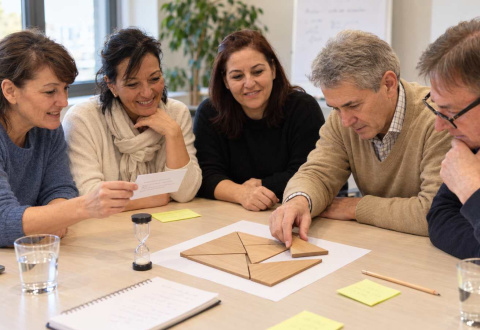
There are no pre-written scripts or set roles. Each participant receives only a mission, a few narrative elements, and the freedom to propose an idea.
Someone imagines the protagonist. Another person thinks of the twist. A colleague builds the dialogues. Another suggests a completely different setting.
Then the Generative Artificial Intelligence comes into play.
The ideas are transformed into images, characters, storyboards, dialogues, and narrative sequences. In a few hours, a simple intuition can become a corporate short film, a mini-series, or a team-created comic.
This is the new frontier of Team Building with Generative AI: not using technology simply to get a result faster, but turning it into a tool for play, discussion, and collective creativity.
When Artificial Intelligence becomes a team game
Generative AI is introducing new ways to work with text, images, and creative content.
Tools like ChatGPT can be used to develop ideas, build characters, craft dialogue, and experiment with different narrative solutions, while ChatGPT Images allows you to create and refine images from text descriptions. (OpenAI)
But in a Team Building, technology shouldn’t replace people.
On the contrary, it should motivate them to collaborate better.
The real result is therefore not the AI-generated image or automatically produced text.
It’s the process that leads a group of people to decide together what they want to tell.
The idea comes before the algorithm
One of the most interesting rules of the format is simple: idea first, then AI.
First, you discuss.
First, you observe.
First, you imagine.
First, you decide.
Only afterwards do you use the technology to turn those insights into a creative product.
This approach prevents the experience from becoming a mere technology demonstration and keeps human skills at the center.
Creativity is born from the group; Artificial Intelligence becomes the tool through which that creativity can be visualized, developed, and tested.
The challenge of the corporate short film
Among the most engaging formats is the creation of a team-created short film.
The group is divided into small teams.
Each team receives a narrative mission.
It could be the story of an imaginary company, a comedy about life in the office, a surreal situation set in Rome, or a futuristic story in which the group must solve a problem that seems impossible.
From that moment on, the challenge begins.
Step 1: find the story
The first task is to build a plot.
Who is the protagonist?
What is the problem?
Who or what stands in the way of the protagonist?
What solution must be found?
And above all: what message do we want to leave with the audience?
The team must learn how to turn many individual ideas into a single story.
Step 2: create the characters
Each participant can contribute to building a character.
One can be the problem-solver, another the visionary, another the “creative disruptor” who questions the most obvious solutions.
AI can help develop traits, dialogue, settings, and visual descriptions.
But the final decision remains with the team.
Step 3: build the storyboard
At this point, the story is broken into scenes.
A sequence might begin in a Roman office, continue through the streets of the historic center, and end in an entirely futuristic Rome.
Each scene must have a purpose.
The group must therefore ask:
“Does this scene really serve the story?”
It’s a simple question, but it’s also very useful in everyday work: it teaches you to distinguish what adds value from what simply creates noise.
Step 4: images and dialogue
Generative AI can step in to transform the teams’ descriptions into visual concepts, environments, characters, and storyboard materials.
The first version may be completely different from the final one.
And that’s exactly what’s great about it.
The group can compare alternatives, identify the most effective elements, and decide how to refine the result.
In this way, Team Building becomes a lab for experimentation, feedback, and continuous improvement.
From the short film to the corporate comic
Not all groups like working in front of a “camera.”
For this reason, the format can turn into a second mode: creating a corporate comic with AI.
In this case, the team must build a story through panels.
A business problem becomes the beginning of the narrative.
A team of colleagues becomes the cast.
A professional challenge becomes the adventure.
A shared solution becomes the ending.
The ideal reference for understanding the power of this language is the world of comics and illustration. In Rome, the International School of Comics has been training professionals in figurative and digital arts since 1979 and offers dedicated pathways, among others, in Comics Illustration & Motion, Graphic Design, Videomaking, and Digital Art. (Scuola Comics)
The comic as a communication tool
A comic has a very interesting feature: it forces you to be concise.
In a panel, you can’t explain everything.
You have to choose.
A joke line must be short.
An image must communicate quickly.
A character’s expression can replace an entire paragraph.
That’s why creating a comic can become a particularly effective exercise in corporate communication.
The team must understand which information is truly important and how to make it understandable to others.
The role of AI in building the panels
Artificial Intelligence can be used to explore different settings, characters, visual styles, and narrative solutions.
A first version may be completely different from the final one.
Teams can compare alternatives, discuss the results, and choose which solution best represents the original idea.
The result then becomes the sum of human creativity, discussion, and technological experimentation.
Rome as a creative set
One of the most interesting features of this Team Building is the ability to use Rome as a real narrative backdrop.
The city can become the set for the short film or the setting for a comic.
One scene can be set in a historic square, another in a contemporary neighborhood, and a third in a completely imaginary Rome.
The group starts from real places and transforms them through imagination.
From the MAXXI to the Rome of the future
The MAXXI – National Museum of 21st Century Arts is a particularly interesting reference for an experience dedicated to contemporary creativity.
Its activities include art, architecture, and photography, and the museum also has a dedicated Education Office for public-facing activities. (MAXXI)
A possible challenge could start right from this atmosphere:
“Imagine Rome in 2050.”
Each team must create a story set in the Capital of the future.
What will the offices be like?
How will people move around?
Which professions will have changed?
What kind of relationship will we have with technology?
The answers become narrative material.
The group must turn an abstract idea into a concrete story by deciding characters, conflicts, settings, and the ending.
Palazzo Esposizioni: art, images, and storytelling
Another very fitting POI is the Palazzo Esposizioni Roma, a historic cultural venue on Via Nazionale.
Since 1883, the Palazzo has promoted exhibitions, meetings, and events, and has developed activities related to the visual arts and the sciences. The facility also includes a cinema hall, an auditorium, exhibition spaces, and a studio designed to foster creativity during hands-on activities. (Palazzo Esposizioni Roma)
So it’s easy to imagine a Team Building in which the group starts by observing images, works, or contemporary prompts in order to create an original story.
The group observes.
Interprets.
Discusses.
Redesigns.
And finally, creates.
The comic as a collaboration workshop
The Team Building can also draw inspiration from the professional world of illustration.
The International School of Comics in Rome is an interesting local reference point for the comics and visual arts world. The Rome campus offers pathways that include comics, illustration, digital art, graphic design, videomaking, and other creative disciplines. (Scuola Comics)
Its universe can become the starting point for designing an activity in which each team must build its own narrative universe.
You don’t need to be a draftsman.
In fact, the format works precisely because it brings together different skills.
Those who can tell stories can work on the script.
Those with visual sensitivity can handle the art direction.
Those who are more organized can coordinate the different phases.
Those who like technology can work on the prompts.
Those who communicate well can present the final result.
Strength comes from combining skills.
Prompting and creativity: a new team skill
One of the most fun elements of the experience is prompting, the ability to write effective instructions to get a coherent result from AI tools.
In a Team Building, prompting can almost become a competition.
One team writes:
“A group of colleagues in Rome.”
Another tries to be much more specific:
“Five professionals with different characteristics, gathered in a contemporary creative space, discussing in front of a storyboard, dynamic atmosphere, natural light, cinematic language.”
The difference between the results can be significant.
This teaches an important lesson:
the quality of the question influences the quality of the result.
And learning to make a precise request also means learning to clarify your own thinking.
Problem solving, listening, and leadership through AI
The business value of the format doesn’t lie in the technology itself.
It lies in the dynamics that the technology brings out.
Problem solving
A story might not work.
A character might seem inconsistent.
An image might be completely different from what was imagined.
The team must understand the problem and find a solution quickly.
Communication
To get a coherent result, everyone must use a common language.
A poorly expressed idea can generate a result completely different from the one expected.
Leadership
Someone will have to make a decision when the group disagrees.
But good leadership doesn’t mean imposing your own idea.
It means helping the group identify the best one.
Listening
An idea that seems secondary can become the starting point for the most fun scene in the short film.
That’s why listening becomes an integral part of the game.
Generative AI and creativity: directing stays human
Talking about AI in a Team Building also means addressing an important question:
who is really the author of the story?
The answer proposed by the format is clear: AI should be considered a creative tool, not a substitute for the person.
UNESCO, in its work on AI and culture, highlights how generative AI is transforming cultural ecosystems, artistic practices, and the processes of producing and distributing works, while also raising questions related to creativity, cultural rights, and diversity of expressions. (UNESCO)
This principle is particularly important in a business activity.
The group must not just accept the first generated result.
They must evaluate, verify, correct, and choose.
In other words:
AI produces possibilities.
People give them meaning.
A final challenge: the Team Festival
After a few hours of work, the most anticipated moment arrives.
The teams present their short films or comics.
You can organize a small AI Team Festival, with different categories.
Best Story
Awards the most original and engaging story.
Best Teamwork
Awards the group that demonstrated the best collaboration.
Best Visual Concept
Awards the quality and consistency of the visual universe.
Best Unexpected Idea
Awards the most surprising idea.
Best AI-Human Collaboration
Awards the group that used AI best without losing their creative identity.
In this way, the competition doesn’t reward only the final product, but also the process that created it.
A Team Building suited also for international companies
Film language and comic language have an important advantage: they can be easily adapted for international groups.
A team can work on the same story using multiple languages.
Dialogue can be translated.
Images can tell the story without needing explanations.
Characters can represent different cultures.
That’s why the activity can be especially interesting for multinational companies, distributed teams, and groups made up of people with different professional and cultural backgrounds.
AI can also become a tool to facilitate participation and experiment with new communication methods.
From the game to a culture of innovation
The most interesting outcome of a Team Building like this might not be the short film.
It might be the question participants ask themselves when they go back to the office:
“If we managed to invent all of this together in a few hours, what else could we create?”
That’s the power of AI-based experiences.
Technology allows you to experiment quickly.
The game reduces the fear of making mistakes.
Collaboration turns individual insights into collective ideas.
And the tangible result makes visible what the group was able to build.
Conclusion
Generative AI in the game opens up a new perspective for corporate Team Building.
Making a short film, creating a comic, designing characters and settings, or building a story set in the Rome of the future become opportunities to develop cross-cutting skills through a fun, contemporary experience.
You don’t need to be a screenwriter.
You don’t need to be an illustrator.
You don’t need to be an Artificial Intelligence expert.
You just need an idea, the ability to tell it, and the desire to build it together with others.
Because the real challenge isn’t asking AI to create a story.
The real challenge is creating a story that nobody could have invented alone.