






















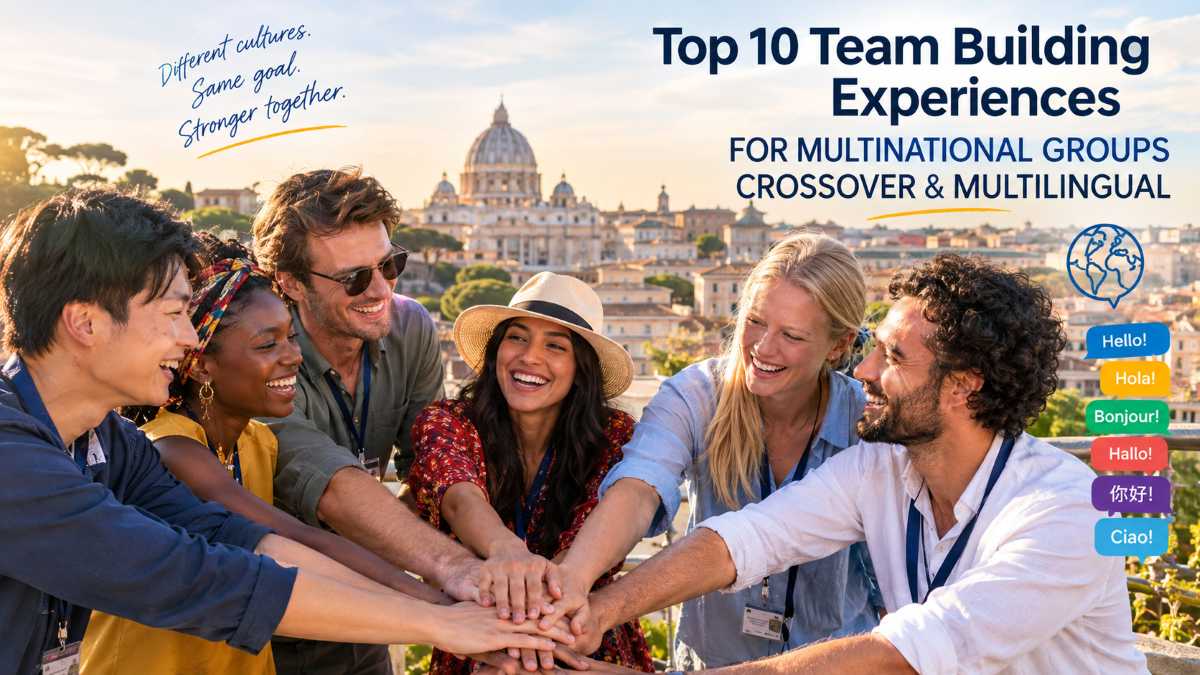
Top 10 Team Building Experiences for Cross-Over Groups and Multinationals (Multilingual)
When a team arrives in Rome from Milan, London, Paris, Madrid, Berlin, Amsterdam, or New York, the first challenge isn’t necessarily choosing a fun activity.
The real challenge is to create an experience capable of bringing together people who don’t always share the same language, the same company culture, the same habits, or the same way of working.
This is where the concept of Multilingual Crossover Team Building comes from: activities designed to help international groups collaborate through universal languages such as games, creativity, music, movement, discovery, food, and problem-solving.
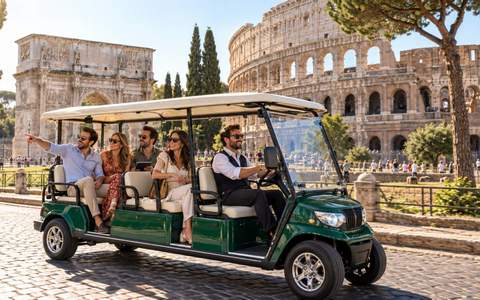
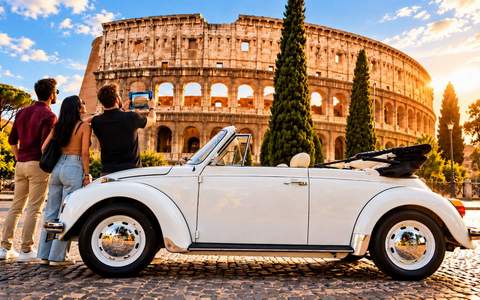
Rome, from this perspective, is an exceptionally effective destination. In fact, the historic center contains a cultural layering spanning nearly three millennia, and it has been recognized by UNESCO as a World Heritage site. (UNESCO World Heritage Centre)
But how can you turn this richness into a true team building experience?
The answer lies in the 10 crossover experiences that allow a multinational group to communicate, collaborate, and have fun even when many languages are spoken.
Why Multilingual Team Building is different
In a standard team building event, it’s possible to rely on verbal communication, instructions, and mutual knowledge.
In an international group, this mechanism can become less effective.
A joke might not be understood. An instruction might lose part of its meaning in translation. A cultural reference can work perfectly for one nationality and be completely unfamiliar to another.
That’s why a team building for multinationals must reduce reliance on language and increase the weight of the experience itself.
The principle is simple:
less language needed, more real collaboration.
The result is an environment where an Italian manager can work side by side with a German colleague, a French project manager, a Spanish creative, or a British executive—without language becoming a barrier.
The 10 Best Multilingual Team Building Experiences in Rome
1. Multilingual Treasure Hunt in the Historic Center
One of the most effective formats for an international group is to turn Rome into one giant playground.
Teams receive a series of missions, riddles, photographs, coordinates, and tests to complete across different points in the city.
The route can go through Piazza Navona, the Pantheon, Campo de’ Fiori, Piazza di Spagna, or other POIs in the historic center.
Piazza Navona is particularly suitable because its history actually began in a place meant for “agones,” meaning games and competitions. (Turismo Roma)
The multilingual component can be managed by alternating clues in English, Italian, French, Spanish, and German, or by using mostly visual challenges.
Why it works
The team doesn’t just need to “talk.”
It must observe, interpret, decide, and collaborate.
It’s an important difference: language becomes only one of the tools available, while the ability to build a solution together becomes the real competitive element.
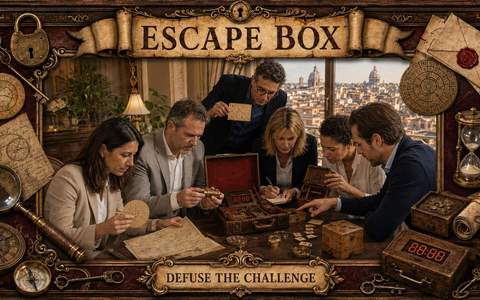
2. Roman Escape Game: Problem Solving Without Language Barriers
An escape game set in Rome can become an extraordinary training ground for international collaboration.
The group is divided into teams and must solve a sequence of riddles, codes, and challenges.
The format can be built around Roman history, art, gastronomy, or a contemporary mystery.
The advantage is obvious: the solution doesn’t belong to a language, it belongs to the team.
One participant may be great at analyzing a numeric code, another at spotting a visual detail, and another at connecting two clues that seem unrelated.
From vocabulary to collaboration
This type of activity is especially interesting for multinationals because it immediately makes visible the different ways of thinking present within the group.
Winning doesn’t necessarily go to whoever speaks English best.
Winning goes to whoever can connect different skills.
3. Street Art & Creative Challenge
Creativity is one of the most international languages there is.
A canvas, an authorized wall, an image, or a concept can become the starting point for an artistic challenge between teams.
Each group can receive a common theme, for example:
"What does teamwork mean to us?"
From that moment on, planning begins.
Who draws? Who chooses the symbols? Who builds the composition? Who tells the meaning of the final result?
The value of the experience is naturally not the artistic quality of the output.
It’s the process.
A language that doesn’t need translation
An image can be interpreted by Italians, French, English, Spanish, and Germans at the same time.
That’s why creativity can become a real tool for intercultural inclusion.
4. Team Beat: Music as a Universal Language
When there are too many languages, you can simply stop talking.
A team-building percussion activity allows participants to work on rhythm, listening, coordination, and synchronization.
The group is guided through the gradual construction of a collective performance.
At the start, each person makes a sound.
Then sounds become rhythms.
Rhythms become a sequence.
And finally the sequence becomes music.
The real goal
To achieve a shared result, you need to listen to others.
You can’t just be good individually.
If someone speeds up, the group loses the rhythm. If someone doesn’t listen, the performance falls apart.
It’s a perfect metaphor for international work:
different people, one outcome.
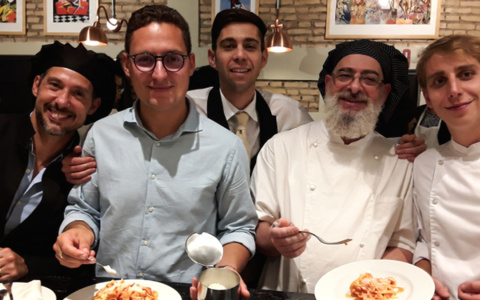
5. Multilingual Cooking Team Building: Hands in Dough
Food is probably one of the most powerful languages when working with international groups.
A cooking experience creates an informal environment where people from different cultures can collaborate without the excessive formality of a meeting room.
The Hands in Dough format can turn making fresh pasta into a real team challenge.
Kneading, rolling, cutting, filling, organizing workstations, and following the time schedule become shared activities.
Rome meets the world
The best part of an international cooking experience is starting from Italian tradition and opening it up to cultural exchange.
Which dish reminds a French colleague of childhood?
Which ingredient is used differently in Spain?
What comfort food does a German colleague prefer?
Cooking thus becomes a pretext for sharing stories.
And when stories pass through food, the language barrier often decreases naturally.
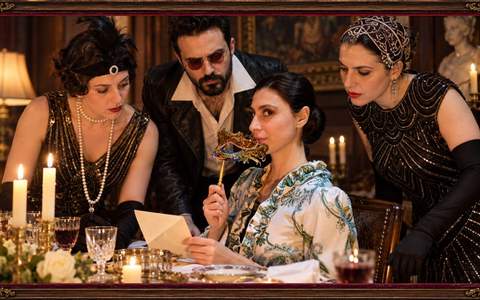
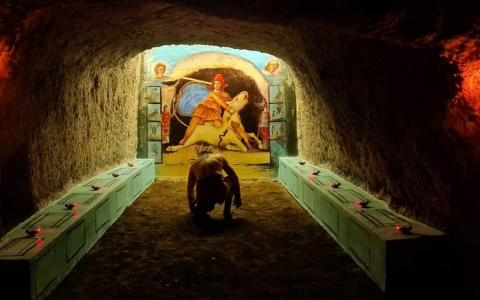
6. Roman Games: Competition, Strategy, and Culture
For an international group that wants something more dynamic, Rome’s history can become the setting for a real competition.
Teams can tackle challenges in strategy, skills, logic, and collaboration inspired by ancient times.
The context can be built around the Imperial Fora, ancient Rome, or other historic locations compatible with the format.
The heritage of Rome’s historic center is particularly suitable for this kind of storytelling: UNESCO highlights the extraordinary layering of the city, where archaeology, Renaissance architecture, and Baroque coexist in the same urban fabric. (UNESCO World Heritage Centre)
History becomes a game
The group doesn’t just listen to an explanation.
It enters the story.
It must choose a strategy, assign roles, collaborate, and win points.
The result is a form of international edutainment, where culture and team building meet.
7. Multilingual Photo Challenge
Not everyone likes running, competing, or taking on physical challenges.
For very diverse multinational groups, a Photo Challenge can be a more inclusive solution.
Teams receive a list of images to create:
-
a scene representing teamwork;
-
a creative photo in front of a monument;
-
a reinterpretation of a work of art;
-
a photograph representing a word;
-
a photographic composition created by the group.
The advantage is that the assignments can be supported by icons and images, reducing the amount of text needed.
Rome as a set
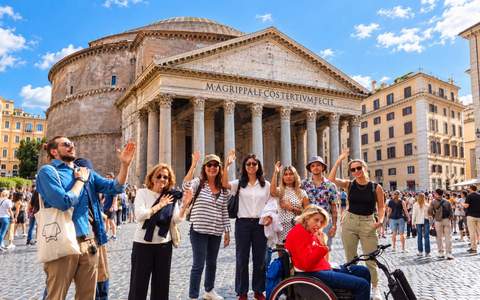
The Pantheon, for example, offers an extraordinary and easily recognizable visual setting on an international level. Its architecture and history make it one of the most significant POIs in the center of Rome. (Turismo Roma)
In this way, the city becomes an open-air photo studio.
8. Slow Team Building: Inclusion, Creativity, and Well-Being
An international group is not necessarily a group that wants to do high-intensity activities.
In fact, in multinationals it’s common to find teams made up of people with different ages, roles, backgrounds, and energy levels.
Slow Team Building was created specifically to deliver more inclusive experiences.
Ceramics workshops, collective painting, sustainable mixology, artistic and creative activities can be done with essential, highly visual communication.
The advantage for multinationals
A slower activity allows you to:
-
talk with colleagues you normally only meet online;
-
encourage spontaneous conversations;
-
reduce competitive pressure;
-
highlight people with different relational styles;
-
create a more accessible environment.
It’s a team building approach that doesn’t aim to make someone “win.”
It aims to make the whole group feel good.
9. Villa Borghese: Wellness & Team Experience
For an international group that comes to Rome after a day of meetings, an outdoor activity can offer a radical break from the corporate environment.
Villa Borghese provides a particularly interesting setting: the park includes centuries-old trees, gardens, fountains, monuments, buildings, and large open spaces in the heart of the city. (Turismo Roma)
Here, it’s possible to build experiences of:
-
corporate wellness;
-
group yoga;
-
mindfulness;
-
walking challenge;
-
orienteering;
-
collaborative games;
-
creative outdoor activities.
From meetings to movement
The shift from the office to green space immediately changes the dynamics.
Jackets are replaced by casual clothing.
PowerPoint presentations make room for interaction.
And people start getting to know each other in a dimension different from the professional one.
10. Aperitivo & Team Challenge: the perfect finale
An international activity can end with a convivial moment.
But the aperitivo shouldn’t simply be “dinner after team building.”
It can become an integral part of the experience.
Imagine teams arriving at the final destination after a treasure hunt.
The score is announced.
Photos are projected.
Teams comment on the mistakes they made.
Someone realizes that the colleague they’ve worked with remotely for months is much more competitive than they thought.
And finally, everyone has something to share.
The value of the informal moment
It’s exactly during these moments that team building often has its most important effect.
The activity creates the memory.
The aperitivo creates the conversation.
The conversation creates the relationship.
How to Design a Real Crossover Team Building
Choosing the activity is only the first step.
For a multinational, the design must take into account a few key variables.
1. Language
English can be used as a common language, but it doesn’t mean everyone has the same level of proficiency.
So it’s better to use:
-
short instructions;
-
visual supports;
-
symbols;
-
practical demonstrations;
-
multilingual briefings when needed.
2. Cultural differences
A joke that works in Italy might not work the same way in Germany.
A competitive style appreciated by one group could create discomfort in another.
That’s why intercultural team building should be designed by avoiding stereotypes and valuing mutual curiosity.
3. Team composition
A common mistake is to keep people of the same nationality together.
It’s better to create mixed teams.
Italians, French, Germans, Spanish, English, and other nationalities must have the opportunity to collaborate.
In this way, the activity also becomes a tool for international networking.
4. Competition level
Competition can be a powerful accelerator of energy.
But it shouldn’t become the only goal.
For crossover groups, it’s often more effective to alternate:
competition + creativity + collaboration + sociability.
The result is a more balanced and inclusive experience.
Rome: the big competitive advantage for an international group
Rome has a feature that’s hard to replicate.
It’s simultaneously:
an international destination, a city of art, an open-air museum, a gastronomic capital, and a narrative setting.
The historic center has been recognized by UNESCO since 1980, with a significant expansion of the perimeter in 1990. (UNESCO World Heritage Centre)
Even Vatican City represents a unique international reference point: Vatican City has been on the UNESCO list since 1984 and concentrates, in an extremely small space, an artistic and historical heritage of worldwide importance. (UNESCO World Heritage Centre)
For a multinational, this means being able to build a program where every activity becomes part of the journey.
You don’t need to artificially create an international environment.
Rome already is.
From team building to the international experience
The future of international corporate events isn’t simply about translating an activity into five languages.
The real evolution is to design activities that work even when the languages are different.
A team building something together.
A photo that tells an idea.
A musical rhythm that must be synchronized.
A dish prepared by people from different countries.
A riddle solved thanks to the combination of different skills.
These are the situations where multiculturalism stops being an organizational difficulty and becomes an advantage.
And this is exactly the meaning of Multilingual Crossover Team Building in Rome: don’t eliminate differences, but turn them into a resource for the group.