


























Futurist Gastronomic Hackathon: the food of the future is born in Lazio
Imagine walking into a kitchen without knowing what you’ll have to prepare.
On the table, you won’t find a recipe, but a selection of ingredients from the Lazio region: seasonal vegetables, legumes, cheeses, flours, fruit, aromatic herbs, oil, honey, and other local products.
Each team receives a mission.
They won’t have to recreate a traditional dish. They’ll have to invent something that doesn’t exist yet.
A new snack. A food product designed for the future. A small food concept capable of telling the story of Lazio through local ingredients, creativity, sustainability, and design.
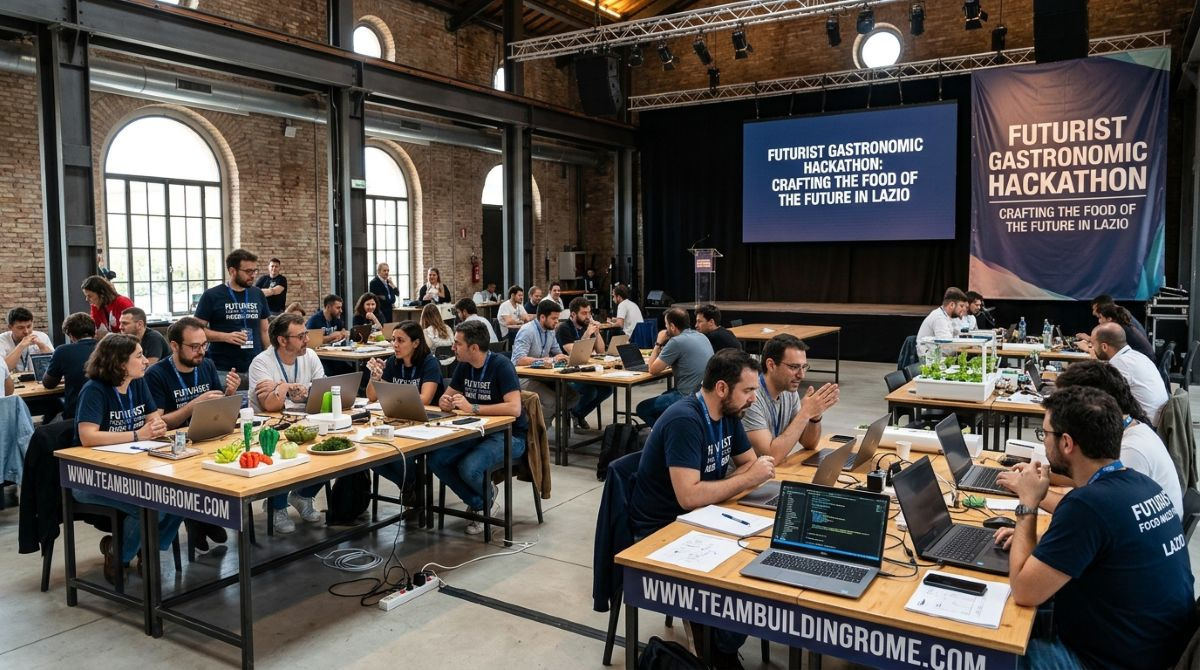
And so the Futurist Gastronomic Hackathon was born: a team-building format that transforms the kitchen into an innovation lab.
It’s not simply a cooking lesson, nor a traditional cook-off: teams must examine the available ingredients, identify original combinations, design their product, plan its presentation, reduce waste, and even imagine how it could be packaged and marketed.
The end result is not just something to taste.
It’s an idea to present, defend, and tell the story of.
What is a Gastronomic Hackathon?
The term hackathon comes from combining hack and marathon and generally refers to an intensive activity in which groups of people work together to quickly develop ideas and solutions.
When applied to the world of gastronomy, the concept takes on a new perspective.
The question is no longer:
“What can we cook?”
But rather:
“What could we invent with what we have available?”
This difference is fundamental.
The group must turn tangible ingredients into a food concept. This means addressing creativity, organization, communication, sustainability, and the ability to work under pressure all at once.
In Lazio, this approach finds particularly fertile ground. Over the years, the Lazio Region has built up a rich heritage of Traditional Agri-food Products (PAT), and in 2024 the regional basket reached 472 recognized products. (Lazio Region)
The region thus becomes the hackathon’s true “pantry.”
From km0 to food design: the new team-building challenge
The km0 concept isn’t used simply as a slogan.
It becomes a creative constraint.
Teams must work primarily with products from Lazio and turn local availability into a design advantage.
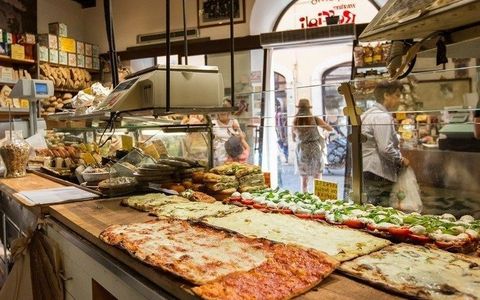
The Campagna Amica Farmers’ Market at Circus Maximus, for example, is an excellent place to discover regional farm produce and products sold directly from local sources. The Via San Teodoro venue brings together more than 60 farms and offers everything from fruit and vegetables to cheese, oil, legumes, flour, honey, preserves, and baked goods. (Campagna Amica)
Alternatively, a sourcing trip could also include the Campagna Amica Market on Via Tiburtina, where agricultural products from across the region are sold. (Campagna Amica)
The market at Fonte Acqua Egeria, in the Appia Antica Park, also connects the km0 concept with the promotion of local farm products and the Roman countryside. (Campagna Amica)
These places can serve as storytelling POIs during the experience, or simply as inspiration for putting together the ingredient basket.
A pantry that tells the story of the region
Lazio offers an extraordinary variety of ingredients and specialties.
You could start with Ricotta Romana PDO, made exclusively from sheep’s milk whey sourced within the region, or explore the world of PAT products with ingredients such as Gaeta olives, Amatriciana guanciale, Roman caciotta, and numerous local varieties of vegetables, legumes, and fruit. (Lazio Farmers’ Markets)
Depending on the season, vegetables such as artichokes, Romanesco broccoli, chicory, fennel, legumes, pumpkins, carrots, and other local produce can also come into play. The regional list includes many specialties associated with specific areas of Lazio. (Lazio Farmers’ Markets)
But the real challenge is not to stop at tradition.
One team could turn a traditional ingredient into a contemporary snack.
Another could come up with an aperitivo version.
Yet another could design a product that’s easy to carry around for urban snacking.
The question becomes:
What will Lazio food look like in 2035?
Teams become food innovation teams
At the start of the activity, each participant joins a team.
Each team receives a work kit containing ingredients, tools, design materials, and a mission brief.
Not everyone necessarily has to cook.
And that’s one of the most interesting aspects of the format.
Different roles can emerge within each group:
-
the Food Designer, responsible for the food concept;
-
the Chef Developer, tasked with turning the idea into a real preparation;
-
the Sustainability Manager, who monitors waste, materials, and impact;
-
the Brand Strategist, who comes up with the name, identity, and positioning;
-
the Art Director, responsible for plating;
-
the Pitch Manager, who prepares the final presentation.
Roles don’t have to be fixed: they can change as the work progresses.
The goal is to create a situation in which different skills complement one another.
Phase One: Food Inspiration
The challenge starts with an exploration phase.
Teams examine the available ingredients and receive some information about the products.
They don’t cook just yet.
First, they have to think.
Which ingredient could take center stage?
Which combination would be surprising?
How can a traditional product be transformed into something new?
Who might buy it?
The first concept emerges from this phase.
From traditional product to futuristic product
The point isn’t to erase tradition, but to reinterpret it.
An ancient ingredient can become the basis of a contemporary snack.
An agricultural product can be transformed into a spread, a cracker, a savory praline, an aperitivo bite, a bar, or a completely new product.
Tradition becomes raw material for innovation.
Phase Two: Food Hack
Once the idea is defined, the creative marathon begins in earnest.
Teams have a limited amount of time to develop their product.
They have to decide on:
-
main ingredients;
-
complementary ingredients;
-
textures;
-
shape;
-
size;
-
preparation method;
-
how it will be eaten;
-
presentation;
-
product name;
-
target audience.
The time limit introduces a typical hackathon element: making decisions without waiting for the perfect solution.
A good idea has to quickly become a prototype.
Eco-design: designing what contains the food, too
What makes the format particularly relevant today is the inclusion of eco-design.
Teams don’t just have to design the contents.
They also have to imagine the container.
Packaging can be put through a real design challenge: less material, greater functionality, opportunities for reuse, easier separation of materials, and fewer unnecessary components.
The topic is especially timely in 2026: new rules under the European Union’s Packaging and Packaging Waste Regulation (PPWR) came into effect on August 12, 2026, with the aim of reducing packaging waste and promoting more circular solutions. (Environment)
In a team-building setting, of course, the goal isn’t to turn participants into regulatory experts.
It’s to help them understand a simple principle:
packaging is part of the product, too.
Packaging becomes a creative challenge
Each team can receive different materials and be tasked with designing packaging that fits its snack.
The challenge can include criteria such as:
-
material reduction;
-
potential for reuse;
-
ease of separation;
-
functionality;
-
appearance;
-
consistency with the food concept.
This way, the activity connects cooking, design, and sustainability.
Food waste: use everything, waste less
Another challenge could focus on reducing food waste.
Teams receive a set quantity of ingredients and have to design a recipe that makes the most of as many edible parts as possible.
This isn’t just a symbolic issue.
The European Commission identifies prevention as a priority in the food waste hierarchy, and the 2025 revision of the Waste Framework Directive introduced binding food waste reduction targets to be met by 2030. (Food Safety)
During the hackathon, this principle can become a practical challenge.
The “Zero Waste” Challenge
Each team can receive a main ingredient along with a limited quantity of scraps or parts that are usually less valued.
The mission:
create a new food item without automatically turning what’s left over into waste.
Teams can then explore textures, transformations, and alternative uses.
The result is judged not only on taste, but also on the team’s ability to design an intelligent solution.
The role of seasonality
The concept can change throughout the year.
In spring, certain vegetables and legumes can take center stage.
In summer, fruit, tomatoes, aromatic herbs, and other seasonal produce can be added to the basket.
In autumn, chestnuts, pumpkins, mushrooms, and other seasonal ingredients can come into the mix.
In winter, the options change again.
This makes the Futurist Gastronomic Hackathon a format that can’t be repeated in exactly the same way every time.
Each edition can have a different ingredient basket.
And each group will have to invent a different solution.
Phase Three: The Plating Lab
Once the food prototype is ready, a new challenge begins.
How do you present a product that doesn’t exist yet?
Plating becomes part of the storytelling.
It’s not enough for the snack to taste good.
It has to be recognizable.
Its shape, the natural colors of the ingredients, arrangement, and size must communicate the concept.
One team might choose a minimalist aesthetic.
Another might draw inspiration from the colors of the Lazio landscape.
Yet another might create a presentation inspired by Roman archaeology.
Creativity becomes part of the product.
Phase Four: Naming and Branding
At this point, marketing comes into play.
Each team has to come up with a name for its product.
They also need a short line explaining why that snack should exist.
Possible concepts might include:
“Lazio Bites – The taste of tomorrow”
or:
“Re:Legume – Tradition redesigned”
or perhaps:
“Roman Roots – Ancient ingredients, future food”
The name must be accompanied by a simple visual identity and a product description.
This also allows participants who are less interested in cooking to contribute their creative, communication, and strategic skills.
The Final: The Future Food Pitch
The cooking stops.
Teams prepare the final display.
Each team has a few minutes to present its product to a panel of judges.
It’s time for the Future Food Pitch.
The presentation can follow a set structure:
1. The Problem
What need does the product aim to address?
2. The Idea
What have you invented?
3. The Local Connection
Which ingredients from Lazio have you used, and why?
4. The Sustainable Choice
How have you reduced waste, materials, or unnecessary components?
5. The Experience
How should it be consumed?
6. The Future
Why could this product become a reality?
In just a few minutes, a simple food preparation becomes a miniature food startup.
How are teams evaluated?
To keep the competition balanced, the judges can use a scoring rubric with several criteria.
Innovation
How original is the concept?
Taste
Is the product well-balanced and enjoyable?
Showcasing the region
Are ingredients from Lazio really at the heart of the product?
Sustainability
Has the team considered waste, seasonality, and materials?
Eco-design
Is the packaging functional and consistent with the product?
Storytelling
Can the team effectively tell the story of its idea?
Presentation
Is the product visually distinctive and convincing?
The winner isn’t necessarily the team with the most sophisticated dish.
The challenge rewards the ability to bring multiple skills together in a single solution.
Lazio’s POIs become part of the story
The Futurist Gastronomic Hackathon can also be designed as a touring experience.
The starting point could be a farmers’ market.
A second stop could focus on discovering a particular product.
A workshop could take place at a food venue.
The final stage could be held at a company venue or in a space specifically set up for the event.
Circus Maximus, the Appia Antica, Rome’s farmers’ markets, and other places connected with food and agricultural culture can become storytelling points throughout the experience.
The region isn’t just used as a backdrop.
It becomes part of the challenge.
Why it’s different from a classic cooking team building
Traditional cooking team building focuses primarily on preparing a recipe.
The Futurist Gastronomic Hackathon, on the other hand, introduces a broader approach.
Participants have to:
-
analyze;
-
design;
-
experiment;
-
collaborate;
-
manage their time;
-
solve problems;
-
make decisions;
-
communicate;
-
present;
-
accept feedback.
The kitchen thus becomes a setting for experimenting with dynamics that are also part of the professional world.
An unexpected ingredient can become a problem.
A recipe that doesn’t work needs to be adjusted.
A team member may have a better idea.
There may not be enough time.
The product may need to be rethought.
These are situations very similar to those that can arise during the development of a company project.
An innovation lab that starts with the region
What truly sets this format apart is the relationship between innovation and local identity.
The food of the future doesn’t necessarily have to come from exotic ingredients or futuristic technologies.
It can also grow out of what a region has been producing for generations.
Lazio has a rich and varied food and agricultural heritage. Products certified as PDO, PGI, and TSG are recognized through European systems that guarantee origin, authenticity, and specific production standards. (Lazio Region)
Innovation can therefore start with the question:
“How can we reinvent what we already have?”
It’s a question about food, but also about business.
Because innovation doesn’t always mean starting from scratch.
Sometimes it means looking at an existing resource in a different way.
From team building to product concept
By the end of the experience, each team will have created more than just a snack.
They’ll have created a small project.
There’ll be a name.
A recipe.
An identity.
Packaging.
A story.
An audience.
A presentation strategy.
And above all, there will have been a collaborative process.
That’s the real value of the Futurist Gastronomic Hackathon: turning food into a language for working on creativity, collaboration, and innovation.
Rome and Lazio become the starting point.
Local ingredients become the raw material.
Sustainability becomes a creative constraint.
The kitchen becomes a lab.
And the group becomes a team of food innovators.
Because perhaps the real food of the future hasn’t been invented yet.
And your team could be the one to invent it.
If you’d like to experience this or something similar, click here to see our offers:
Request a free quote and get all the information about your Team Building experience.
Request a free quote and get all the information about your Team Building experience.