






















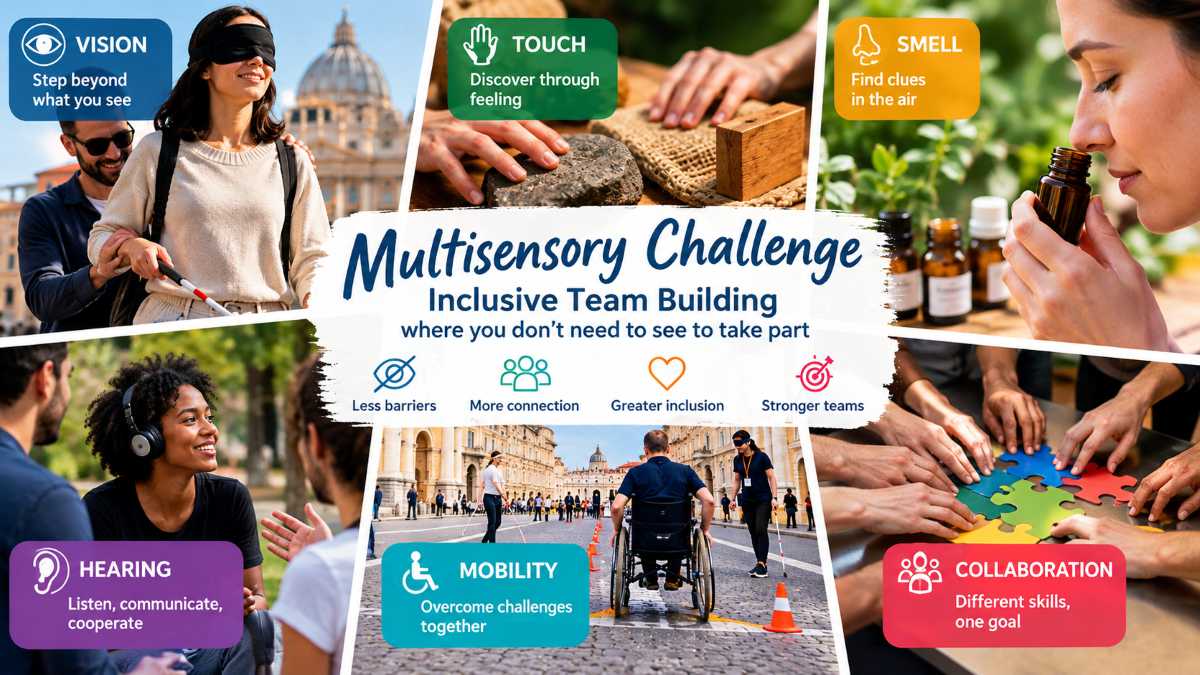
Multisensory Challenge: inclusive team building where you don’t need to be able to see to take part
Imagine entering a space where, for a few hours, sight stops being the main tool for interpreting what’s happening.
No images to look at.
No maps to read.
No colors to recognize.
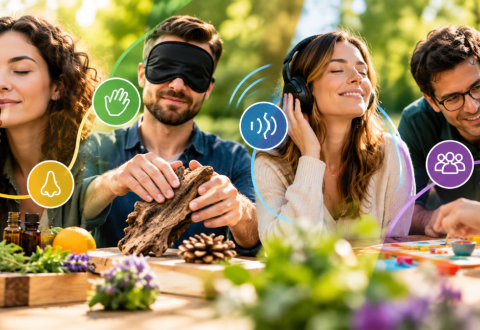
Instead, touch, smell, listening, orientation, communication and above all collaboration come into play.
That’s the idea behind the Multisensory Challenge, an inclusive Team Building format designed to show that participating in a corporate activity doesn’t necessarily mean seeing, running, or having certain physical abilities.
The real challenge is to find alternative strategies together.
The concept isn’t just theoretical. A concrete example comes from the City of the Disability Agenda, a project focused on awareness and inclusion, which brought these experiential methods into the corporate world as well.
In July 2024, at the Industrial Village in Turin, the City of the Disability Agenda, in collaboration with Abile Job, organized a Team Building day for over 100 employees of Iveco Group. Among the activities offered were an experiential route with wheelchairs, canes, and blindfolds, as well as a Smell and Touch Memory game. Source: Consulta for People in Difficulties.
It’s an interesting example because it shifts the concept of inclusion from a simple theoretical message to real participation.
When Team Building changes your perspective
Many Team Building activities are built around speed, competition, physical ability, or how quickly people can interpret visual information.
A treasure hunt often requires reading a map.
An escape room uses codes, images, and objects.
A sports activity may require certain motor skills.
A photographic challenge naturally relies on sight.
The Multisensory Challenge starts from the opposite question:
what happens if we temporarily remove some of the tools we normally use to participate?
The answer isn’t just an added difficulty.
It’s the opportunity to discover that a group can build new ways of communicating.
One person can guide through their voice.
Another can recognize something through touch.
Another can remember a scent.
Someone can become the team’s reference point.
Someone else can organize the information.
Individual performance leaves room for the complementarity of skills.
And that’s one of the most interesting concepts in inclusive Team Building: not asking everyone to do the same thing, but creating conditions in which every person can contribute to the shared outcome.
City of the Disability Agenda: a concrete example
The City of the Disability Agenda has developed a set of games and experiences dedicated to learning about disability through active, participatory methods.
Among the proposed activities are the Experiential Path, the Touch and Smell Memory, “(Don’t) Hear Who’s Speaking,” Space Ability, and City4All.
The project explains that the Experiential Path uses wheelchairs, white canes, and blindfolds to let participants experience some mobility and orientation difficulties that people with physical-motor and visual disabilities may face.
The Touch and Smell Memory, on the other hand, reworks the classic memory game by replacing the purely visual reference with tactile and olfactory stimuli.
These elements are described directly on the official page of the City of the Disability Agenda.
A Team Building for over 100 employees
The experience carried out with Iveco Group represents a particularly significant case for the corporate world.
It wasn’t, in fact, an activity meant for just a few participants, but a day for over 100 employees.
The project brought into the workplace activities capable of addressing disability through play, experience, and collaboration.
This aspect is especially interesting for those who organize large-scale corporate events.
An inclusive Team Building, in fact, doesn’t have to be a side activity reserved for a small group.
It can become the central theme of a company day.
How the Multisensory Challenge works
The format can be organized as a sequence of challenges in which participants progressively reduce their reliance on sight and learn to use other sensory channels.
Teams can include people with different roles.
Each challenge assigns a task.
Each task requires collaboration.
Each solution must be shared.
Challenge 1: the orientation path
The first challenge can be inspired by the experiential route developed by the City of the Disability Agenda.
Participants tackle a short circuit using, depending on the challenge, blindfolds, canes, or wheelchairs.
The goal shouldn’t simply be to “simulate a disability.”
The value of the activity is rather in observing how the environment, information, and collaboration can facilitate—or complicate—an experience.
So the team must learn to communicate.
Those who can see can describe.
Those who walk the route must listen.
Those who coordinate must choose the right words.
And when communication doesn’t work, the group has to change strategy.
The lesson isn’t “try disability”
It’s important to keep a correct approach.
An experience like this can’t truly replicate a person’s daily life with a disability.
A blindfold used for a few minutes is not the same as the experience of a blind person.
A wheelchair used during a game doesn’t represent the everyday life of someone who uses it on a regular basis.
That’s why the value of the format must be presented as a tool for awareness and reflection, not as a perfect simulation of disability.
The difference matters.
The goal is to help the group question barriers, communication, and accessibility.
Touch and Smell Memory: when memory doesn’t go through the eyes
The second challenge can take inspiration from the Touch and Smell Memory of the City of the Disability Agenda.
The principle is simple.
The traditional memory game uses images.
Here, instead, recognition can happen through touch and smell.
Participants must identify matching elements without being able to rely exclusively on visual memory.
A surface.
A shape.
A texture.
An aroma.
A scent.
The brain must build another “map” of information.
And that’s how a simple game becomes a business metaphor.
From competition to collaboration
The team doesn’t necessarily need to be rewarded only for speed.
It can be evaluated on the ability to:
-
communicate the information;
-
listen to others;
-
share their perceptions;
-
remember the elements;
-
organize roles;
-
find alternative strategies;
-
involve all participants.
In this way, the outcome doesn’t belong to an individual.
It belongs to the group.
The value of multisensory Team Building
The real interest of an experience like the Multisensory Challenge doesn’t lie only in the simple originality of the challenges.
The value lies above all in the change of perspective.
At work, we’re used to operating through computers, documents, charts, presentations, video calls, and dashboards.
Communication happens mostly through words and images.
A multisensory experience temporarily breaks this pattern.
Listening
When sight becomes less important, the other person’s voice takes center stage.
You need to listen more carefully.
A unclear description can compromise the challenge.
Good communication, on the other hand, can simplify it.
Trust
Relying on a colleague becomes an integral part of the experience.
The person who guides must be precise.
The person receiving the instructions must learn to trust.
The team must build a shared language.
Problem Solving
When a strategy doesn’t work, it needs to be changed.
The group experiences firsthand the principle that there is often more than one solution to the same problem.
Inclusion
The challenge can be designed so that each person has a role.
It’s not necessary for everyone to be fast.
It’s not necessary for everyone to be athletic.
It’s not necessary for everyone to have the same personality.
The format can highlight different skills.
Multisensory Challenge in Rome: turning the city into an inclusive experience
Rome offers an additional opportunity: using the city’s POIs as part of the storytelling.
Team Building can be organized in an accessible venue and then narratively connected to one of the capital’s major symbols.
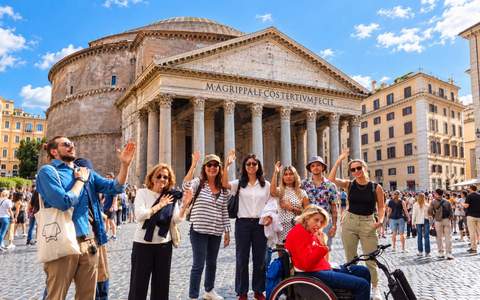
The route could start, for example, near Piazza Navona, continue to the Pantheon, and reach Campo de’ Fiori, turning some places in the city into reference points for a series of challenges.
Another possibility is using Villa Borghese, where an indoor multisensory activity can be paired with a calmer outdoor phase.
Even the EUR district, with its spacious areas and distinctive rationalist architecture, can become the setting for a corporate day built around the theme of accessibility.
The principle remains the same, though:
the venue must be truly accessible and the route must be planned before the event, not adapted at the last moment.
Accessibility: adding a ramp isn’t enough
A truly inclusive Team Building requires broader planning.
Accessibility isn’t only about entering a venue.
Before the event, it’s necessary to assess:
Physical accessibility
Entrances, restrooms, passage areas, elevators, surfaces, and distances must be checked.
Sensory accessibility
It’s helpful to provide alternatives to information that is exclusively visual or audible.
Communication accessibility
Instructions must be simple, clear, and available through different methods.
Group organization
Teams must be built in a way that avoids someone being identified only through their disability.
Materials
Tools must be chosen and adapted based on the participants and the venue.
This level of planning attention is what turns an activity simply “themed around inclusion” into a truly more accessible experience.
From inclusive Team Building to corporate culture
An experience like this can have an interesting effect even after the event ends.
Questions come up during the game.
How do we communicate when we can’t use our usual tool?
How important is it to describe information well?
How difficult can an activity become when the environment isn’t designed for everyone?
How does a situation change when a person receives the right support?
These questions can then be brought back into the company.
The real strength of inclusive Team Building, therefore, isn’t only what happens during the two or three hours of the activity.
It’s what can keep being discussed afterward.
A new idea of Team Building
The Multisensory Challenge offers a different way to interpret the concept of Team Building.
Not necessarily more competitive.
Not necessarily more spectacular.
But more focused on people’s ability to adapt, communicate, and collaborate.
The example of the City of the Disability Agenda also shows that this kind of experience can be brought into large organizations: the day organized for over 100 employees of Iveco Group is a concrete example of corporate application of the format. (Cpd Consulta)
So, the interesting direction for the future is to design activities in which difference isn’t a limitation to overcome, but a characteristic of the group to consider from the very beginning.
Because a truly inclusive Team Building shouldn’t ask people to become the same.
It should create conditions so that different people can collaborate to achieve the same goal.
Multisensory Challenge: the most important challenge is changing perspective
At the end of the day, the most interesting result might not be the score achieved.
It could be awareness.
That seeing isn’t the only way to understand.
That listening can become a guidance tool.
That touch can replace an image.
That a scent can become a clue.
That a voice can guide a team.
And above all, that when a way of participating doesn’t work for everyone, the issue isn’t necessarily the person.
Sometimes it’s the way we designed the experience.
And it’s precisely from this question that a more inclusive, more conscious, and more contemporary Team Building can emerge.
If you want to experience this or other similar events, click here—you’ll find our proposals:
Request a free quote and get all the information about your Team Building experience.
To organize this experience for your company, request a quote.