
































Cine-Drone Racing & Aerial Filmmaking: coordination and group direction with flight technology
A drone takes off.
On the monitor, a completely different perspective of the city appears.
The pilot follows the preset path, while a colleague controls the framing. Another group member checks the next sequence. A fourth is already thinking about how to turn those images into a story.
Then comes the order:
"Three, two, one... take!"
The drone passes through the first gate, climbs slightly, makes a turn, and begins the planned trajectory. Everything seems simple, but behind those few seconds of flight there’s a collective effort made of planning, communication, precision, and the ability to make decisions quickly.
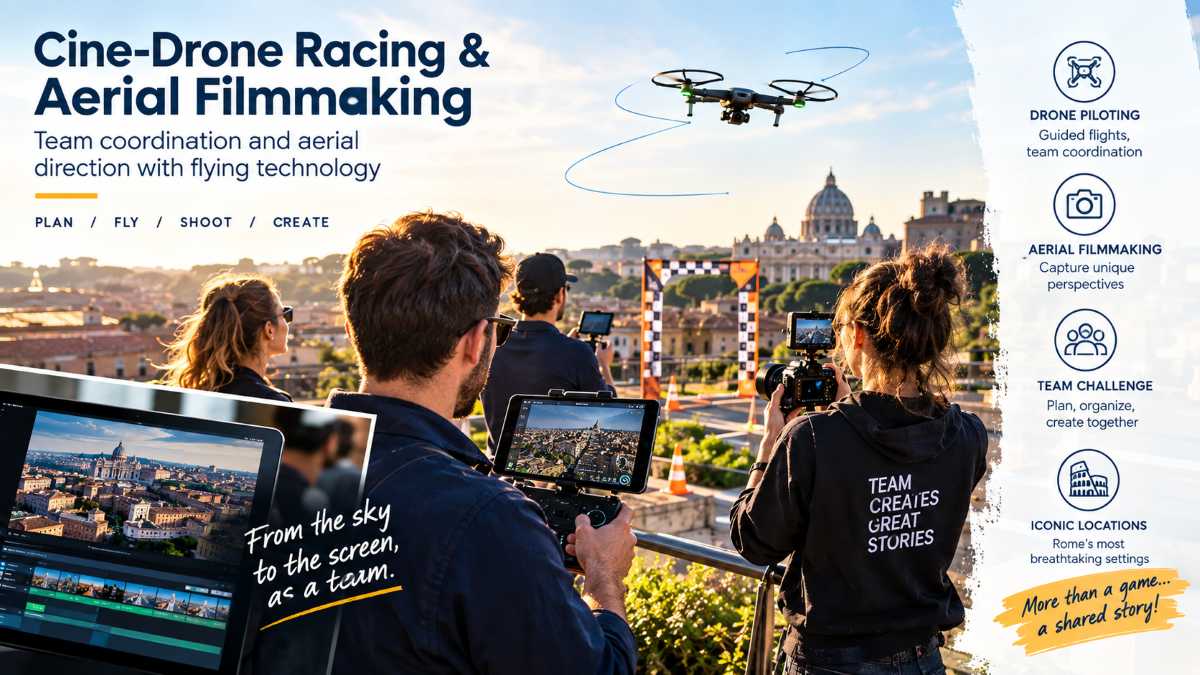
That’s the idea behind Cine-Drone Racing & Aerial Filmmaking, a new Team Building format that combines assisted piloting of micro-drones, drone racing, directing, video production, and corporate storytelling.
This isn’t just about flying a drone.
The real challenge is turning the flight into a cinematic scene and the group into a real film crew.
From drone to story: a Team Building built like a film set
The concept comes from the meeting of two worlds that seem, at first glance, different.
On one side there’s the technological component: micro-drones, simulators, radio controllers, paths, gates, monitors, and recording systems.
On the other side there’s cinematic creativity: scriptwriting, storyboards, directing, framing, editing, and storytelling.
The result is an activity in which each participant can take on a precise role.
The pilot isn’t necessarily the director.
The director doesn’t necessarily need to be the technician.
Anyone with a particularly attentive eye for composition can take care of the images.
Anyone who’s good at organization can become the production coordinator.
Anyone who loves storytelling can develop the story.
So the team must learn how to bring different skills together.
And that’s exactly the most interesting point of this format.
Not just who flies better wins
In a classic drone race, the goal may be to arrive first.
In Cine-Drone Racing & Filmmaking, though, speed is only one part of the challenge.
A perfect flight that can’t be used from a filmmaking perspective can be worth less than a simpler sequence that can tell something.
The team must therefore answer a much more complex question:
how do we turn a few minutes of flight into a story that makes sense?
From this question comes an experience that blends technology with cross-functional skills.
How Cine-Drone Racing & Filmmaking works
The format can be built in progressive modules, allowing even people who have never flown a drone to participate.
The first phase focuses on safety and learning about the equipment.
The second introduces participants to assisted piloting.
The third turns the group into a crew.
The fourth leads to the production of the sequences.
The fifth culminates in the viewing or presentation of the final result.
1. Briefing: strategy first, then takeoff
Each team receives a creative brief.
It can be, for example, about telling:
-
the company’s identity;
-
a corporate value;
-
a new campaign;
-
the launch of a product;
-
the concept of innovation;
-
a metaphor about teamwork;
-
Rome through the group’s perspective.
Before turning on a drone, the team must decide what it wants to tell.
This phase is essential because it introduces a principle typical of audiovisual production:
technology works for real when it serves an idea.
2. Drone Lab: learning to control flight
After the briefing comes the most spectacular part.
Participants are introduced to piloting micro-drones, using systems and configurations suited to the location and the level of the participants.
The first goal isn’t to create a cinematic recording.
It’s learning to control:
-
direction;
-
speed;
-
altitude;
-
trajectory;
-
rotation;
-
passing through gates;
-
stopping;
-
coordination with the other team members.
The assisted mode makes the experience accessible even to those who have never used a radio controller.
Indoor or outdoor?
The format can be designed for both indoor and outdoor, but with different modes.
In an indoor environment, it’s possible to build a real controlled circuit with small gates, soft obstacles, and passing points.
This solution is especially interesting for conventions, meetings, and company days at hotels, event spaces, or private locations.
Outdoors, on the other hand, the route can become more scenic, using available space to build a true cinematic sequence.
However, choosing the location must be supported by a prior check of operating conditions and applicable rules for flights.
Directing comes into play
Once piloting is learned, the nature of the experience changes completely.
The drone isn’t just an object to control anymore.
It becomes a flying camera.
The team must decide how to use it.
A top-down shot can introduce a scene.
A close pass can create dynamism.
A lateral movement can gradually reveal a place.
A circular framing can become the transition between two moments of the story.
So the group must start thinking like a crew.
Storyboard: the map of the film
Before recording, each team builds a storyboard.
Professional drawings aren’t necessarily needed.
Just a few guidelines:
SCENE 1 → SCENE 2 → SCENE 3 → FINALE
For each sequence, the following are defined:
-
drone position;
-
movement;
-
subject;
-
duration;
-
starting point;
-
ending point;
-
any dialogue;
-
music or sound effect;
-
the purpose of the scene within the story.
In this way, the work becomes very similar to that of a small film production.
Drone Racing: the adrenaline component
The racing portion adds energy to Team Building.
Teams can tackle a course made of gates and checkpoints, trying to complete the sequence in the least time possible or with the fewest errors.
But the race can be integrated into a story.
For example, the team might have to progressively conquer some “scenes” of its film.
Each completed checkpoint unlocks a new narrative element.
A particularly challenging trajectory can become the action scene.
A precise pass through a gate can represent the transition.
The final challenge can correspond to the short film’s ending.
In this way racing and filmmaking are not two separate activities.
They become two parts of the same story.
Group direction: who does what?
One of the most interesting elements of the activity is how roles are distributed.
A team could be made up of:
Drone Pilot
Responsible for controlling the drone and executing the trajectories.
Director
Decides how the scene should be built and coordinates the crew.
Camera Operator
Controls the monitor and checks the quality of the framing.
Script & Storytelling
Builds the narrative thread and coordinates the scenes.
Flight Coordinator
Monitors the operational sequence and communicates with the pilot.
Editor
Collects the material and contributes to building the final video.
Naturally, roles can rotate.
And that rotation is what turns the activity into a real Team Building exercise.
Skills that come into play
Cine-Drone Racing & Filmmaking simultaneously activates different contemporary skills.
Communication
The pilot must receive clear and quick information.
A wrong direction can compromise a sequence.
Confusing communication can force the team to repeat the scene.
Coordination
The team must synchronize people, technology, and timing.
It’s not enough that each component is good individually.
It’s necessary for everyone to work toward the same goal.
Leadership
During production, figures capable of coordinating the group may emerge spontaneously.
Leadership isn’t necessarily assigned to whoever has a managerial role.
It can emerge from the ability to organize, listen, and make decisions.
Problem Solving
A drone may not follow the trajectory perfectly.
A recording may turn out unusable.
Time can change.
A scene may not work.
The team must quickly find an alternative solution.
Creativity
The final result also depends on the ability to turn an abstract idea into images.
And here the drone becomes a creative tool.
Cine-Drone in Rome: when the city becomes a set
Rome is particularly interesting for this format because it offers an extraordinary number of cinematic scenarios.
The historic center, parks, modern architecture, and private locations allow for very different experiences.
The route can be designed based on the location and the necessary authorizations.
Piazza Navona and the historic center
Piazza Navona, with its Baroque architecture and the Fountain of the Four Rivers, can become a narrative reference within a storyboard.
The same applies to the Pantheon, Campo de’ Fiori, or Trastevere.
For an urban activity, though, these places should not be automatically considered usable for drone flights: feasibility must be verified in advance based on the UAS geographical area, the type of operation, and any restrictions.
Villa Borghese
A green setting like Villa Borghese offers an entirely different atmosphere.
Trees, avenues, and open spaces can become scenic elements of a video production.
In this case too, the exact area must be chosen by verifying flying conditions in advance and any limitations.
EUR: architecture and contemporary cinema
The EUR district makes it possible to build a more contemporary aesthetic.
Geometric lines, rationalist architecture, and large perspectives can be especially interesting for a corporate video dedicated to innovation and technology.
It’s an example of how Team Building can also turn into a visual exploration of the city.
From “Lights, camera, action!” to the Cine-Drone: two ways to tell Rome
The format naturally connects to existing cinematic Team Building experiences in Rome.
With Lights, camera, action!, for example, the group becomes a real crew: it writes the story, assigns roles, and produces a short film. Lights, camera, action! – The Rome set
The Cine-Drone adds an extra technological dimension.
The camera doesn’t stay on the ground.
It can move through space and create completely different perspectives.
Even Rome in a Shot uses the city as a creative set, turning participants into protagonists of a photographic route through iconic locations. Rome in a Shot – Urban Game
So the Cine-Drone can become the natural evolution of a shared philosophy: using the city not only as a backdrop, but as part of the story the group must build together.
The finale: editing the story
After the trials, comes the most curious moment.
The teams watch the recorded material.
Some footage is perfect.
Other shots are shaky.
Some sequences are too long.
Others last just a few seconds.
Someone realizes their original idea doesn’t work.
And that’s exactly where the last challenge begins.
The group must select the footage and build a coherent sequence.
It’s not necessarily about producing a professional film.
The goal is to create a short, recognizable, shareable video, in which every image has a function.
The moment of the winners
The day can end with a real mini-awards ceremony.
Each team presents its video.
The audience can evaluate different aspects:
-
storytelling quality;
-
creativity;
-
coordination;
-
originality of the shots;
-
difficulty of the trajectories;
-
ability to use the location;
-
effectiveness of the message.
Awards can be organized during an aperitif or a company dinner.
The result is something more than a simple event souvenir.
It’s content created directly by the team.
Safety and regulations: the drone isn’t a toy
When a Team Building activity uses drones, the spectacular element must be accompanied by professional planning.
In Europe, UAS operations are governed by the EU Regulation 2019/947 and the related applicable provisions. EASA indicates, for the Open category, conditions such as keeping the flight within visual line of sight (VLOS), the general limit of 120 meters, and the ban on flying over gatherings of people. EASA – Easy Access Rules for Unmanned Aircraft Systems
In Italy, ENAC also specifies that before every flight it’s necessary to check the UAS geographical zones via the d-flight portal and comply with any limits present in the area. ENAC – Drone flights: limitations and airspace reservations
For the Open category, specific requirements are also provided, among other aspects, related to operator registration, drone identification, insurance, and pilot competence, with some exceptions linked to the characteristics of the aircraft. ENAC – General requirements for the Open category
For this reason, in Team Building, piloting should be organized with qualified operators and instructors, using equipment and scenarios consistent with the applicable regulations.
For operations that don’t fall under the Open category, additional requirements may be necessary: ENAC identifies, among the examples of the Specific category, BVLOS operations and other configurations that require a risk assessment and, depending on the case, an operational authorization or another modality provided for by the regulations. ENAC – Specific Category
So, in a corporate event, the spectacular element must always come after safety.
Why Cine-Drone is contemporary Team Building
The value of the format isn’t only in the technology.
Drones are the tool.
The real goal is the team’s work.
First, you have to plan.
Then, communicate.
Then, practice.
Then, make mistakes.
Then, correct.
Finally, you need to turn many individual skills into a single result.
It’s a surprisingly close process to real business life.
A project starts from an idea.
It’s broken down into activities.
People take on different roles.
Information must flow.
Unexpected events require decisions.
And the final result depends on the ability to work together.
A perfect metaphor for teamwork
The drone can fly only if someone pilots it.
But a recording becomes a story only when someone decides where to go, what to show, and why to show it.
Similarly, a corporate group can have extraordinary talents, but the result depends on the ability to coordinate them.
The Cine-Drone makes this concept visible.
Literally.
A Team Building that leaves an image
At the end of the day, the video remains.
But something less tangible also remains.
The memory of a team that had to learn a new language.
Of those who piloted for the first time.
Of those who discovered they have a talent for directing.
Of those who solved a problem at the last second.
And of those who turned an initially confusing idea into a scene.
And above all, the feeling that when technology, creativity, and people all move in the same direction, even a small team can produce something surprisingly big.
The Cine-Drone Racing & Aerial Filmmaking brings Team Building into a dimension in which participation alone isn’t enough.
You have to think, coordinate, fly, and tell the story together.
Because the real film isn’t what the drone records from the sky.
It’s what the team manages to build when everyone contributes to the same story.
If you want to experience this or similar activities, click here—you’ll find our proposals:
Request a free quote and get all the information about your Team Building experience.
To organize your event, request a quote.