























The Machines of Leonardo: when Renaissance genius becomes a Team Building experience driven by ingenuity, creativity and challenge
What happens when a group of colleagues receives a project that seems apparently incomplete, some materials and one certainty: to reach the solution, they’ll have to think together?
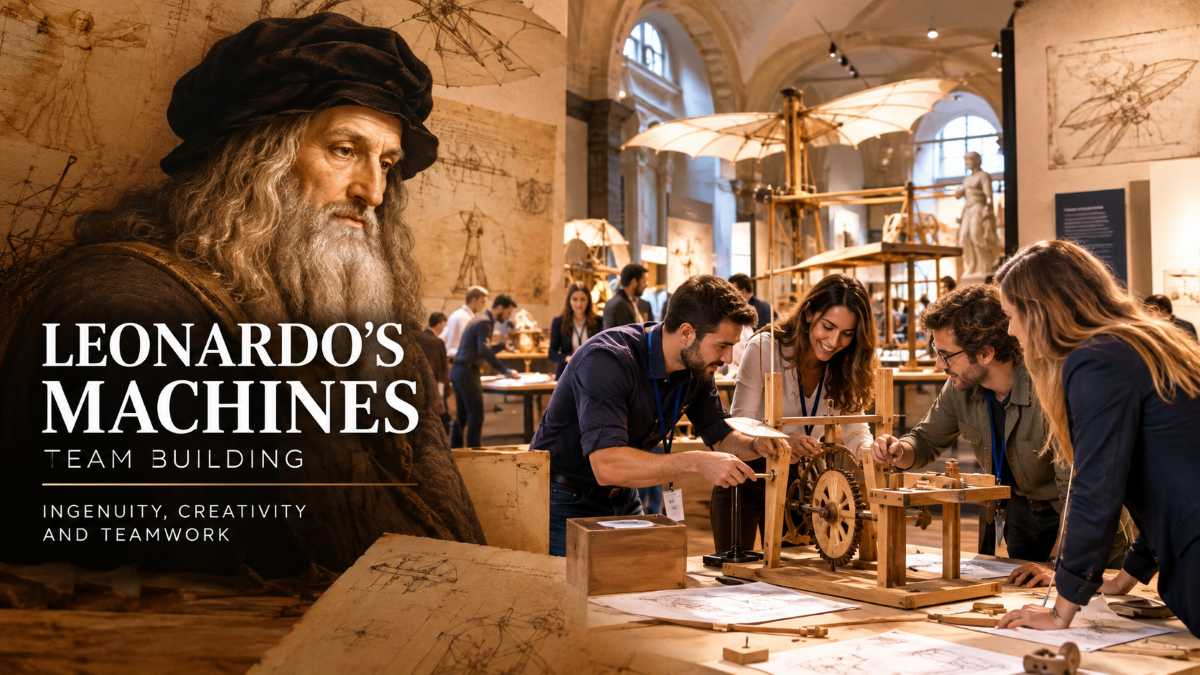
The answer takes shape in The Machines of Leonardo, a team building experience inspired by the method of Leonardo da Vinci, designed to turn curiosity, planning and experimentation into a real team activity.
It’s not simply about building an object. The heart of the experience is the journey that leads from observation to action: interpreting a drawing, formulating a hypothesis, assigning roles, building a prototype, testing that prototype’s operation, correcting mistakes and finally putting it to the test.
It’s exactly this step that makes the format especially interesting for a company: the idea doesn’t stay on paper, but has to become something tangible.
And when the prototype doesn’t work on the first try, the group faces the same question that accompanies every innovation process: what can we change to make it work?
The format falls under the Mind Games & Strategy category of TeamBuildingRome and is based on building and testing three different machines, with a concluding trial in which one of the creations becomes the protagonist of the challenge. (Team Building Rome)
Leonardo da Vinci: a model of applied curiosity
Leonardo da Vinci is often remembered for the extraordinary variety of his interests: painting, anatomy, engineering, architecture, nature, mechanics and scientific observation coexist in his studies.
But behind this apparent multiplicity there is a common element: curiosity turned into a method.
Leonardo observed how things worked, took notes, drew, formulated hypotheses and tried to understand the relationships between the elements.
His Codexes reflect precisely this dimension of his work: pages where drawings, notes, studies and insights come together.
For this reason, the reference to Leonardo is particularly effective when brought into the world of team building.
In fact, a business team is continuously faced with problems that don’t have a solution already prepared. Information must be gathered, viewpoints compared, a response designed, and then checked to see whether that response works in reality.
It’s the same path that the format takes inside the experience:
observe → understand → design → build → test → correct.
The difference is that here the process isn’t conveyed through a theoretical lesson.
It’s lived.
From drawing to machine: the team steps into Leonardo’s workshop
Let’s imagine opening a file.
There isn’t a detailed manual explaining every step. There are drawings, instructions, elements to interpret and information that must be connected.
The group observes.
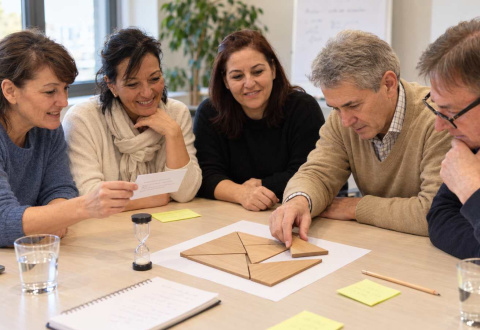
Someone immediately spots a detail. Someone else tries to understand how the overall mechanism works. One participant tries to formulate a hypothesis, while another prefers to start manipulating the materials.
This is the moment when the team’s first behaviors emerge.
Who takes the initiative?
Who listens?
Who checks?
Who organizes?
Who challenges the first solution?
Who can turn an abstract idea into a concrete action?
1. Deciphering the design
The first phase is dedicated to understanding.
The teams receive materials and instructions needed to interpret the design and reconstruct how the machine works.
It’s not just an observation exercise. It’s a collaborative problem-solving activity because the information must be shared and interpreted.
One person may notice a detail that another hadn’t.
A second person may understand the meaning of that detail.
A third person may figure out how to turn it into a practical solution.
So the machine starts to take shape before it’s even built: it’s born in the conversation.
2. Building the prototype
After the planning comes the more concrete moment.
Ideas must become material.
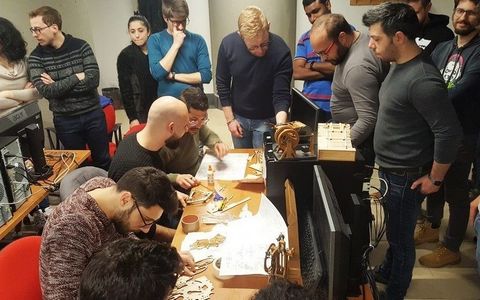
The teams organize the work, assign tasks and begin building.
And it’s precisely in this phase that the theoretical project meets reality.
One element may not work as expected.
A connection may prove to be not very stable.
A solution that seemed perfect on paper may turn out to be ineffective when applied.
This is where building becomes a particularly effective metaphor for business work.
Because even in real projects, a good idea isn’t necessarily a good solution.
The difference is made by the ability to test, listen to the results and quickly modify what doesn’t work.
3. Test, correct and try again
The prototype is put to the test.
If it works, the group can analyze why.
If it doesn’t work, it must figure out what to change.
Error becomes information.
This is one of the most interesting aspects of the experience: the team isn’t rewarded only for having had a good initial intuition, but for the ability to improve the project through experience.
It’s a logic very close to iterative design and design thinking, where the idea is turned into a prototype, the prototype is tested, and the test results fuel a new version.
The cycle continues until the project reaches the goal.
When building becomes a competition
At a certain point the atmosphere changes.
The teams have built, experimented and corrected.
Now the challenge arrives.
One of the machines becomes the protagonist of the concluding test planned by the format. Precision, strategy and the ability to improve the project can make the difference. (Team Building Rome)
The competition introduces a new variable: time.
A solution must be not only working, but sufficiently effective to be used in the test.
The team must therefore decide whether to keep refining the prototype or consider the project ready.
It’s a choice that is far from trivial.
When should we stop designing and start acting?
This is also a very common question in business life.
A project can be improved endlessly, but there always comes a moment when a decision must be made and execution must begin.
The real workshop is the group
The machine is the visible result.
But the real workshop of the experience is the team.
During construction, dynamics emerge that would normally remain invisible.
A particularly precise person may become the reference point for controlling the project.
Another may spontaneously take on coordination.
Someone else may prove especially creative in finding alternative solutions.
Others can contribute mainly through listening, organizing, or the ability to challenge an idea.
There isn’t necessarily a single leader.
A situational leadership may emerge, in which different roles become important at different times.
When creativity is needed, the person who knows how to generate alternatives stands out.
When precision is needed, the one who controls the details becomes central.
When a difficulty arises, the person capable of keeping the group oriented toward the solution can become decisive.
So team building becomes an opportunity to observe not only the result, but also how the group arrives at the result.
Leonardo in Rome: turning Team Building into a cultural experience
Rome offers a particularly suitable setting to develop an experience dedicated to Leonardo.
The theme can in fact be linked to real cultural POIs in the city, creating a route that combines team building, history, art and innovation.
A point of reference is the Leonardo da Vinci Museum in Piazza del Popolo, where Leonardo’s genius is presented through models inspired by his original projects, with machines dedicated also to flight, war, mechanics and civil engineering. (Turismo Roma)
Leonardo da Vinci Museum – Turismo Roma
Another particularly interesting POI is the Leonardo da Vinci Experience on Via della Conciliazione, a short walk from St. Peter’s Basilica, where reproductions of machines and Leonardo’s paintings are displayed within a multimedia route. (Turismo Roma)
Leonardo da Vinci Experience – official website
In the heart of the historic center, between Campo de' Fiori and Piazza Navona, you can also find the Leonardo exhibition at Palazzo della Cancelleria, dedicated to inventions and Leonardo-esque machines. The route includes working and interactive models and presents the machines through different categories linked to natural elements and mechanisms. (Turismo Roma)
Leonardo exhibition – official website
The connection with Palazzo della Cancelleria also adds a particularly evocative architectural and historical component. The palace preserves important Renaissance rooms and its courtyard is traditionally attributed, at least for the design, to Donato Bramante. (Turismo Roma)
So the theme can become the thread running through a broader day: observing Leonardo, learning how he thinks, and then transforming that same logic into a hands-on team experience.
From the museum to the workshop: an immersive business route
A possible structure of the event can start with a cultural moment.
The group meets Leonardo through his projects, his inventions, and the historical context in which they were created.
After that, the experience moves into the operational dimension.
From the museum rooms you ideally go to the workshop.
The group receives the materials.
The project is opened.
The teams start discussing.
The result isn’t written in advance.
And this is exactly what makes the experience engaging: knowing Leonardo isn’t enough; you have to try to think like a designer.
For a business event in Rome, the route can therefore be built by combining culture and experiential activities, adapting timings and settings to the characteristics of the day.
The Machines of Leonardo and business problem solving
The value of the format isn’t linked only to the creative component.
Building the machines allows you to work on different cross-functional skills.
Problem solving
The group must tackle real problems and find workable solutions.
Creative thinking
A difficulty may require a solution different from the one initially imagined.
Communication
Information must circulate quickly among team members.
Listening
A good insight can come from a person who initially didn’t take on a central role.
Time management
The presence of a final challenge forces the team to set priorities.
Organization
Materials, roles and activities must be coordinated.
Situational leadership
The reference role can change depending on the project phase.
Adaptability
When a prototype doesn’t work, the group must modify its strategy.
Systems thinking
Every component of the machine must work in relation to the others.
And it’s precisely this last point that creates an interesting parallel with organizations.
A machine is made up of different elements.
An organization is as well.
If each component works perfectly but doesn’t communicate with the others, the system may still not work.
From machine to team: the metaphor of interdependence
Let’s imagine a machine made up of ten elements.
The first one can be perfect.
The second too.
The third can be built with great precision.
But if the connections between the elements aren’t correct, the entire system gets stuck.
The same can happen in an organization.
A department can achieve excellent results without those results automatically producing an equally effective outcome for the entire company.
Team building makes this dynamic immediately visible.
Participants can observe the results of their decisions without needing long theoretical explanations.
Does the machine not work?
You need to understand which relationship must be changed.
Does the team not communicate?
The project slows down.
Is information not shared?
A solution can become more difficult.
Is a decision made too quickly?
It might be necessary to go back.
The strength of the experience lies precisely in the possibility to see the concrete consequences of collaboration.
A creative format even for international groups
The visual and hands-on component makes The Machines of Leonardo suitable even for international groups.
You don’t have to base the experience exclusively on verbal communication.
Drawings, materials, prototypes and practical tests become a shared language.
For a multinational company, this can be especially interesting.
Participants from different countries can collaborate on the same project without necessarily having the same level of language knowledge.
The reference to Leonardo also adds a cultural dimension that’s easily recognizable internationally.
His name is associated with creativity, art, observation, invention and research.
The format can therefore also become a way to tell a contemporary Italian identity through a historical figure capable of bridging different disciplines.
From the Machines of Leonardo to the Ideal City
The Leonardo theme can also be developed through other formats included in TeamBuildingRome’s offering.
Among them is Leonardo’s Ideal City, an experience in which teams work on designing and building a city made up of interdependent elements. The format shifts the focus from the single machine to the functioning of an entire system. (Team Building Rome)
Leonardo’s Ideal City – TeamBuildingRome
Another experience connected to the world of Leonardo’s inventions is Leonardo’s Bridges, which uses bridge building as a metaphor for collaboration, coordination and overcoming obstacles. (Team Building Rome)
Leonardo’s Bridges – TeamBuildingRome
In this way, it’s possible to build different business routes while keeping a common thread: Leonardo as a symbol of the passage from idea to implementation.
What you’ll discover during the experience
During The Machines of Leonardo, the group can discover:
-
how roles are spontaneously assigned;
-
which communication methods emerge under pressure;
-
how decisions are made;
-
how much it matters to share information;
-
how the team reacts when an idea doesn’t work;
-
which people emerge during the creative phases;
-
how time is managed;
-
how important it is to test a solution concretely;
-
how the group’s behavior changes when competition arrives;
-
why a good project often requires multiple attempts;
-
how creativity and precision can complement each other;
-
how interdependence influences the final result.
For which companies is the Team Building The Machines of Leonardo recommended?
The experience can be included in different business occasions:
-
meetings and conventions;
-
company kick-offs;
-
incentive events;
-
team building days;
-
activities dedicated to collaboration;
-
onboarding routes;
-
events for international groups;
-
programs dedicated to creativity and innovation;
-
activities for management teams;
-
moments of integration between departments;
-
company events dedicated to Italian culture.
In addition, the practical nature of the format makes it possible to adapt the difficulty level, the duration and the structure of the challenge to the group’s characteristics.
An experience that talks about innovation without giving a lesson on innovation
Maybe this is the most interesting point.
To talk about innovation, it isn’t always necessary to organize a conference.
Sometimes it’s enough to put a group in front of a problem.
A project to interpret.
Materials to use.
Time to respect.
A machine to make work.
And to observe what happens.
Leonardo left us an extraordinary amount of drawings and studies, but the value of his projects isn’t only in their beauty.
It lies in the curiosity that generated them.
In the desire to understand how things work.
In the attempt to connect different disciplines.
In the ability to turn observation into a project.
The Machines of Leonardo brings this philosophy into the team.
It doesn’t ask participants to be inventors.
It asks for something simpler and, at the same time, very concrete: to observe, discuss, try and improve together.
FAQ – The most frequently asked questions
Is it necessary to have technical skills?
No. The format is designed to be tackled through observation, discussion, planning and collaboration. No prior technical knowledge is required. (Team Building Rome)
How many machines are built?
The format is structured around reconstructing three different machines, with one of the completed realizations later used in the final challenge. (Team Building Rome)
Does the activity involve a competition?
Yes. The final phase introduces a competitive component, while keeping teamwork and the building process at the center. (Team Building Rome)
Is the format suitable for international groups?
Yes. The practical and visual component can make it easier for multilingual groups to participate, and the instructions can be adapted to the needs of the event. (Team Building Rome)
Is it possible to connect the activity to a cultural route in Rome?
Yes. The theme can be integrated with POIs dedicated to Leonardo, such as the Leonardo da Vinci Museum in Piazza del Popolo, the Leonardo da Vinci Experience on Via della Conciliazione or the Leonardo exhibition at Palazzo della Cancelleria, creating an experience that combines culture and business activities. (Turismo Roma)
Can the experience be customized?
Yes. The format can be adapted depending on the group, business goals, available duration and the challenge’s difficulty level. (Team Building Rome)
Leonardo, the machine and the future of the team
At the end of the day, a machine remains.
But something else remains as well, something less visible.
The memory of who had the idea.
Of who corrected a mistake.
Of who convinced others to change strategy.
Of who listened.
Of who built.
And above all, of the moment when a set of separate pieces finally started working as a single system.
This is the storytelling strength of The Machines of Leonardo: using an invention to talk about people, using a construction to talk about collaboration, and using a Renaissance project to tackle one of the most current business challenges: turning different skills into a shared outcome.
Leonardo observed the world to understand how it worked.
A team observes itself to understand how it can work better.
And just like in a machine, it’s often the connection between parts that makes the difference.
If you want to live this experience or something similar, click here—you’ll find our proposals:
Request a free quote and receive all the information about your Team Building experience.
Request a free quote and receive all the information about your Team Building experience.