


























The power of trust in high-performance teams: when a team truly learns to rely on others
There’s a moment, in every team, when individual competence is no longer enough.
It can happen during a match, when time is almost up. During a complex project, when a decision has to be made quickly. Or in the middle of an unexpected problem, when no one alone has all the information needed.
It is exactly in these moments that an often invisible, yet essential, variable comes to the surface: trust.
A team can be made up of well-prepared, motivated, highly skilled professionals. But if people don’t trust one another, they will tend to check on each other, protect their own information, avoid delegating, slow down decisions, and work in isolated compartments.
When, instead, trust is present, something different happens.
One person can make room for a colleague.
Another can ask for help without perceiving it as a weakness.
A leader can delegate a decision.
A team member can take responsibility knowing that the others will be ready to support them.
This is the difference between a group of competent people and a high-performance team.
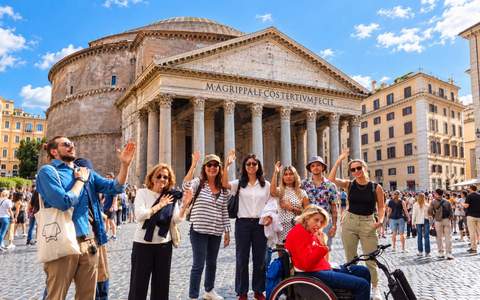
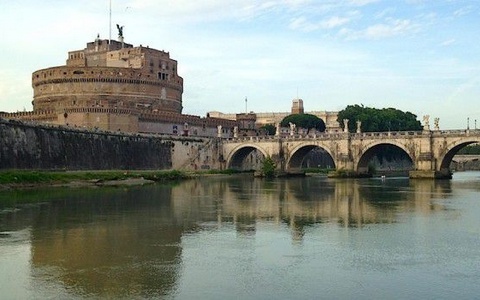
And Rome, with its parks, archaeological areas, sports spaces, and event venues, offers an extraordinary laboratory for turning trust—from an abstract concept—into a concrete experience.
Trust doesn’t simply mean “getting along”
When talking about trust inside a company, there’s a risk of reducing the concept to personal likability.
But professional trust is much more concrete.
It means being able to rely on the fact that a person will:
-
do what they said they would;
-
communicate a problem before it becomes critical;
-
share the important information;
-
respect their role;
-
know when to ask for support when needed;
-
accept feedback;
-
be willing to change their position in light of new information;
-
not try to turn every decision into an individual competition.
In a high-performance team, trusting doesn’t mean believing that others are infallible.
It means knowing that even when something goes wrong, the group has the resources to respond.
And it’s precisely this distinction that makes the concept of trust particularly interesting for team building.
When trust becomes visible
Imagine a group of colleagues.
A few minutes earlier, they were seated around a meeting table.
Now they have to face a challenge.
The rules are clear, the time is limited, and the outcome depends on everyone.
One person receives information that the others don’t have.
Another has to make a decision.
A third participant has a key skill to complete the challenge.
At this point, the team has to choose.
Check everything?
Or distribute responsibilities?
Wait for everyone to agree?
Or rely on the person who, at that moment, has the best information?
Trust emerges exactly here.
Not in statements.
In decisions.
Trust and performance: the real advantage lies in the speed of collaboration
A team that doesn’t trust tends to naturally increase control levels.
Every decision must be verified.
Every piece of information has to pass through more people.
Every responsibility is kept.
The result can be a slow organization, even when the people who make it up are very competent.
Trust, on the other hand, reduces some friction.
It doesn’t mean eliminating control, but making it smarter.
When responsibilities are clear and people trust one another’s skills, the group can delegate decisions.
This is especially important in contexts characterized by:
-
rapid change;
-
complex projects;
-
international work;
-
cross-disciplinary teams;
-
commercial activities;
-
emergency management;
-
innovation;
-
distributed leadership;
-
high time pressure.
A high-performance team isn’t the one where a single person controls everything.
It’s the one in which people know when to take initiative and when to rely on others.
The Rugby Team Building: trust passes through the ball
Among the formats included in TeamBuildingRome’s proposal, Rugby Team Building represents this principle in a particularly immediate way.
The format uses rugby to work on collaboration, trust, communication, responsibility, leadership, and inclusion. One of the most interesting metaphors comes directly from the logic of the game: whoever carries the ball needs the support of their teammates. (Team Building Rome)
Rugby Team Building – TeamBuildingRome
It’s a simple dynamic, but extremely powerful.
The player can’t do everything alone.
They have to know that someone will come to support them.
They need to be willing to pass the ball.
They must accept that, at a certain stage of the play, the protagonist might be someone else.
Trust also means making room
This is one of the most interesting lessons a team activity can bring into the corporate world.
A manager may be used to solving every problem personally.
A very skilled professional may have a tendency to step in all the time.
An experienced collaborator might believe their method is the most effective.
But a team grows when individual skills become shared resources.
In rugby, as in work, passing isn’t a surrender.
It’s a strategy.
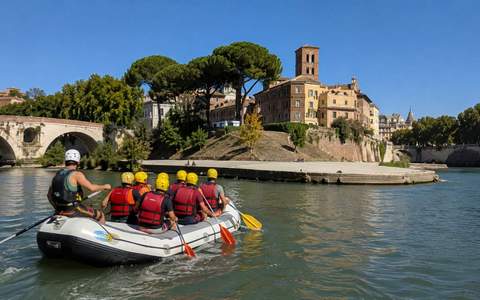
Dragon Boat: when twenty people must move like one team
If rugby makes trust visible through passing, Dragon Boat makes it visible through rhythm.
In the format proposed by TeamBuildingRome, crews must coordinate their paddling and find a common rhythm. The activity works on communication, leadership, coordination, listening, pressure management, and mutual trust. (Team Building Rome)
Dragon Boat Team Building – TeamBuildingRome
It’s not necessary for everyone to have the same strength.
It’s necessary for them to be able to sync up.
If someone accelerates too much, the crew’s rhythm changes.
If someone falls behind, the effect ripples across the entire boat.
Performance is collective.
The Laghetto dell'EUR as a coordination laboratory
One of the scenarios that can be used for a Dragon Boat experience is the Laghetto dell'EUR, in the Central Park of the Lake.
The artificial lake, set within the large green system of the EUR, is accompanied by the Japanese Walk and the Garden of Waterfalls. (Turismo Roma)
Laghetto dell'EUR – Turismo Roma
Here, the landscape can become part of the experience.
The city remains in the background.
In front of the group, there’s water.
And on the water, there’s a very simple rule: if you don’t coordinate, the boat won’t move the way you want.
Escape Box: trusting the skills we don’t have
Trust isn’t only about sports activities.
It can also emerge in front of a riddle.
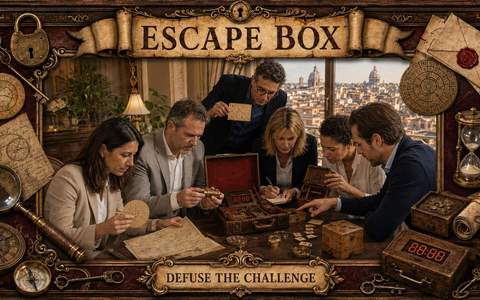
The Escape Box format by TeamBuildingRome starts from a situation where nobody necessarily has all the information needed to reach the solution. (Team Building Rome)
Escape Box Team Building – TeamBuildingRome
One participant can be especially good with numbers.
Another may have excellent visual memory.
A third can quickly understand the logic of a mechanism.
A fourth can be the best at coordinating the work.
If everyone tries to solve everything individually, time passes.
If, instead, the information is shared, the group can build a solution more quickly.
Trust in other people’s skills
This dynamic is very close to that of many corporate projects.
We can’t be experts in everything.
A truly effective team doesn’t try to turn every person into a universal professional.
It does something else:
it recognizes the skills present in the group and knows when to rely on them.
This also means accepting that a colleague might have a better solution than ours.
And it’s one of the most mature forms of professional trust.
Gladiators: trusting when pressure increases
Trust is tested especially when pressure rises.
That’s why even a format like Gladiators – games without borders, set on Via Appia Antica, can become an interesting laboratory for observing team dynamics.
The format combines sports challenges, strategy, problem-solving, and collaboration, bringing participants into a scenario inspired by gladiator training. (Team Building Rome)
Here, trust can take a different shape.
It doesn’t just mean knowing that someone will do their part.
It means knowing that, when the initial plan doesn’t work, the group won’t fall apart.
Trust as collective resilience
A strong team isn’t the one that doesn’t make mistakes.
It’s the one that knows what to do after the mistake.
If a strategy doesn’t work, you have to change your approach.
If a participant runs into difficulty, the group must adapt.
If the pressure increases, communication must become even more effective.
This is the trust organizations truly care about: not an abstract feeling, but the belief that the team has the ability to respond together.
Via Appia Antica: a venue that amplifies the experiential dimension
The Parco Archeologico dell'Appia Antica offers one of the most captivating settings for outdoor experiences in Rome.
The park includes a wide stretch of the ancient Via Appia and numerous archaeological sites, including the Cecilia Metella complex, Capo di Bove, Villa dei Quintili, and the Parco degli Acquedotti. (Turismo Roma)
Parco Archeologico dell'Appia Antica – Turismo Roma
The venue adds a narrative dimension to the experience.
The team isn’t simply in a green space.
They move through a landscape where history, archaeology, and nature coexist.
And when the activity is built with care, the place isn’t just a backdrop anymore.
It becomes part of the story.
Terme di Caracalla: trust as a system
Another particularly interesting POI is the Terme di Caracalla.
The complex, built between 212 and 216 AD, was far more than just a place to bathe: it included spaces dedicated to sport, walking, and study. Its underground areas also housed a complex service infrastructure, with water systems, heating, storage deposits, and other functions necessary for the operation of the entire system. (Turismo Roma)
Terme di Caracalla – Turismo Roma
It’s a perfect metaphor for talking about organizations.
On the surface, we see the result.
Behind the result is a network of people, processes, and responsibilities.
If one element stops, the entire system can be affected.
Performance comes from connections
A high-performance organization works in a similar way.
Marketing, sales, administration, production, IT, human resources, and management can have specific objectives.
But the final result comes from connections.
Trust allows these connections to become more fluid.
It doesn’t eliminate the need for procedures.
It makes them more effective when people understand their role and recognize the roles of others.
Villa Ada: when the team leaves the meeting room
Not all team-building activities need to have a strong competitive component.
Sometimes trust grows better through activities that help people slow down, observe, and communicate.
Villa Ada Savoia, with its 160 hectares of parkland and a landscape shaped by gardens, historic buildings, and green areas, offers a particularly suitable setting for outdoor experiences and group activities. (Turismo Roma)
Villa Ada Savoia – Turismo Roma
Here, the concept of trust can be addressed through orientation activities, collaboration, listening, problem-solving, or experiential routes.
The distance from the office helps change perspective.
When the context changes, some behaviors change too.
And that’s one of the goals of good team building: creating a situation different enough from routine to allow people to observe how they collaborate.
The Three Elements: trusting in different conditions
The THE THREE ELEMENTS format works on communication, leadership, listening, role organization, problem-solving, mutual trust, adaptability, coordination, and pressure management. (Team Building Rome)
The Three Elements – TeamBuildingRome
Its interest in relation to the topic of trust lies in the variety of situations.
A team can be highly effective in a certain context and struggle when the environment changes.
High-performance trust, instead, requires adaptability.
Trust doesn’t mean predictability
A common mistake is thinking that trusting means knowing exactly what the other person will do.
It’s almost the opposite.
Trust becomes important precisely when we don’t know what will happen.
If the context changes, we need to know the colleague will respond.
If a problem arises, we need to be able to rely on their ability to communicate.
If a decision has to be made quickly, we need to know it will be guided toward the common goal.
This form of trust allows a team to function even under uncertainty.
The 7 dimensions of trust in high-performance teams
1. Reliability
Doing what you said you would do creates predictability and reduces the need for control.
2. Competence
Trusting also means recognizing the skills of others and knowing when to give them room.
3. Communication
Information must circulate, especially when something isn’t going according to plan.
4. Responsibility
A team works when each person understands their role and accepts its responsibilities.
5. Professional vulnerability
Asking for help, admitting a mistake, or stating that you don’t have an answer shouldn’t automatically be interpreted as weakness.
6. Feedback
Trust allows people to receive observations without immediately turning them into a personal conflict.
7. Common goal
Trust becomes stronger when people perceive that individual success is connected to the collective outcome.
How trust is built during a Team Building
A good experience shouldn’t just put people in the same room.
It should create situations where collaboration is truly necessary.
First phase: creating a shared goal
The group must have a clear target.
Not simply “doing an activity,” but achieving a shared outcome.
Second phase: distributing information
When information is distributed among more people, the group is forced to communicate.
Third phase: making roles interdependent
If each participant can complete the activity on their own, trust becomes less relevant.
If, instead, the result depends on the interaction between different roles, collaboration becomes necessary.
Fourth phase: introducing a difficulty
Trust can be seen when something changes.
A shorter time limit.
New information.
A different rule.
An unexpected obstacle.
Fifth phase: leaving room for reflection
The debriefing moment is essential.
After the activity, the group can ask:
When did we really trust each other?
When did we try to control too much?
Who took the initiative?
Did we share all the information?
How did we respond to the mistake?
What can we transfer to daily work?
This is where the game becomes learning.
Trust and leadership: leading doesn’t mean controlling
One of the most important steps involves the relationship between trust and leadership.
A leader who has to control every detail can hardly build a truly autonomous team.
Effective leadership doesn’t necessarily mean having all the answers.
It can mean creating the conditions so the right people can make the right decisions at the right time.
During team building, this becomes especially clear.
One person can lead a phase.
Another can take control of the next one.
Another can become essential when things get difficult.
Leadership can therefore become situational and distributed.
The result isn’t a decrease in authority.
It’s an increase in the team’s overall capability.
Trust and psychological safety: creating a space where people can participate
Another important dimension is the ability to express ideas, doubts, and difficulties without fear of being immediately devalued.
In a team that wants to achieve high performance, the ability to say:
"I didn’t understand."
"I don’t think this strategy will work."
"I made a mistake."
"I need help."
can be extremely valuable.
The issue isn’t avoiding mistakes.
It’s making sure mistakes are communicated early enough to be managed.
That’s why a trust culture can also contribute to the quality of decisions.
When team building becomes a mirror of the company
The most interesting part of a team-building experience isn’t necessarily what happens during the game.
It’s what the group discovers about itself.
A team may realize it’s too dependent on a single person.
Another may discover that it has many skills, but not very effective communication.
Another may realize that it has great execution capability but poor handling of unforeseen events.
Trust therefore becomes a lens through which to observe how the team works.
It’s not for labeling.
It’s for generating questions.
What you’ll discover during a trust-focused experience
A Team Building built around the theme of trust can help the group observe:
-
how responsibilities are distributed;
-
how quickly information circulates;
-
who takes the initiative;
-
who tends to control;
-
who knows how to delegate;
-
how mistakes are handled;
-
how the team reacts to pressure;
-
which skills are recognized;
-
which ones remain unused;
-
how communication changes when difficulty increases;
-
how much the individual result is connected to the collective one;
-
which behaviors can be transferred to daily corporate life.
Which companies find a Team Building on trust valuable for
The topic can be particularly useful for:
-
management teams;
-
companies in a growth phase;
-
newly formed groups;
-
international teams;
-
companies undergoing reorganization;
-
departments that need to improve collaboration;
-
sales teams;
-
groups distributed across multiple locations;
-
companies working on complex projects;
-
organizations looking to strengthen delegation and responsibility;
-
teams going through change.
However, there isn’t a single format that works for everyone.
Choosing the activity should start from the goal.
If the focus is synchronization, an activity like Dragon Boat can offer an immediate metaphor.
If the focus is the distribution of information, Escape Box can be particularly effective.
If the group needs to work on support and mutual responsibility, rugby offers a very clear dynamic.
If, instead, the goal is to combine pressure, strategy, and adaptability, a sports or outdoor format can create different conditions.
Rome as a laboratory for trust
One of the advantages of organizing a team building in Rome is the ability to completely change the setting.
The city lets you move from a meeting room to a park, from an archaeological area to a sports facility, from an artificial lake to a historic villa.
The Parco dell'Appia Antica, for example, combines archaeological heritage and natural scenery in a particularly large area, while the Laghetto dell'EUR offers an urban and aquatic backdrop. (Turismo Roma)
Terme di Caracalla introduces a monumental and historic dimension, while Villa Ada allows you to work in a large green space within the city. (Turismo Roma)
So the venue shouldn’t be chosen just for its beauty.
It should be consistent with what the group needs to experience.
Trust as the team’s invisible infrastructure
We can imagine a company as a large machine.
People are the components that make it up.
Skills are the tools.
Processes are the connections.
Objectives represent direction.
But among all these components, there is an element that’s hard to see and impossible to fully replace with procedures: trust.
Without trust, every connection becomes slower.
With trust, people can delegate, communicate, take responsibility, and respond to unforeseen events.
That’s why the topic of trust isn’t just for team-building activities.
It belongs to the everyday life of organizations.
Conclusion: a strong team isn’t one that doesn’t need others
At the end of a challenge, the result may be a ranking.
But the real value of the experience is often found elsewhere.
In the person who decided to pass the ball.
In the colleague who listened to an idea different from their own.
In the participant who admitted they didn’t have the solution.
In the leader who chose to delegate.
In the group that, in the face of a mistake, decided not to look for a culprit but a solution.
Trust doesn’t make a team invulnerable.
It makes it more capable of facing together what can’t be predicted.
And that’s exactly what distinguishes a merely competent team from a group capable of high performance.
Because the true strength of a team doesn’t come from the fact that every person knows how to do everything.
It comes from the awareness that, when the decisive moment arrives, everyone can rely on the others.
FAQ – Trust and Team Building
1. Why is trust important in a business team?
Because it allows people to delegate, share information, take responsibility, and collaborate without having to continuously control each other’s work.
2. Can a Team Building really increase trust?
An experience doesn’t replace daily work on company culture, but it can create concrete situations where people can observe and practice collaboration, responsibility, communication, and trust.
3. Which activity is best suited for building trust?
It depends on the goal. Rugby, Dragon Boat, Escape Box, and outdoor activities offer different dynamics and can be chosen based on the group’s characteristics. (Team Building Rome)
4. Do you have to be sporty?
No. Many formats can be adapted even for participants without sports experience. In Rugby Team Building, for example, the format is built through progressive exercises and activities that are accessible even to those who don’t know rugby. (Team Building Rome)
5. Is the trust-based Team Building suitable for managers?
Yes. It can be used to work on delegation, leadership, communication, responsibility, and the ability to rely on the skills present within the group.
6. Where can you organize a trust-based Team Building in Rome?
The choice depends on the activity. Among the possible settings are green areas like Villa Ada, water-based venues like the Laghetto dell'EUR, and outdoor contexts connected to Appia Antica. (Turismo Roma)
If you want to live this experience or something similar, click here—you’ll find our proposals:
Request a free quote and get all the information about your Team Building experience.
For information and to request a quote, you can also use the page dedicated to quote requests.