











































Eco-Challenge ESG: Sustainable Team Building that leaves a positive footprint in Rome
When a corporate challenge becomes a mission for the environment
What if, at the end of a Team Building, besides photos and memories, there were also something tangible left behind?
A greener area, better cared for.
New trees planted.
A park returned to the community.
A beach freed from litter.
Or the awareness that a seemingly simple choice can have different effects on the environment.
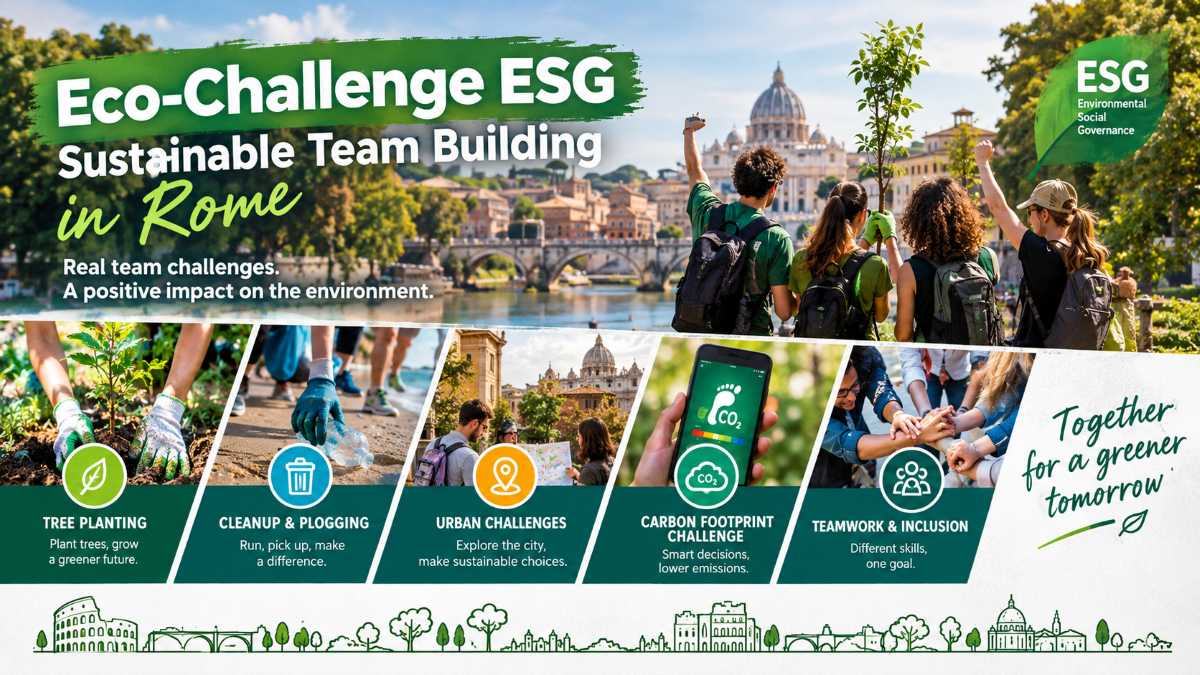
This is where the idea behind the Eco-Challenge ESG comes from: a Team Building format in which collaboration between colleagues turns into a real environmental mission.
This isn’t just about “doing something green”.
The goal is to create an experience where sustainability, play, strategy, movement, and teamwork all come together in the same journey.
In Rome, this concept can take on a particularly interesting dimension: parks, historic villas, green areas, the Tiber, and urban spaces become settings where teams can tackle different missions—from planting to collecting waste, from plogging to challenges around carbon footprint.
The Eco-Challenge can also be linked to the United Nations Sustainable Development Goals, especially those dedicated to sustainable cities, responsible consumption, climate action, and the protection of terrestrial ecosystems.
What is an Eco-Challenge Team Building?
An Eco-Challenge is a corporate activity designed to put people in front of a concrete sustainability-related challenge.
Participants are divided into teams and receive a series of missions.
The special thing is that not all challenges necessarily have to be the same.
One team might handle a small tree-planting activity, another might tackle an environmental cleanup mission, while another might participate in a urban game based on carbon footprint.
So the result isn’t measured only in terms of speed.
Other factors come into play as well:
-
organizational skills;
-
collaboration;
-
resource management;
-
knowledge of the environment;
-
problem-solving;
-
decision-making ability;
-
communication;
-
awareness of the consequences of their choices.
So the game becomes a tool for making visible something that would normally remain abstract.
Every decision produces a consequence.
And that’s exactly the heart of the Eco-Challenge.
Tree planting: building something that lasts
One of the most symbolic activities is planting trees and shrubs.
Imagine a team in front of a green area.
There are no computers, meetings, or presentations.
There are tools, soil, plants, and a mission to complete.
The group must organize itself.
Who prepares the soil?
Who sets the plant in place?
Who checks the distances?
Who takes care of irrigation?
Who coordinates the operations?
The difference from many traditional Team Building activities is clear: here, the outcome doesn’t end when the game ends.
The team’s work can leave behind a tangible element intended to remain in the territory.
In Rome, the topic of urban forestry is particularly timely. Rome City Authority is carrying out tree-enhancement projects and a Green and Nature Plan that also considers the presence of trees and green spaces in relation to biodiversity and the mitigation of heat islands.
For this reason, a corporate planting can be designed—when authorized and carried out with the relevant competent parties—as part of a broader territorial project.
The tree as a metaphor for the team
There is also a strong symbolic component.
A tree grows over time.
So does a work group.
A tree needs the right conditions.
So does a team.
A tree doesn’t live in isolation from the ecosystem.
And neither can a company be considered separate from the territory in which it operates.
Planting therefore becomes a simple but powerful metaphor: what is built together can continue to grow even after the event has ended.
Plogging: when running means taking care of the territory
Another option is plogging, an activity born from the combination of movement and collecting litter.
In Team Building, it can turn into a true team competition.
The group receives gloves, bags, and the materials needed for collection and follows a previously identified route.
But even here, competition can be built in a more sophisticated way.
You don’t necessarily win by simply collecting more waste.
You can assign different points based on the type of materials, proper sorting, collection accuracy, the ability to complete the route, or the quality of information collected.
In this way, the participant isn’t just “the one who collects”.
They become part of a team that must observe, decide, organize, and act.
From the park to the Tiber: Rome as an environmental lab
Rome offers particularly interesting scenarios for building activities of this kind.
An urban park can become a playground.
A stretch along the Tiber can turn into a mission focused on observation and care for the territory.
A historic villa can become the starting point for a challenge on sustainable mobility.
A neighborhood can be transformed into a map where teams must make environmental choices.
So the theme isn’t just about “being outdoors”.
It’s about using the territory as an integral part of the narrative.
A concrete example is the Eco-Challenge on the Tiber, a format dedicated to participatory cleanup, gamification, and environmental awareness.
From this perspective, the river becomes not only a backdrop, but an integral part of the mission.
The same logic can be applied to other outdoor routes, adapting the challenges to the features of the territory and the company’s goals.
The Carbon Footprint Challenge: when decisions become points
The most innovative version of the Eco-Challenge can be built around carbon footprint.
In this case, participants don’t necessarily need to collect materials or plant trees.
They must make decisions.
Each team receives an imaginary company situation.
For example:
“You need to organize a business trip for ten people.”
At that point, choices begin.
Plane or train?
Private car or public transport?
International hotel or local accommodation?
Menu with local products or foods from long supply chains?
Single-use or reusable materials?
Digital event or in-person event?
Each choice changes the team’s environmental score.
The mission then becomes a combination of strategy, economics, sustainability, and problem-solving.
The game makes consequences visible
The strength of this format is above all educational.
Many sustainability-related decisions are normally addressed through documents, reports, or presentations.
During a Carbon Footprint Challenge, however, they become immediately understandable.
The team can discover that a solution that seems more economical can have a greater environmental impact.
Or that a small organizational change can alter the overall result.
So no lesson is simply “delivered”.
A situation is created in which people learn through the consequences of their own decisions.
A true Eco-Challenge must measure impact
One of the most important elements for making an ESG Team Building credible is measurement.
Saying “we did a sustainable activity” isn’t enough.
It’s better to define some indicators upfront.
Tree planting
-
number of trees or shrubs planted;
-
area involved;
-
species used;
-
party responsible for subsequent maintenance.
Environmental cleanup
-
quantity and type of waste collected;
-
area involved;
-
number of participants;
-
methods of disposal.
Plogging
-
kilometers covered;
-
amount of waste collected;
-
number of teams;
-
amount of materials correctly sorted.
Carbon Challenge
-
estimated emissions per scenario;
-
difference between the various strategies;
-
number of sustainable decisions made;
-
theoretical reduction compared to the reference scenario.
In this way, the Team Building also produces a measurable trail of the experience.
ESG: not just the environment
The ESG acronym includes three dimensions:
Environmental, Social, and Governance.
That’s why a well-designed Eco-Challenge shouldn’t stop at the environmental dimension.
The Environmental component relates to the relationship with nature, resources, emissions, biodiversity, and waste.
The Social component comes into play when the activity involves local communities, associations, inclusion, collaboration, and collective responsibility.
The Governance component can instead emerge through the way decisions are made, responsibilities are defined, and results are measured.
This makes the Eco-Challenge particularly interesting also for companies that are developing an internal culture connected to sustainability.
Within the European framework, the European Commission covers corporate sustainability reporting and environmental, social, and governance aspects.
The Team Building naturally doesn’t replace ESG reporting.
However, it can become an experiential tool through which certain values and behaviors linked to corporate sustainability become more understandable.
The social dimension: a group that works for something beyond the group
There’s also another interesting element.
Many Team Building events end with a winner.
The Eco-Challenge can end with a shared result.
Even if teams compete with each other, the environment represents a common goal.
This changes the dynamic.
The colleague who, just minutes earlier, was an opponent can suddenly become someone to collaborate with to solve a problem.
One team can help another.
A decision can become more important than the score.
And competition can make room for collaboration.
This is where one of the most interesting features of ESG Team Building comes to life: the ability to turn an individual challenge into a collective outcome.
For companies also interested in social impact, one already developed example is the Social Treasure Hunt Team Building Solidarity & ESG Impact, which uses challenges, riddles, and gamification to connect group experience with a purpose of solidarity.
Eco-Challenge and inclusion: an activity designed for everyone
Another aspect to consider is accessibility.
An environmental activity doesn’t necessarily have to be based on physical performance.
The team can include different roles:
-
coordinator;
-
observer;
-
map manager;
-
photographer;
-
data collector;
-
materials manager;
-
decision analyst;
-
communicator;
-
hands-on participant.
This makes it possible to build activities in which people with different physical abilities can contribute to the outcome.
The real challenge therefore doesn’t become “who runs faster?”, but how can we use everyone’s skills to reach the goal?
It’s a particularly important principle when the Eco-Challenge is proposed as an inclusive corporate experience.
From Team Building to everyday behavior
The value of an Eco-Challenge shouldn’t end with the event.
One of the most interesting possibilities is to create a small “before and after”.
Before the activity, participants are asked to answer some questions about their habits.
After the experience, the same questions are asked again.
Or you can launch a small corporate micro-challenge:
7 days of sustainable mobility.
One week without single-use plastic.
A company lunch with local supply chains.
A day without the elevator.
A week of mindful waste separation.
In this way, Team Building becomes the starting point for a broader path.
You don’t need to promise major transformations.
It’s enough to create a small connection between what you experienced during the activity and what can be applied in everyday life.
Why does the Eco-Challenge work as Team Building?
The format combines different elements.
Collaboration
No team can correctly complete the mission without distributing tasks and responsibilities.
Communication
Information must be shared quickly.
Leadership
The guiding role can change depending on the situation.
Problem Solving
Teams must respond to unexpected events and constraints.
Responsibility
Every decision produces a consequence.
Environmental awareness
Sustainability isn’t simply explained: it’s experienced.
Emotional involvement
Doing something tangible in the territory can create a different kind of memory than an activity that is purely recreational.
A possible Eco-Challenge day in Rome
A full format could start with a morning briefing.
Teams receive a map and a mission.
First challenge: reach the starting point using a sustainable mobility solution.
Second challenge: tackle an environmental observation challenge.
Third challenge: complete a cleanup or plogging mission.
Fourth challenge: participate in the planting planned by the project.
Fifth challenge: take on a Carbon Footprint Challenge.
Sixth challenge: develop a final strategy.
At the end, the teams meet.
The data is collected.
The results are calculated.
And you discover something interesting: the leaderboard doesn’t just tell you who scored the most points.
It shows which strategies produced the most interesting consequences.
Awards can therefore include different categories:
-
best strategy;
-
best collaboration;
-
best sustainable solution;
-
greater environmental impact;
-
best communication;
-
fair play award.
In this way, the experience values different behaviors.
Rome, the territory, and a new idea of Team Building
Rome is often described through monuments, squares, fountains, and buildings.
But the city also has another dimension.
It’s made of parks, tree-lined streets, riverside routes, green areas, and communities.
An Eco-Challenge lets you observe the Capital from a different perspective.
The park is no longer just a backdrop.
The Tiber is no longer just a view.
The neighborhood is no longer just a place to pass through.
They become part of the mission.
For a company interested in expanding its outdoor experience, it can also be interesting to explore the proposals of Team Building and Incentives in Rome, where the urban and natural environment of the Capital is used as the setting for different experiences.
And perhaps that’s the most interesting feature of the Eco-Challenge ESG Team Building.
It doesn’t simply take a group out of the office.
It brings the group to a situation where collaborating means producing a real outcome.
The final goal isn’t only to win.
It’s learning how to decide together.
Because sustainability, just like Team Building, doesn’t come from the sum of individual actions.
It comes from the ability to move in the same direction.
And when that direction leaves a positive mark on the territory, Team Building takes on a new meaning.
A new frontier: from sustainability to impact
The Eco-Challenge can also be integrated with other ESG formats already available.
One example is Bicycle Thieves – Solidarity Team Building & ESG Impact, where teams collaborate to assemble bicycles destined for a solidarity project.
Another path is MURALS – Social Team Building, Street Art, and ESG, which connects creativity and the revitalization of shared spaces.
In this way, the company can build a real ESG Team Building journey, choosing different experiences but sharing one element: turning people’s collaboration into an activity with a concrete environmental or social dimension.
From Team Building to everyday behavior
At the end of the day, the teams come back together.
The missions are finished.
The results are collected.
People talk about what happened.
Someone looks at the territory.
Perhaps for the first time, they don’t see it only as part of the Roman scenery.
They see it as something that concerns everyone.
And that’s exactly the most interesting result of an Eco-Challenge.
Not just the score.
Not just the leaderboard.
Not just the final photo.
But the awareness that a group can do a lot when it decides to move in the same direction.
A company is made of people.
People make choices.
And choices, even the seemingly small ones, shape how an organization relates to the world.
Maybe the future of Team Building won’t just be about asking:
“How much did we have fun?”
But also:
“What positive thing did we leave behind?”
In Rome, this question can find an answer through an Eco-Challenge.
Because a territory isn’t only the place where an event takes place.
It can become part of the story the group decides to build together.
FAQ – Eco-Challenge and ESG Team Building
1. What is a corporate Eco-Challenge?
It’s a Team Building activity dedicated to sustainability, which can combine games, collaborative missions, orientation, environmental training, and concrete actions designed with partners and competent stakeholders.
2. Can participatory cleanup be organized along the Tiber?
Yes, but it must be designed exclusively in areas and with methods permitted, respecting authorizations, safety, and procedures required by the competent authorities.
3. What skills does this activity develop?
Collaboration, communication, leadership, problem-solving, organization, individual responsibility, and systems thinking.
4. Why is the activity connected to ESG principles?
Because it makes it possible to tackle environmental and social topics concretely, involving people in an experience focused on responsibility, participation, and the relationship with the territory.
5. Can the Eco-Challenge result be measured?
Yes. It’s possible to define indicators related to participation, hours of activity, completed missions, and—when planned for and properly managed—the concrete outcomes of the initiative.
6. Is the Eco-Challenge suitable for international groups as well?
Yes. The format can also be delivered in English or as a multilingual version, and it can include dedicated storytelling about the history of the Tiber and the main POIs in Rome.
If you want to experience this or similar experiences, click here, you’ll find our proposals:
Request a free quote and get all the information about your Team Building experience.
For the phrase “request a quote” you can also use an alternative destination: request a quote.




