











































Roman pizza as a team-building experience: when tradition becomes collaboration
Some experiences begin long before the moment you eat.
They start when you get your hands into the dough, when you choose an ingredient, when someone suggests an idea and someone else turns it into something concrete.
Roman pizza as a Team Building experience is born exactly from this simple insight: turning one of the Capital’s most convivial symbols into an activity that gets people moving, sparks creativity, and fosters collaboration.
In Rome, pizza is not just food. It’s part of everyday life, popular culture, and the urban experience. Tradition includes the thin and crispy round pizza, the pizza in a baking tray, the one “alla pala” (by the slice, cooked on a paddle), and the famous white pizza from the ovens.
For a corporate group, all of this can become far more than just a dinner.
It can become a small team workshop.
From the meeting room to the kitchen: change the space, change the way people collaborate
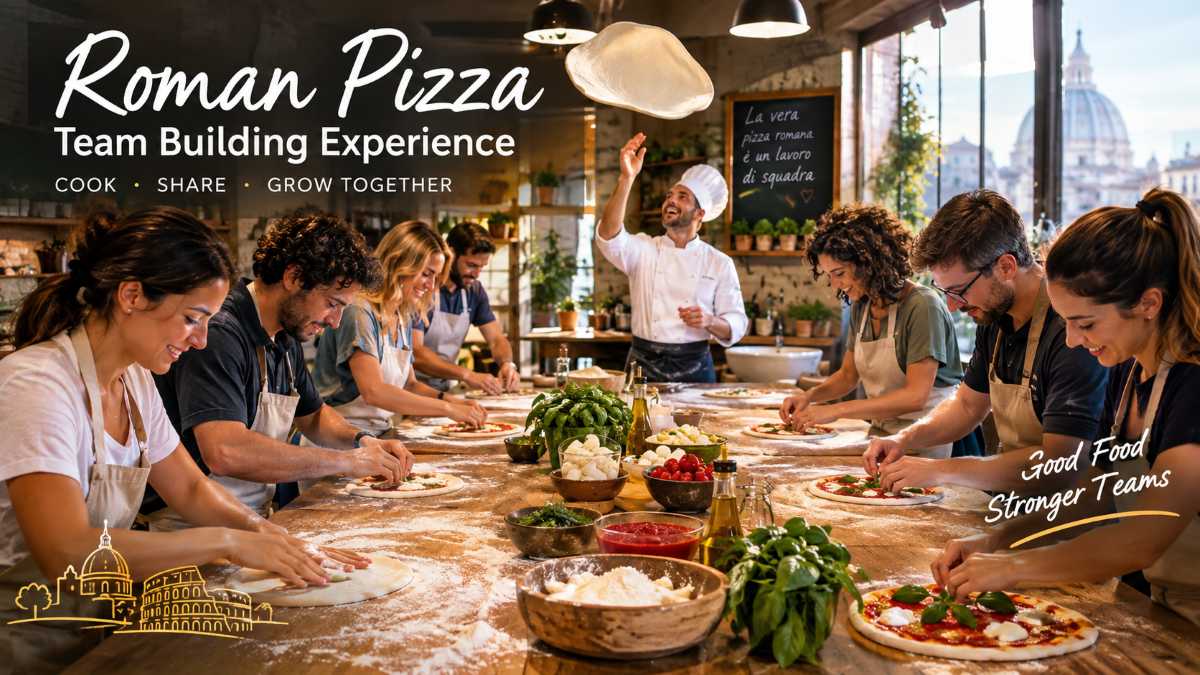
Let’s imagine a group of colleagues arriving at a cooking school in the heart of Rome.
A few minutes earlier, people were talking about goals, budgets, strategies, clients, and deadlines.
Then the rules change.
On the table appear flour, water, tomato, mozzarella, oil, basil, and other ingredients.
The pizzaiolo explains the techniques.
The group listens.
Someone watches closely.
Someone else asks questions.
Then comes the moment when you have to move from theory to practice.
You knead the dough.
You stretch it out.
You top it.
You decide.
And it’s precisely at this moment that the usual relationship between colleagues can turn into something different.
Gastronomic Team Building, in fact, makes it possible to create informal situations where people collaborate without the rigidity of everyday corporate roles.
An approach in line with the experiences of cooking class and culinary team building in Rome offered by Team Building Rome, where the kitchen becomes a tool to encourage interaction, creativity, and sharing.
Why Roman pizza, specifically?
Roman pizza has a particularly interesting feature for a business activity: it’s immediate.
You don’t need everyone to be an expert in cooking.
You don’t need any specific technical skills.
The preparation, instead, creates a sequence of small gestures and decisions that everyone can easily understand.
Roman round pizza, traditionally thin and crispy, is today the star of a true gastronomic rediscovery. In fact, various specialized sources describe the return of the “romana” as one of the most interesting trends on the contemporary pizza scene.
But for a team-building activity, the value isn’t only gastronomic.
It’s experiential.
A pizza can become a small project.
And every project needs:
-
a goal;
-
a sequence of activities;
-
a distribution of tasks;
-
time management;
-
effective communication;
-
a shared choice;
-
a final result.
In other words, the same ingredients we find in many corporate projects.
Only here, the final result can also be tasted.
One pizza, many roles: the value of teamwork
From kneading to baking
One of the most interesting features of the pizza experience is that it lets you observe the group as it tackles a complete process.
First comes the dough.
Then the working of the dough.
Next comes stretching it out.
Then comes the choice of toppings.
Finally, baking and the tasting moment.
Each phase can become an opportunity for collaboration.
Those with more manual skill can handle stretching.
Those who like to organize can coordinate the ingredients.
Those who are creative can suggest a pairing.
Those who pay closer attention can manage the timing.
There isn’t necessarily a role that’s better than the others.
What matters is the need to make all roles work together.
Communication becomes concrete
At the office we often talk about effective communication in abstract terms.
In the kitchen, however, communication becomes immediately visible.
“How much tomato do we add?”
“Who prepares the ingredients?”
“Do we divide this pizza or do we make individual ones?”
“How much time is left?”
“Is this combination better, or that one?”
These are simple questions, but they represent a fundamental dynamic: listening, proposing, discussing, and deciding.
The final outcome depends on the quality of the interactions.
Creativity enters the kitchen
A pizza can follow tradition or become a creative exercise.
And it’s precisely here that pizza team building can turn into a real challenge.
Each team can receive the same basic ingredients and the task of creating an original pizza.
The challenge can be built around a theme.
The pizza that tells Rome
Each team must create a pizza inspired by the Capital.
The result may recall the flavors of Roman cuisine, the city’s neighborhoods, or simply a memory experienced in Rome.
The corporate pizza
The team must invent a pizza that represents the company’s identity.
A name.
An image.
A combination of ingredients.
A short story.
So the pizza becomes a metaphor for the brand.
The Mystery Pizza
The ingredients are presented without fully revealing the final result.
Teams must observe, reason, and build a recipe.
It’s a simple format that also introduces a problem-solving component.
The Pizza Challenge
Teams work at the same time and, at the end, present their creation.
This doesn’t necessarily mean turning the activity into an exaggerated competition.
The goal can mainly be to create a moment of participation, irony, and discussion.
Rome becomes part of the experience
One advantage of organizing culinary team building in Rome is the opportunity to connect the kitchen to the city.
In fact, pizza can become a starting point for telling the story of Roman food culture.
The route can be paired with an experience in the historic center, a food walk, or an activity dedicated to discovering the Capital’s flavors.
Rome offers many neighborhoods where food tradition is particularly present.
Trastevere, Testaccio, San Lorenzo, Pigneto, and Ostiense are also highlighted by the official Rome tourism portal among the areas linked to food culture and the life of local venues.
This allows you to build hybrid formats.
A cooking class can be preceded by a Urban Game in the center of Rome.
A tasting can be included within a food treasure hunt in Rome.
Dinner can become the concluding moment of a more varied business day.
In this way, pizza represents not only the activity.
It becomes one stop within a bigger story.
Roman pizza and food culture: a true Italian Experience
For an international group, a pizza experience can take on an even more interesting meaning.
This isn’t just about learning how to prepare a dish.
You connect with a part of Italian culture through hands-on activity.
The act of kneading the dough.
Choosing the ingredients.
The relationship with the oven.
The convivial moment.
The way people come together around a table.
These are all elements that help create what today is often called an Italian Experience.
And Rome provides a particularly effective setting.
The group can enjoy the cooking class after a day spent between the Colosseum and the Roman Forum, or combine the activity with a visit to the historic center, a treasure hunt, or an aperitivo.
So the gastronomic experience becomes part of the destination itself.
From pizza to the team: what the experience can develop
A cooking experience doesn’t replace a structured training path, but it can create many useful situations for observing and stimulating group dynamics.
Collaboration
Preparing pizza together means coordinating different actions toward a common result.
Communication
Decisions must be shared quickly and in a way everyone can understand.
Creativity
Ingredients become raw material for inventing new combinations.
Problem solving
Dough that doesn’t turn out as expected, or a choice that needs to be changed at the last moment, become small problems to solve.
Time management
The preparation must follow different phases and timelines.
Spontaneous leadership
During the activity, people capable of organizing, coordinating, or involving others may naturally emerge.
Sharing
The result doesn’t stay individual: tasting creates a collective moment.
PIZZA FUN: pizza becomes Team Building
Within the proposals of Team Building Rome, the format PIZZA FUN – Pizza Making Team Building in the heart of Rome is born exactly from the idea of turning pizza preparation into a corporate experience.
The format is designed for groups of up to 45 people at the cooking school in the historic center, with the possibility of identifying alternative locations for larger groups. Participants are guided by professional chefs in preparing the dough, stretching it out, choosing ingredients, and baking it.
The experience can also be personalized by combining cooking class, aperitivo, music, tasting, and convivial moments.
For larger groups, it can also be interesting to consider PIZZA ACROBATICA, a format that combines pizza preparation, team activities, and a show by acrobatic pizzaioli. The program listed on the site is designed for groups from 50 to 300 participants.
In this case, the kitchen meets entertainment.
The pizza isn’t just prepared.
It’s put on display.
A corporate dinner that becomes an experience
The difference between a normal corporate dinner and a pizza experience is mainly the level of participation.
During a traditional dinner, the group arrives, sits down, and chats.
During a culinary Team Building activity, the group creates something before even eating it.
This completely changes the dynamic.
People move.
They compare notes.
They laugh.
They try.
They make mistakes.
We start again.
And in the end, they sit together in front of the result of their work.
It’s a simple but important step:
from diners to protagonists.
And it’s exactly this transformation that makes pizza such an interesting tool for building corporate experiences.
When to organize a Pizza Team Building in Rome
The pizza experience can be included in many moments of the corporate calendar.
End-of-year Team Building
An informal way to close out the year and celebrate the work you’ve done together.
Corporate Kick-Off
After a day of meetings, the kitchen can become the moment dedicated to socializing and building the new team spirit.
Incentives in Rome
For Italian and international groups, pizza helps connect food, culture, and the destination.
Welcome event
A simple, immediate activity to encourage people to get to know each other, especially those who haven’t worked together yet.
Interactive corporate dinner
When the goal is to turn a normal dinner into a more participatory experience.
The formula can also be integrated with other Team Building in Rome proposals, building a program made up of multiple experiences.
The real secret ingredient? The group
In the end, pizza is only the starting point.
The most important ingredient is always the group.
The flour can be perfect.
The tomato can be excellent.
The mozzarella can be high quality.
The oven can reach the ideal temperature.
But if people don’t communicate, don’t collaborate, and don’t share decisions, the outcome can be completely different.
And that’s exactly why Roman pizza as Team Building works so well as a metaphor.
A good pizza is born from balance.
A good team is too.
A pizza requires time, technique, and attention.
A team requires trust, communication, and listening.
A pizza becomes something more when ingredients are combined the right way.
And a group of people can become something more than the simple sum of its parts when it learns to work together.
In Rome, all of this can happen around a table, with hands in the flour and the smell of pizza fresh from the oven.
Because sometimes the simplest way to talk about collaboration is simply getting together to do something.
If you want to experience this or something similar, click here—you’ll find our proposals:
Request a free quote and receive all the information about your Team Building experience.
Request a free quote and receive all the information about your Team Building experience.




