

























The Cuisine of Ancient Rome: recipes from the past with ingredients and techniques from the De Re Coquinaria
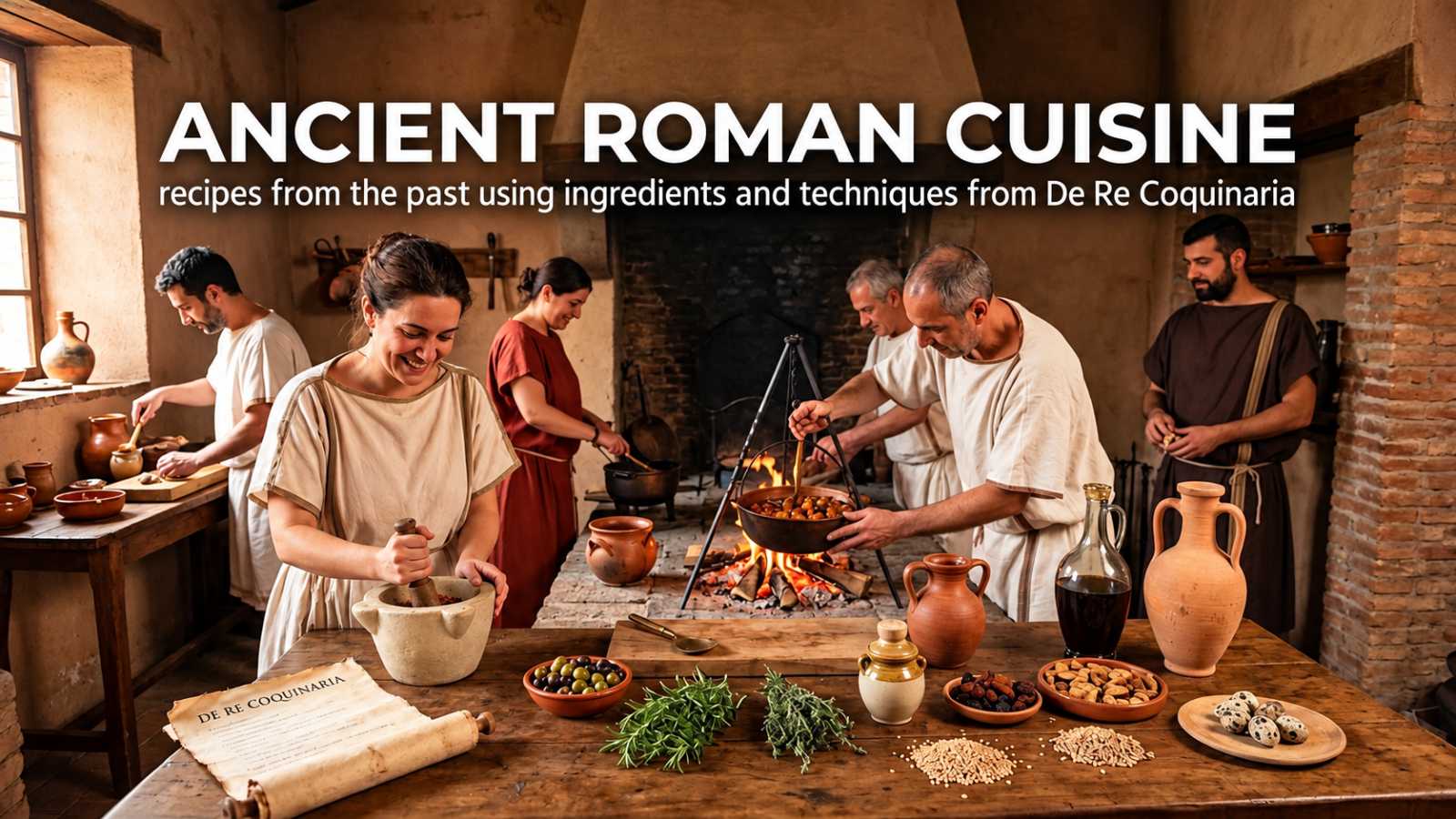
Let’s imagine a Roman kitchen from almost two thousand years ago.
On the table there are no digital scales, refrigerators, stand mixers, or recipe books with step-by-step photos. There are stone mortars, amphorae, knives, pots, spices, aromatic herbs, wine, honey, olive oil, and ingredients that we recognize only in part today.
A cook takes some dates, adds pepper, vinegar, honey, and a fish sauce. Then they pound everything in the mortar.
They’re not following a modern recipe.
They are working according to a culinary logic described in the De re coquinaria, the most important collection of recipes from ancient Roman cuisine that has come down to us, traditionally associated with Apicius. However, the work in the form preserved is the result of a more complex and later tradition than the figure of Marcus Gavius Apicius, who lived in the 1st century AD (Wikipedia)
And it is precisely this time gap that makes the experience especially interesting for a Team Building.
Because recreating a Roman recipe doesn’t simply mean cooking.
It means interpreting.
Experimenting.
Communicating.
Dividing up tasks.
And turning an ancient text into a contemporary experience.
When history enters the kitchen
The cuisine of ancient Rome was much more complex than the stereotypical image of a Roman banquet suggests.
Sources describe a food culture in which eating could have a strong social and spectacular component. In the grand banquets of the elites, dinner was organized in several stages and could include appetizers, main courses, and desserts, with sought-after ingredients and elaborate preparations. (The Metropolitan Museum of Art)
The De re coquinaria represents a privileged window into this world.
The work gathers recipes dedicated to vegetables, legumes, meats, fish, fruit, sauces, and preparations that are very different from one another. It is not simply a recipe book in the modern sense: it is also a testimony to the material culture, tastes, and culinary techniques of a society far removed in time.
And that is exactly where the format The Cuisine of Ancient Rome begins.
An experience in which the group doesn’t just talk about history.
The kitchen becomes the laboratory through which to rediscover it.
From the De re coquinaria to the table: how the experience is created
An ancient recipe book becomes a team challenge
One of the most fascinating features of recipes attributed to the Apician tradition is their essential simplicity.
The instructions can be extremely concise.
Pound.
Stir.
Add.
Boil.
Strain.
Reduce.
Bind.
Serve.
For a contemporary cook used to precise quantities, temperatures indicated to the degree, and strict cooking times, this language presents a small challenge.
And that’s exactly where Team Building comes in.
Participants receive a historical recipe and must turn it into a clear, shared process.
Who interprets the text?
Who prepares the ingredients?
Who works with the mortar?
Who monitors the cooking?
Who tastes?
Who coordinates the group?
So the kitchen becomes a small miniature business organization.
Ingredients of Ancient Roman cuisine
Garum, honey, wine, vinegar, and spices: a surprising balance
One of the aspects that most strikes you when studying Roman cuisine is the use of ingredients we today associate with very different preparations.
Garum, or liquamen, was a sauce made from fermented fish used as a condiment and found in numerous preparations. Ancient sources show how important it was in Roman gastronomy. (Penelope)
Alongside garum, we often find:
-
olive oil;
-
wine;
-
vinegar;
-
honey;
-
pepper;
-
cumin;
-
coriander;
-
mint;
-
rue;
-
lovage;
-
dates;
-
fruit;
-
aromatic herbs;
-
cooked grape must or reduced must, indicated as defrutum in various recipes.
The result is a cuisine in which the line between sweet, savory, sour, and spicy can become much thinner than modern habits suggest.
Roman taste isn’t simply “ancient”
It’s a mistake to imagine that a historical reconstruction must necessarily produce dishes with a strange or unappetizing flavor.
Many recipes can be reinterpreted using contemporary ingredients compatible with those documented, while still keeping the original logic of the preparation.
The result becomes a kind of dialogue between past and present.
The techniques of the De re coquinaria
The mortar as a precision tool
One of the most representative images of Roman cuisine is that of the mortar.
Pounding doesn’t simply mean chopping.
It means extracting aromas, creating emulsions, combining ingredients, and turning different elements into a single sauce.
In recipes from the De re coquinaria, you often find indications that call for pounding pepper, herbs, spices, and other ingredients before adding liquids such as wine, vinegar, honey, or liquamen. (Penelope)
During a Team Building activity, this step becomes particularly interesting.
The result depends on the work of everyone.
One person can focus on the spices.
Another can measure the liquids.
Another can check the consistency.
The recipe is no longer just a text.
It becomes a process.
A lesson in collaboration born two thousand years ago
Roman cuisine offers an extremely current metaphor.
A good result doesn’t necessarily come from the sum of people working simultaneously.
It comes from the ability to coordinate different contributions.
So the mortar becomes a small symbol of teamwork.
Different ingredients.
Different roles.
One single result.
A Roman recipe to reinterpret together
Patina de piris: when fruit meets pepper and honey
Among the most curious preparations in the De re coquinaria we find the patina de piris, a dish based on pears in which ingredients such as pepper, cumin, honey, passito wine, liquamen, oil, and eggs appear. The recipe is traditionally interpreted as a kind of baked preparation, somewhere between a sweet and savory dish. (coquinaria.nl)
It is precisely this type of recipe that helps you understand how different the perception of taste was in antiquity.
The pear isn’t treated simply as dessert.
Honey isn’t necessarily associated with pastry.
Pepper isn’t exclusively meant for savory dishes.
The ingredients are combined to create a complex balance.
The recipe becomes a creative test
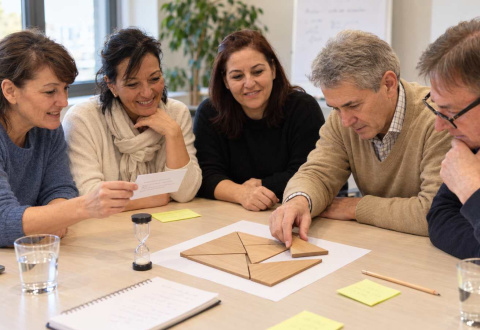
During the Team Building, a team may receive a simplified version of the recipe and work on reinterpreting it.
A second group can handle the sauce.
A third group can study the ingredients.
A fourth group can take care of presentation.
In the end, all teams compare their results.
This isn’t necessarily about declaring a winner.
The goal can be to understand how different people can interpret the same starting point, producing different outcomes.
From garum to defrutum: the vocabulary of Roman cuisine
Learning a new language through food
One of the most fun elements of the experience is discovering the Roman culinary vocabulary.
Garum.
Liquamen.
Defrutum.
Passum.
Patina.
Mortarium.
Each term tells part of the gastronomic culture of the time.
Defrutum, for example, was associated with grape must concentrated through reduction. In many recipes, its role was to add intensity and a sweet component.
Passum, on the other hand, referred to a sweet wine used in various preparations.
The result is a cuisine in which wine is not only a drink served with a meal, but can become a real ingredient.
When the team has to translate the past
A particularly interesting activity is to give participants a simplified version of a recipe, leaving the group the task of turning it into a real contemporary cooking sheet.
So they must:
-
identify the ingredients;
-
understand the techniques;
-
reconstruct the quantities;
-
divide up tasks;
-
set a sequence;
-
verify the result;
-
present the dish.
In other words, they must turn incomplete information into a concrete result.
A dynamic very close to many professional situations.
Rome as a historical laboratory
From the historic center to the places of the ancient city
Organizing a cooking experience dedicated to ancient Rome means being able to create an event in which cuisine speaks to the city.
The program can be linked to a cultural itinerary through some of the Capital’s main POIs.
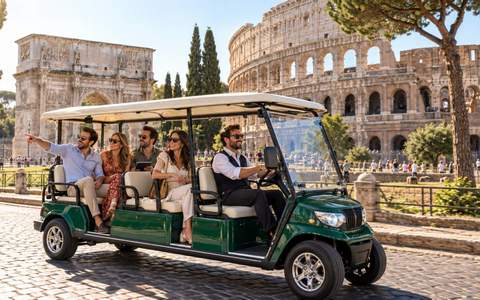
You can start at the Roman Forum, cross the area of the Imperial Fora, reach the Capitoline Hill, and continue toward the historic center.
Another possible reference point is the Capitoline Museums system, part of the Museums System of Rome Capitale. (Musei in Comune Roma)
For an experience more closely tied to everyday life in ancient Rome, the Crypta Balbi is also particularly interesting; today it is part of the National Roman Museum: the site preserves traces of an ancient Roman neighborhood where there were homes, workshops, a bakery, and other spaces connected to everyday life. (Museo Nazionale Romano)
Another itinerary: the Via Appia Antica
The Via Appia Antica offers a completely different setting.
Here, the archaeological landscape makes it possible to build an experience in which cuisine can be connected to the history of the territory.
An interesting cultural precedent is provided by initiatives dedicated to Roman food organized by the Parco Archeologico dell’Appia Antica, where tastings of historical reconstructions were proposed, also based on the writings of Cato, Varro, Apicius, and Columella. (Parco Appia Antica)
So, cuisine isn’t simply added to the visit.
It becomes a key for interpreting the past.
The Cuisine of Ancient Rome as a Team Building
From the recipe to teamwork
The value of the experience isn’t only gastronomic.
A historical cooking experience makes it possible to work simultaneously on different skills.
Communication
Every recipe requires clear information.
If someone misinterprets a step, the entire process can change.
Collaboration
Preparation must be divided into complementary activities.
No one can do everything alone.
Problem solving
Ancient recipes don’t always provide all the information we’re used to today.
So the group has to find solutions.
Creativity
Reinterpretation allows you to compare different approaches and find new ways of presenting the dish.
Shared leadership
Depending on the phase of the activity, different people can take over coordination.
Listening
An effective kitchen requires paying attention to the instructions of others.
Time management
The sequence of operations can be decisive.
A sauce prepared too early or cooking started late can change the final result.
From the past to a contemporary cooking experience
Not just a cooking lesson
The format can be built by taking inspiration from experiences such as Cooking Team Building in Rome, like Mani in Pasta or Pizza Fun, adapting their collaborative logic to a path dedicated to ancient Roman gastronomy. (Teambuilding Rome)
The difference lies in the story.
It’s not just about preparing a dish.
You start from a historical source.
You discover the ingredients.
You understand the techniques.
You reconstruct the preparation.
And finally, you taste.
It is this step that turns a cooking class into a true cultural experience.
A corporate day among archaeology, cooking, and conviviality
An ideal format for meetings, incentives, and conventions
The Cuisine of Ancient Rome can be included within a broader corporate program.
Morning
Meetings or conventions in a location in the center of Rome.
Cultural break
Guided walk among the main places of ancient Rome.
Afternoon
Workshop dedicated to the De re coquinaria and division of participants into teams.
Laboratory
Preparing recipes, studying ingredients, and experimenting with techniques.
Finale
Presentation of the dishes and shared tasting.
The program can be completed with other food-related activities included in the offer of Team Building Rome, creating a day in which culture, cooking, and collaboration become parts of the same story.
Why rediscover Roman cuisine through a Team Building?
Because food has a characteristic that few other tools possess.
It’s immediate.
It doesn’t necessarily require specialized skills.
It allows people to talk.
To observe.
To experiment.
To make mistakes.
To laugh.
And above all, to build something together.
The cuisine of ancient Rome adds one more element: curiosity.
When faced with a recipe from the De re coquinaria, the participant doesn’t exactly know what the result will be.
They must interpret.
Just as happens very often at work too.
Ancient Rome comes back to the table
In the end, when participants sit around the same table, something interesting happens.
The distance between past and present shrinks.
An ancient ingredient has become a sauce.
A Latin recipe has become a dish.
A group of colleagues has become a cooking brigade.
And a page of history has become a shared experience.
Maybe that’s the most interesting value of The Cuisine of Ancient Rome.
Don’t just tell about Rome.
But let people taste it through its history.
FAQ – The Cuisine of Ancient Rome
Is it necessary to know how to cook?
No. The experience can also be designed for participants with no cooking experience at all, with chefs or tutors guiding the group.
Are the recipes really taken from the De re coquinaria?
The format can use documented recipes and techniques from the tradition of the De re coquinaria, reinterpreting them in a contemporary way. It’s important to distinguish the historical source from the modern reconstruction of the recipe.
Can it be organized in Rome?
Yes. The format can be included in corporate programs in the historic center or combined with cultural and archaeological itineraries.
Is it suitable for international groups?
Yes. The theme of Roman cuisine can be easily presented also in English and turned into an experience suitable for international teams.
Is it possible to pair it with a cultural visit?
Yes. It can be integrated with itineraries dedicated to ancient Rome, museums, archaeological sites, and routes through the historic center.
Can it be customized for a company?
Yes. The structure can be adapted to the number of participants, the duration of the event, the location, and the group’s objectives.
If you want to live this experience or something similar, click here, you’ll find our proposals:
Request a free quote and get all the information about your Team Building experience.
To organize a tailored experience you can also request a quote by indicating number of participants, period, location, and event objectives.