











































Team Building in a nutshell: when you only have 1 hour available
One hour.
Sixty minutes.
At first glance, that doesn’t seem like enough time to organize a real Team Building.
But let’s change perspective.
Let’s imagine a corporate team that has just finished a meeting. The room is still full of slides, computers, and notes. Between one appointment and the next, there are only sixty minutes before an aperitif, dinner, or the transfer to another venue.
The risk is thinking there isn’t enough time to do something together.
Actually, it’s exactly in situations like this that a new idea of Team Building is born: short, intense, immediate activities designed to produce a concrete experience in a short time.
You don’t necessarily need three hours.
You don’t always have to cross Rome.
You don’t have to build a big competition.
Sometimes, a well-designed challenge, a clear goal, and a group ready to get involved are enough.
Team Building in 1 hour: less time, more focus
Duration is only one of the elements that define a Team Building activity.
A sixty-minute experience can be very effective when it eliminates downtime and focuses attention on a few core dynamics:
-
communication;
-
collaboration;
-
creativity;
-
listening;
-
problem solving;
-
coordination;
-
decision making;
-
ability to work under pressure.
The secret is in the design.
A short activity can’t afford a long introduction, complex transfers, or rules that are hard to understand.
The group must get into the dynamic quickly.
The first 10 minutes are decisive
In a one-hour format, the briefing must be simple.
The teams receive the goal, understand the rules, and start almost immediately.
This doesn’t mean sacrificing quality.
On the contrary.
It means designing every phase so it serves a precise purpose.
A good 60-minute activity could be structured like this:
0–10 minutes: briefing and team division.
10–40 minutes: main challenge.
40–50 minutes: finale or final test.
50–60 minutes: comparison, awards, or debriefing.
This structure can naturally be adapted based on the group and the venue.
Why choose a short Team Building?
When corporate time is already packed
The corporate world is often made up of very dense schedules.
Meetings.
Conventions.
Presentations.
Workshops.
Calls.
Dinners.
Transfers.
Incentives.
So adding a Team Building activity means finding a moment that doesn’t compromise the entire program.
A short format can be especially useful for this very reason.
It can be placed:
-
before a dinner;
-
during a meeting break;
-
at the end of a convention;
-
during a kickoff;
-
within an incentive program;
-
between two training sessions;
-
as an opening activity;
-
as a closing activity.
The real question no longer becomes:
“Do we have enough time?”
But:
“What experience can we build with the time we have?”
60-minute activities: the power of simplicity
1. Team Beat: creating harmony in a few minutes
A particularly interesting example is TEAM BEAT, the music workshop where participants work on rhythm, coordination, and listening.
The strength of a music activity is immediacy.
You don’t need to spend half an hour explaining how collaboration works.
The group experiences it directly.
A percussionist introduces a rhythm.
One person responds.
Another adds a sound.
Step by step, the group must synchronize.
The corporate metaphor becomes clear without the need for long explanations.
If everyone follows only their own rhythm, the result is confused.
When, instead, people learn to listen to each other, a shared rhythm emerges.
An ideal dynamic for an hour
TEAM BEAT can be a great example of a short activity because the experience can focus immediately on interaction between participants.
The group doesn’t need to learn to become musicians.
It needs to learn how to function together.
And it’s precisely this immediacy that makes music an interesting tool for a focused Team Building.
2. A photographic challenge: telling Rome in a few shots
When the venue is the historic center, even a photography activity can be turned into a short experience.
The concept of Rome in One Shot allows you to transform the city into a set through photography, creativity, interpretation, and storytelling.
For a one-hour format, you can imagine a concentrated version.
A mission.
Few stops.
A limited number of trials.
One big final challenge.
Piazza Navona as a set
Let’s imagine three teams receiving a mission near Piazza Navona.
They must create a photograph capable of conveying a corporate word:
Trust.
Innovation.
Leadership.
Teamwork.
They have only a few minutes to decide:
who interprets;
who takes the photos;
who directs;
which point in the square to use;
how to build the scene.
In this case, Rome isn’t just the backdrop.
It becomes part of the challenge.
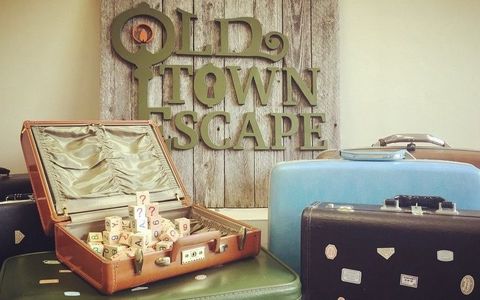
3. Escape Museum: when time becomes part of the game
Another possibility is working on the logic of puzzles.
The Escape Museum uses the Leonardo da Vinci space in the center of Rome as the setting for a challenge based on clues, codes, observation, and problem solving.
It’s an interesting example because time can become an integral part of the experience.
When a team knows it has a limited window of time, it also changes the way it communicates.
Information must be shared quickly.
Someone has to make decisions.
Someone else must verify the clues.
One participant may see a solution that the others haven’t noticed.
Sixty minutes, sixty decisions
The value of a short activity isn’t necessarily in the number of trials.
It lies in the quality of the decisions.
A team that has to solve a problem in a short time immediately experiences:
-
priorities;
-
information management;
-
listening;
-
delegation;
-
leadership;
-
time pressure;
-
coordination.
They are all dynamics that can show up in professional life as well.
4. Problem Solving: one mission, one hour, one solution
Not all short activities have to be set in the historic center.
A meeting room can become a problem-solving lab.
The group receives a mission.
They have materials, information, and constraints.
They must find a solution.
An activity like Escape from the Labyrinth, for example, works on the combination of game play, problem solving, and collaboration.
In a shorter version, the logic can be turned into a micro-challenge:
you have a goal, you have some resources, and you have limited time.
The solution must be built together.
Difficulty isn’t always the problem
Often, the real obstacle is the organization of the group.
Who speaks?
Who listens?
Who takes notes?
Who suggests?
Who checks?
Who decides?
In a one-hour activity, these behaviors emerge quickly.
5. Villa Borghese: when 60 minutes become a micro-adventure
A short activity can also be outdoors.
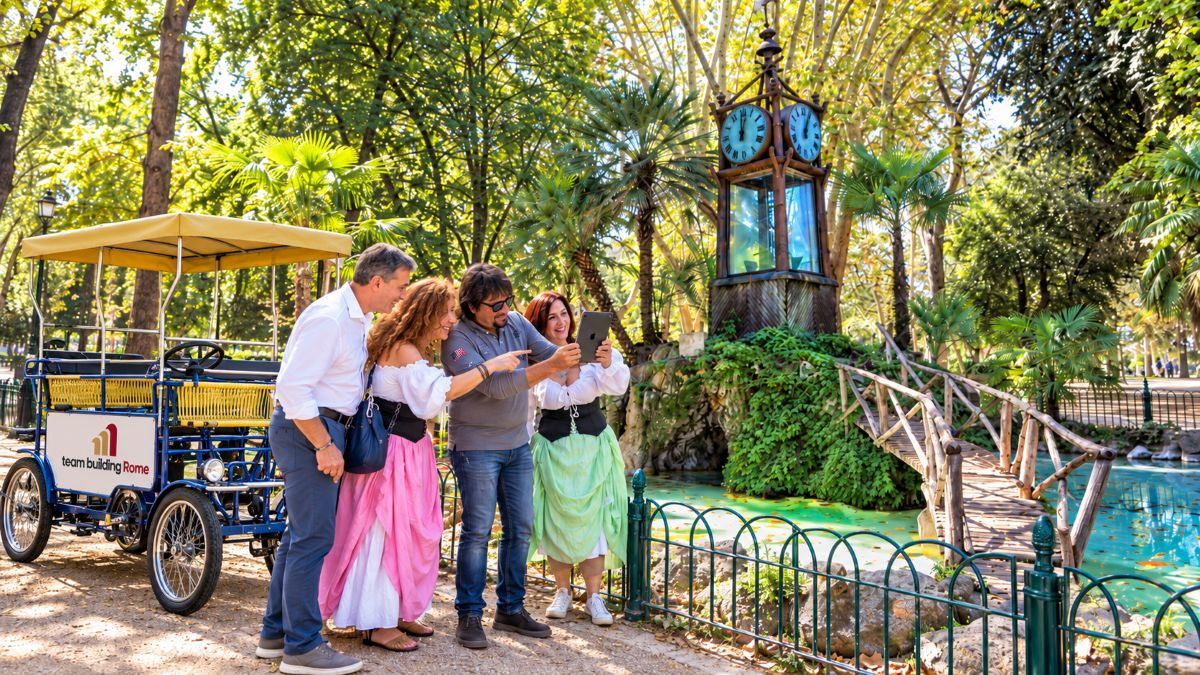
In the case of Without Brakes, Villa Borghese becomes the setting for an experience based on orientation, strategy, and collaboration.
The venue is an important element.
In a city like Rome, in fact, it’s not always necessary to build an extremely long route.
Sometimes it’s enough to choose a specific area and turn it into a playing field.
A park like a giant chessboard
Let’s imagine dividing the participants into small teams.
Each group receives a map.
Some points become checkpoints.
Each checkpoint contains a small challenge.
The team must decide which route to follow.
Time is ticking.
Information must be shared.
One person may have the map.
Another may handle the challenges.
Another still can keep track of time.
In less than an hour, the park becomes a small city to interpret strategically.
Team Building Express: it’s not a “poor” version
A short duration requires more precision
One risk with a one-hour Team Building is considering it simply a shortened version of a longer activity.
It shouldn’t be like that.
A good short format must be designed from the start to last a short time.
The difference is substantial.
You don’t take a three-hour activity and cut it.
You build an experience in which every minute has a role.
The briefing
It must be understandable.
The challenge
It must start quickly.
The pace
It must keep attention high.
The finale
It must arrive with a clear conclusion.
The debriefing
It must turn what happened during the game into a reflection on teamwork.
The debriefing: ten minutes that can change the meaning of the activity
In a short Team Building, you might be tempted to skip the final moment.
That’s a mistake.
The debriefing helps turn a game into a conscious experience.
After the challenge, the facilitator can ask a few questions:
What worked?
The group identifies effective strategies.
Where did you waste time?
The team analyzes the moments of difficulty.
Who took the lead?
Different roles are observed.
Did you listen to all ideas?
Communication is reflected on.
What would you have done differently?
The game becomes a learning opportunity.
Just a few minutes are enough, but their value can be significant.
The one-hour Team Building for meetings and conventions
A break that becomes an experience
Let’s imagine a convention organized in a hotel in central Rome.
The morning is dedicated to corporate content.
After lunch, there’s a plenary session.
Before dinner, there’s one hour left.
Instead of leaving that time empty, it can be turned into a connection moment.
A micro musical challenge.
An urban game.
A creativity game.
An improvisation workshop.
A photography activity.
An escape experience.
The choice depends on the group profile.
For a creative team, an activity based on imagination can work.
For an international group, a format that’s strongly visual can be useful.
For a large convention, a musical experience can be interesting.
For a group that needs to work on collaboration, a strategic game may be more suitable.
The advantage of short Team Building for international groups
Rome continuously hosts companies from different countries.
For these groups, the reduced duration can be especially interesting.
A 60-minute activity is easy to fit into a broader incentive program.
And many formats can be created with simple, visual, international communication.
One example is TEAM BEAT: rhythm doesn’t need to be continuously translated.
Another example is Rome in One Shot: images, places, and missions can become a shared language.
The result is an experience that’s accessible even when the group includes people with different languages and cultures.
Rome’s POIs become part of Team Building
You don’t need to cross the whole city
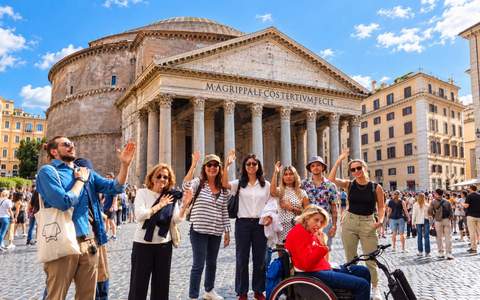
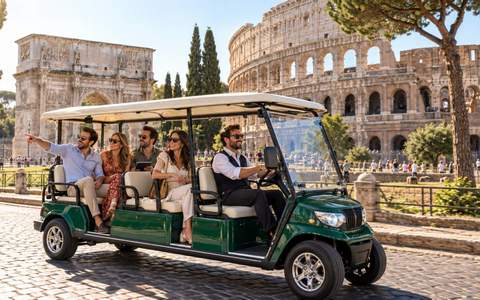
One of the most interesting aspects of Rome is the density of meaningful places.
In just a few minutes, you can find yourself in front of a historic square, a fountain, a Renaissance palace, or an archaeological area.
This makes it possible to plan short activities without giving up the cultural component.
Among the possible POIs to use as a narrative context, we find:
-
Piazza Navona;
-
the Pantheon;
-
Campo de’ Fiori;
-
Trevi Fountain;
-
Spanish Steps;
-
Villa Borghese;
-
Piazza Venezia;
-
Roman Forum;
-
Area of the Imperial Forums;
-
Castel Sant’Angelo.
However, it’s not necessary to visit all these places.
For a one-hour Team Building, the quality of the mission matters more than the number of monuments crossed.
60 minutes, a precise goal
The concept of Team Building in a nutshell comes from a very simple question:
how much can happen in an hour?
The answer is: a lot, if the experience is well designed.
In sixty minutes, a group can:
-
create a performance;
-
solve a riddle;
-
create a story;
-
complete a mission;
-
go through a small urban route;
-
build an object;
-
make decisions under pressure;
-
collaborate to achieve a shared goal.
Duration doesn’t necessarily determine intensity.
It’s the structure of the experience that does.
Team Building in a nutshell: the new frontier of short corporate activities
The world of corporate events is becoming increasingly flexible.
Not all teams can dedicate half a day to an activity.
Not all events need a long program.
Sometimes, the best moment to work on the team is exactly a small window between two commitments.
One hour can be enough to break the routine, recharge energy, build connections, and bring people back to work with a different perspective.
So the real challenge isn’t finding a Team Building that lasts one hour.
It’s finding a Team Building that makes good use of that hour.
And Rome, with its museums, squares, parks, historic buildings, and endless narrative possibilities, can become the ideal lab to do just that.
FAQ – Team Building in 1 hour
Is it really possible to organize a one-hour Team Building?
Yes. The key is choosing a format designed to be immediate, with a short briefing, a well-defined central activity, and a quick conclusion.
Which activity should you choose for one hour?
It depends on the goal. For music and coordination, TEAM BEAT can be a good choice; for creativity and Rome in One Shot; for puzzles and problem solving, Escape Museum; for strategy and movement, outdoor formats can be considered.
Is one hour enough for a large group?
It can be, especially for activities that allow many people to be involved at the same time. However, the design must take into account the number of participants and logistics.
Is it possible to organize the Team Building directly in a hotel?
Yes. Many indoor formats can be designed directly in the meeting room or in a space within the venue hosting the event.
Can you organize a short Team Building in English?
Yes. For international groups, it’s possible to choose activities based on music, images, movement, puzzles, and simple communication.
Can a one-hour Team Building be included in a convention?
Yes. It’s one of the contexts where a short format can be especially useful—for example, between a work session and an aperitif or dinner.
If you want to experience this or similar ones, click here; you’ll find our proposals:
Request a free quote and receive all the information about your Team Building experience.
To build a one-hour activity tailored to the number of participants, the venue, and the event goals, you can also request a quote.




