











































Top 10 Historic Roman Trattorias Where to Organize a Team Dinner
In Rome, there are dinners that start when you sit down at the table, and others that begin much earlier—passing through a neighborhood, a square, an alley, or a monument.
For a company, choosing a historic Roman trattoria for a team dinner therefore means doing more than simply booking a restaurant. It means bringing colleagues, managers, clients, or international guests into an authentic part of the city—turning a shared moment into an experience capable of telling Rome through its food, architecture, and the stories of the people.
Roman cuisine has a particularly interesting characteristic for the corporate world: it is convivial. Carbonara, amatriciana, gricia, cacio e pepe, lamb (abbacchio), artichokes, tripe, and quinto quarto all belong to a tradition born around the table and sharing.
And it is sharing that is one of the key elements of a well-designed corporate dinner.
In this selection, we’ve gathered 10 historic Roman trattorias and restaurants that can become a starting point for an evening with the company, a team dinner, an incentive, or a corporate event in Rome.
Why choose a historic Roman trattoria for a corporate dinner
A group dinner in a traditional trattoria can have a completely different value than a simple dinner in a contemporary restaurant.
The difference isn’t just on the menu.
It’s in the history of the place.
It’s in the details of the dining room.
It’s in the neighborhood.
It’s in the ability to tell participants why that restaurant exists right there—and what relationship it has built over the years with the city.
A dinner in Testaccio, for example, can become an opportunity to talk about the neighborhood’s popular and culinary history; a dinner in the Jewish Ghetto can be included in a route dedicated to Jewish-Roman cuisine; while an evening near the Pantheon makes it possible to combine gastronomy and the historic center.
In this way, Rome becomes an integral part of the event.
The 10 historic Roman trattorias for a team dinner
1. La Matriciana – Since 1870, between Roman cuisine and the Teatro dell'Opera
La Matriciana – official website is one of the longest-running establishments in Roman dining.
Born in 1870, the year of Rome’s annexation to the Kingdom of Italy, the trattoria is located in Via del Viminale, right in front of the Teatro dell'Opera di Roma.
Its history is especially interesting for a corporate dinner because for decades the venue was a meeting point for artists, musicians, and cultural figures. After performances at the Teatro Costanzi, in fact, La Matriciana became a place frequented by important names from Italian opera and culture. (La Matriciana)
For an international team, it can therefore be interesting to build an evening around the theme "Rome between food, music, and shows".
Dinner can become the closing moment of an itinerary in the historic center, with an evening walk between the Quirinale, Via Nazionale, and the Teatro dell'Opera.
Ideal for: elegant corporate dinners, international groups, incentives, events after meetings, and corporate evenings in the center of Rome.
2. Ristorante Piperno – Roman tradition since 1860
In the heart of the ancient Jewish Ghetto, in a small square in the historic center, you’ll find Ristorante Piperno, an establishment that tells the story of Roman cuisine dating back to 1860.
The restaurant is closely tied to the tradition of Roman cuisine and offers specialties such as artichokes alla giudia, baccalà, fresh pasta, coda alla vaccinara, and tripe alla romana. Today, it is run by the third generation. (Ristorante Piperno)
The setting allows you to create an experience that’s far broader than just the dinner.
Before sitting down at the table, the group can walk through the streets of the Ghetto, reach the Portico d'Ottavia, and discover one of the most layered corners of Roman history.
For an international company, it’s an appealing formula: walking tour + cultural storytelling + Roman dinner.
Ideal for: international groups, management dinners, cultural incentives, and dinners paired with tours of the historic center.
3. Checchino dal 1887 – Quinto quarto in the heart of Testaccio
In Testaccio, a neighborhood deeply connected to Rome’s popular gastronomic history, you’ll find Checchino dal 1887.
The name already tells the story: the restaurant has been in operation since 1887, and the family management has reached the sixth generation. Its identity is closely tied to quinto quarto, a fundamental element of traditional Roman cuisine. (Checchino dal 1887)
One of the most evocative aspects is the wine cellar carved out in the natural caves of Monte Testaccio.
It’s really the neighborhood that makes this proposal particularly interesting for a team dinner.
The group can start with a short activity or walk to explore the area, then arrive at the table while the day’s narrative is still alive.
The Testaccio neighborhood, in fact, is one of the places in Rome where gastronomy, industrial archaeology, the market, and popular tradition coexist in a particularly evident way.
Ideal for: gourmet team building, groups that want to discover popular Rome, incentives, and informal corporate dinners.
4. Felice a Testaccio – Cacio e pepe as a collective ritual
Still in Testaccio, Felice a Testaccio is another historic name in Roman cooking.
The trattoria was founded in 1936 from the passion of Felice Trivelloni, and over time it has become a true institution of the neighborhood. The venue is known above all for its cacio e pepe, traditionally tossed at the table. (Felice a Testaccio)
Here, the value of a group dinner lies especially in its conviviality.
You can imagine a long company table, dishes arriving at the center, the wine accompanying the conversation, and cacio e pepe becoming almost a small gastronomic performance.
For a corporate dinner that isn’t overly formal, it’s a format that helps people step out of their professional roles and talk more naturally.
Ideal for: corporate teams, informal groups, celebrations, end-of-meeting dinners, and networking evenings.
5. Giggetto al Portico d'Ottavia – Dinner inside the history of the Ghetto
Few venues manage to bring together Roman history and traditional cuisine like Giggetto al Portico d'Ottavia.
The venue’s story begins in 1923, when Luigi Ceccarelli, known as Giggetto, and his wife Ines took over an old osteria in the heart of the Ghetto. The tradition has continued through the third generation. (giggetto.it)
However, the real distinguishing element is the location.
The trattoria is right next to the Portico d'Ottavia, one of the most significant monuments of ancient Rome and one of the landmark places in the Ghetto area.
The cuisine also lets you connect with the Jewish-Roman tradition, with the famous artichokes alla giudia among the protagonists of the offering.
So for a team dinner, you can build a narrative format:
Ancient Rome → Ghetto → Jewish-Roman cuisine → convivial dinner.
A simple way to turn a corporate dinner into a cultural experience.
Ideal for: international companies, incentives, and groups that want to learn about Rome’s culinary history.
6. Taverna Trilussa – Since 1910 in the heart of Trastevere
In the heart of Trastevere, Taverna Trilussa carries forward a tradition dating back to 1910.
The venue’s story begins as Taverna degli Amici and later takes the name Trilussa, in homage to the famous Roman poet. (TavernaTrilussa)
It’s a particularly interesting location for a corporate dinner because Trastevere naturally offers a narrative dimension.
The team can start the evening by strolling through alleys and squares, walking through one of Rome’s most characteristic neighborhoods, and then arriving at the table.
In this way, dinner becomes the second part of the experience.
First the city.
Then the table.
Finally, time to talk, laugh, and share the day.
Ideal for: international groups, incentives, evening team building, and dinners with a strong experiential component.
7. Armando al Pantheon – A family story since 1961
A few steps from the Pantheon, you’ll find Armando al Pantheon.
Its story begins in 1961, when Armando Gargioli took over an old restaurant on Salita de' Crescenzi and turned it into a "Bottiglieria con Cucina". Since then, the family tradition has continued through the generations. (Armando al Pantheon)
It’s one of the most interesting options for a team dinner in Rome’s historic center.
The group can meet at the end of a meeting day and reach the restaurant by crossing some of the most scenic squares in the center.
The Pantheon, Piazza della Rotonda, Piazza Navona, and Campo de' Fiori can all be easily integrated into an urban itinerary.
Dinner thus becomes the arrival point of a small journey through monumental Rome.
Ideal for: management dinners, international corporate groups, incentives, and elegant dinners tied to tradition.
8. Trattoria Sora Lella – Family Rome on Tiber Island
Few trattorias have such a clearly recognizable cinematic and family identity as Trattoria Sora Lella.
The family’s story has roots going back to the 1940s, and the trattoria on Tiber Island has become, over time, one of the best-known places for Roman cuisine. The official site lists 1959 as the starting point of the trattoria’s history. (Trattoria Sora Lella)
The location is a fundamental element.
Tiber Island, in fact, is one of the most particular places in central Rome, connected to Trastevere and the Ghetto via its historic bridges.
For groups of more than six people, the trattoria indicates the possibility of organizing tasting menus, an element that is especially interesting for a corporate dinner. (Trattoria Sora Lella)
Here, the evening can be built around a simple theme:
"Rome of families, stories, and passed-down recipes".
Ideal for: small and medium groups, incentives, premium dinners, and companies looking for a strong Roman identity.
9. Il Matriciano – More than a century of Roman cuisine in Prati
In the Prati neighborhood, near the Vatican, Il Matriciano tells a story that began in 1912.
The Colasanti family has carried forward, for four generations, a tradition that started with Luigi Colasanti, originally from Amatrice, who came to Rome in the early years of the 1900s. The venue initially opened as a bottiglieria and wine shop, later evolving into a restaurant. (Il Matriciano)
It’s an interesting option when the corporate program includes a day around the Vatican-Prati area.
The restaurant also has a private room for small events up to 15 people, a feature that can be useful for smaller teams or management dinners. (Il Matriciano)
The evening can be paired with a stroll in the Prati neighborhood or with a cultural program in the Vatican area.
Ideal for: small teams, management, private dinners, and groups that want more privacy.
10. Hostaria Romana – The trattoria of the 1950s
In the historic center, between Trevi Fountain and Via del Quirinale, Hostaria Romana preserves a history rooted in the 1950s.
Born in the post-war period, Hostaria Romana was designed to keep Roman culinary traditions alive. Over the decades, the management has passed through different generations, maintaining a cooking style strongly tied to preparations like matriciana, carbonara, and cacio e pepe. (hostariaromana.it)
It’s an interesting choice for groups who want a dinner in the Capital’s tourist heart without giving up the atmosphere of a trattoria.
The location also makes it possible to create a small evening route among Trevi Fountain, Via Rasella, Quirinale, and Piazza di Spagna.
Ideal for: international groups, teams visiting Rome for a few days, and corporate dinners paired with an itinerary in the historic center.
How to turn a dinner into a real Team Building experience
A historic trattoria doesn’t necessarily have to be only the place where the day ends.
It can become the final stage of a corporate experience.
The simplest formula is to design a program in three moments:
1. The city
The group is involved in a short urban experience.
It could be a photo hunt, an urban game, a narrative itinerary, or a themed walk.
2. The challenge
Before dinner, you can include a small team activity: a food quiz, a challenge around Roman cuisine, an ingredient hunt, a photo challenge, or a game dedicated to the neighborhood’s history.
3. The table
Dinner becomes the moment when the teams come together, share what they’ve experienced, and turn competition into conviviality.
This is exactly the step that can transform a corporate dinner in Rome into a true team building event.
From trattoria to gastronomic Team Building
For companies that want to take things one step further, dinner can be preceded by—or replaced with—a real gastronomic activity.
One example is A Tavola with the Chef, an experience in which participants work together under the guidance of a chef, divide tasks, and prepare a shared menu.
The value of the activity lies exactly in the team dynamic: communication, coordination, time management, collaboration, and problem solving become an integral part of preparing the menu.
Another option is Pizza Fun, designed for companies and groups that want to combine Italian gastronomic culture, conviviality, and teamwork.
For more spectacular events, you can also plan a Acrobatic Pizza, while for a completely different kind of evening you can choose Dinner in the Dark, where the table becomes a sensory experience dedicated to communication, listening, and trust.
Corporate dinner and storytelling: why Rome makes the difference
The real advantage of organizing a team dinner in a historic trattoria is that you’re not simply bringing the team to eat.
You bring the team into a story.
You can tell how La Matriciana was born in 1870.
You can cross the Ghetto before arriving at Piperno or Giggetto.
You can talk about quinto quarto while walking around Testaccio before sitting down at Checchino.
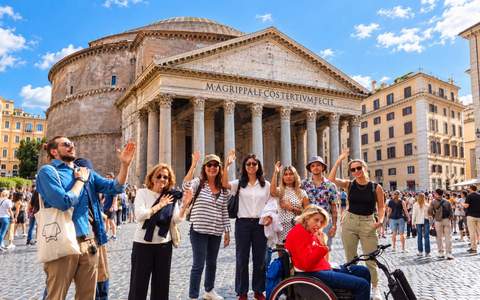
You can reach the Pantheon at sunset before going into Armando.
You can cross the Tiber and reach Tiber Island before a dinner at Sora Lella.
These details completely change how people perceive the event.
Dinner is no longer just a gastronomic moment.
It becomes shared memory.
A team dinner can become the most remembered moment of the event
After a day of meetings, workshops, or conventions, it’s often dinner that’s the moment when people finally can talk without an agenda.
No more slides.
No more presentations.
No more deadlines.
There’s a table.
And there’s Rome.
That’s why choosing the trattoria should be considered an integral part of event planning.
Location, history, number of participants, the possibility of having a reserved space, the menu, the handling of dietary needs, and the chance to connect dinner to a prior activity are all elements to evaluate together.
As an alternative to a traditional trattoria, for a more spectacular evening you can also plan a Murder Mystery Dinner, a Ancient Rome Dinner with show, or an itinerant dinner like River Track on the Tiber.
The logic remains the same: don’t simply organize a dinner—build a story in which the team can recognize itself.
FAQ – Team Dinner in Rome’s Historic Trattorias
Which neighborhood is best for a Roman corporate dinner?
Testaccio, Trastevere, the Jewish Ghetto, the historic center, and the Pantheon area are especially interesting because they make it easy to combine dinner, culture, and walks.
Are historic trattorias suitable for corporate groups?
Yes, but it’s important to check in advance the number of participants, availability, dedicated menu options, and space management. Some venues are small or have specific setups for groups.
Is it possible to organize a corporate dinner with an activity before dinner?
Absolutely. A dinner can be preceded by an urban game, a treasure hunt, a food tour, a photo challenge, or a team building activity.
Which cuisine should you choose for an international group?
Roman cuisine is especially effective because it offers dishes that are immediately recognizable and has a strong cultural identity. Still, it’s a good idea to plan dietary needs in advance.
Can a dinner at a trattoria be considered Team Building?
Dinner on its own is mainly a convivial activity. To turn it into true team building, you can add a challenge, a game, storytelling, or a structured activity before or during the dinner.
Is it possible to organize a private dinner for a small group?
It depends on the venue’s setup. Some restaurants have private rooms or reserved spaces, while others mainly work with tables in the main dining area. Availability should be confirmed during event planning.
Conclusion
Rome’s historic trattorias show that food can become an extraordinary relationship-building tool.
A carbonara can open up a conversation.
An artichoke alla giudia can tell the story of a neighborhood.
A walk at the Portico d'Ottavia can become the beginning of an evening.
A set table near the Pantheon can turn a corporate dinner into a memory.
And when food, the city, and people are brought together the right way, dinner stops being simply the end of a workday.
It becomes part of the Team Building experience.
If you want to live this experience—or others like it, click here. You’ll find our proposals:
Request a free quote and get all the information about your Team Building experience.
To organize your experience, you can also request a customized quote based on the number of participants, the venue, and the event goals.





