

































Team Beat: the rhythm of the group
There’s a moment, during a Team Building activity, when people stop being simply coworkers and start moving as a single team. No meeting room is needed, no slides, and not even a long theoretical explanation.
Sometimes, all it takes is a rhythm.
A clap, a drumbeat, a sequence of percussion. At first, each person follows their own instinct. Someone speeds up, someone waits, someone tries to figure out what the others are doing. Then, slowly, the sound organizes itself. Individuals begin to listen to one another, and the group builds something that no one could have created alone.
This is the idea behind Team Beat, a musical Team Building in which rhythm becomes a tool to develop collaboration, listening, and group alignment.
In Rome—a city built for centuries on meetings, cross-pollination, and different languages—this experience takes on an even more evocative meaning: just as a city doesn’t live thanks to a single building, a team works when every element finds its place.
What is Team Beat?
When music becomes Team Building
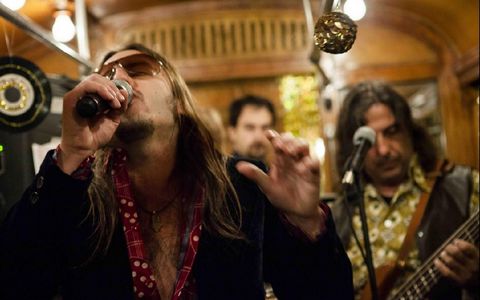
Team Beat is a experiential Team Building activity based on rhythm and percussion.
Participants are guided by professional percussionists through exercises and rhythmic sequences that require attention, coordination, and listening skills.
The goal isn’t to turn participants into musicians.
It doesn’t matter whether you know how to play an instrument, have a sense of rhythm, or understand music.
The real goal is to create a situation where each person can directly experience how their behavior influences others.
So an apparently simple dynamic can become a powerful metaphor for teamwork:
if someone runs too fast, the group loses the rhythm; if someone doesn’t listen, the sequence breaks; if everyone collaborates, the result becomes harmonious.
The first exercise: learning to listen
In many business settings, we’re used to thinking about communication mainly through words.
During Team Beat, something different happens.
To be able to follow a rhythmic sequence, you need to learn how to listen to what’s happening around you. The sound produced by others becomes essential information for knowing when to jump in, when to stop, and how to adapt.
Listen before acting
It’s an essential skill in professional life too.
A collaborator who speaks without listening risks proposing solutions that don’t fit the situation. A manager who doesn’t pick up on the signals from their team may not notice a difficulty. A team in which everyone tries—at the same time—to push their own idea makes it hard to reach a shared result.
Rhythm makes all of this immediately noticeable.
You don’t need to explain the concept of active listening at length: the group experiences it directly.
From individuals to the group: when alignment is born
Let’s imagine a group of people who have never worked together in this way.
Each person receives an instrument or a rhythmic part.
At first, the result is inevitably messy.
Someone anticipates the timing. Someone else gets lost. One participant tries to guide the others while another prefers to stay in the background.
Then comes the moment when the group starts to find structure.
Noise becomes rhythm.
Rhythm becomes sequence.
Sequence becomes music.
It’s exactly in this transition that the value of Team Building emerges.
The power of synchronization
Synchronization requires, at the same time:
-
attention;
-
listening;
-
coordination;
-
trust;
-
adaptability;
-
respect for others’ timing;
-
awareness of one’s role.
These are skills we find every day within companies.
In fact, a project rarely works because one person is exceptionally competent. It works because different skills can coordinate with one another.
Why rhythm strengthens teamwork
A concrete metaphor for collaboration
One of the most interesting aspects of Team Beat is the ability to turn concepts that are often abstract into a tangible experience.
Saying “you need to collaborate” can be ineffective.
Having people experience what collaboration truly means is completely different.
When a part of the rhythmic sequence depends on what another participant does, the concept of interdependence becomes immediately understandable.
No one plays alone
In a team, there aren’t only protagonists.
There are moments when you need to lead and moments when you need to follow. Some people have a more visible role, and others contribute in a less obvious but equally important way.
Music allows you to represent this dynamic without turning it into a theoretical lesson.
The group must find its balance.
Nonverbal communication and body language
Team Beat also works on another key element: nonverbal communication.
Even before words, people communicate through movement, posture, eye contact, gestures, and reaction timing.
In a rhythmic experience, these signals take on special importance.
A gesture can indicate the start.
A look can anticipate a change.
A movement can suggest to the group slowing down or speeding up.
When words aren’t enough
This dynamic is especially interesting for international teams.
When people with different languages and cultures participate, music can become a shared language.
You don’t need to translate a rhythm.
You don’t need to know the other person’s language.
You simply need to listen and participate.
And it’s precisely this immediacy that makes Team Beat suitable for multicultural business groups as well.
Team Beat in Rome: turning the city into a backdrop
Rome offers an ideal setting for creating a Team Building experience that blends activities with the surrounding area.
The city can become an integral part of the event’s story.
From the Colosseum to the team’s rhythm
For centuries, the Colosseum has represented one of the most recognizable symbols of ancient Rome’s organizational capacity.
Behind the monumentality of the amphitheater was a complex organizational system made of people, roles, skills, and coordination.
It’s a perfect suggestion for introducing the theme of teamwork: no great work is born from the isolated action of a single individual.
Piazza Navona: rhythm, movement, and creativity
Another particularly evocative setting is Piazza Navona.
The square, with its Baroque architecture and the famous Fountain of the Four Rivers, tells a Rome made of movement, spectacle, and artistic cross-pollination.
It’s a place that naturally lends itself to reflection on creativity.
Because even a working group—just like an orchestra—shouldn’t be limited to performing: it must interpret, adapt, and create.
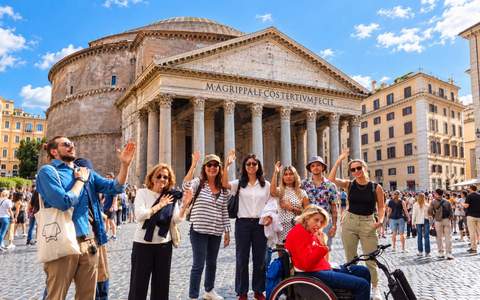
The Pantheon and the idea of harmony
The Pantheon, on the other hand, offers a suggestion linked to balance.
Its architecture is built around proportions and geometries capable of creating a strong sense of harmony.
In a team, harmony doesn’t mean that everyone is the same.
It means that differences, skills, and personalities can coexist within a shared structure.
What skills does a musical Team Building develop?
Team Beat can be designed to work on different transversal skills.
Active listening
Rhythm forces you to pay attention to others.
It’s not enough to know what to do: you need to understand when to do it.
Coordination
Each participant must synchronize their action with that of the others.
This dynamic directly recalls the coordination needed in business projects.
Leadership
A musical group can have moments in which someone naturally takes on a guiding role.
Real leadership, though, doesn’t consist of dominating the rhythm of others.
It consists in creating the conditions for the group to find its own rhythm.
Problem solving
When a sequence doesn’t work, you need to quickly understand what to change.
Changing the tempo, correcting a mistake, observing others, and starting again are all small problem-solving experiences.
Trust
To work, a collective performance requires mutual trust.
Each participant must know that others are contributing to the common result.
From rhythm to company culture
The value of a Team Building activity shouldn’t end when the activity ends.
The real challenge is to transfer what has been experienced into everyday professional life.
What can a team take home?
After an experience like Team Beat, a simple question can become very powerful:
“What’s our rhythm as a team?”
Does the team communicate well?
Do people listen?
Is there space for quieter people?
Can it adapt when something changes?
Are there moments when everyone tries to lead at the same time?
Or does someone constantly stay in the background?
The value of the experience also lies in the ability to use these questions to open up a follow-up conversation.
For which companies is Team Beat recommended?
Team Beat can be particularly interesting for:
-
companies that want to improve internal collaboration;
-
newly formed teams;
-
international groups;
-
companies facing organizational changes;
-
sales and marketing divisions;
-
groups that need to strengthen communication;
-
companies looking for an original and engaging activity;
-
corporate events and incentives in Rome.
It’s also a proposal suitable for groups with very different experience levels, because it doesn’t require prior musical skills.
Team Beat isn’t a competition: it’s a collective construction
One of the most interesting aspects of this experience is moving beyond the logic of competition.
It’s not necessarily the person who’s best who wins.
The best result comes when the group manages to work as a whole.
This difference matters.
In many Team Building activities, the comparison between teams can be a positive stimulus. In Team Beat, however, the focus can shift to building a shared result.
Success doesn’t belong to one person.
It belongs to the group.
A perfect metaphor for the world of work
Let’s think of an orchestra.
A percussionist can’t independently decide to speed up without considering what the other musicians are doing.
Likewise, in a company, every decision has consequences for the work of the people collaborating on the same project.
The quality of the final result depends on the ability to coordinate different skills.
That’s why rhythm is such an effective metaphor.
Each person has their own sound, but it’s mutual listening that turns many sounds into a team.
The Team Building that leaves a rhythm in your memory
A Team Building day can be forgotten.
But an experience can become a shared memory.
That’s one of the reasons why experiential activities like Team Beat can be particularly effective: they don’t just talk about collaboration, but allow people to experience it physically and together.
And when, a few days later, someone in the office jokingly brings up that rhythm, that sequence, or the moment when the whole group finally managed to play together, the Team Building keeps living on.
Because maybe the real goal wasn’t to learn how to play.
It was to learn how to listen to one another.
Team Beat: the group’s rhythm as a business experience
In Rome, between the history of the Roman Forum, the squares of the historic center, and the places that have made the city one of Europe’s great cultural crossroads, Team Beat can become much more than a simple musical activity.
It can turn into a concrete metaphor for collaboration, leadership, communication, and belonging.
Because an effective team isn’t one where everyone does the same thing.
It’s the one in which each person finds their own rhythm and manages to synchronize it with the others’.
And when that happens, the result can be truly surprising.
If you want to experience this or similar activities, click here—you’ll find our proposals:
Request a free quote and get all the information about your Team Building experience.
You can request a free quote and receive all the information about the experience that best suits your group.