












































The curiosities of Trastevere that few know: the most authentic neighborhood in Rome told through its secrets
Strolling through Trastevere means stepping into a Rome different from the one in postcards. Here time seems to slow down; the cobblestone streets tell stories of merchants, artists, and locals, while every alley hides details that even many Romans miss.
It is precisely this atmosphere of mysteries, symbols, and legends that makes Trastevere one of the most fascinating places to organize a Team Building activity. Every square becomes a stop to explore, every building keeps an anecdote, and every viewpoint can turn into a challenge in observation, collaboration, and problem solving.
Discovering Trastevere doesn’t only mean visiting a historic neighborhood, but experiencing an engaging journey where culture, play, and emotions blend into a single story.
Why Trastevere is perfect for a Team Building
Trastevere represents the most authentic soul of Rome.
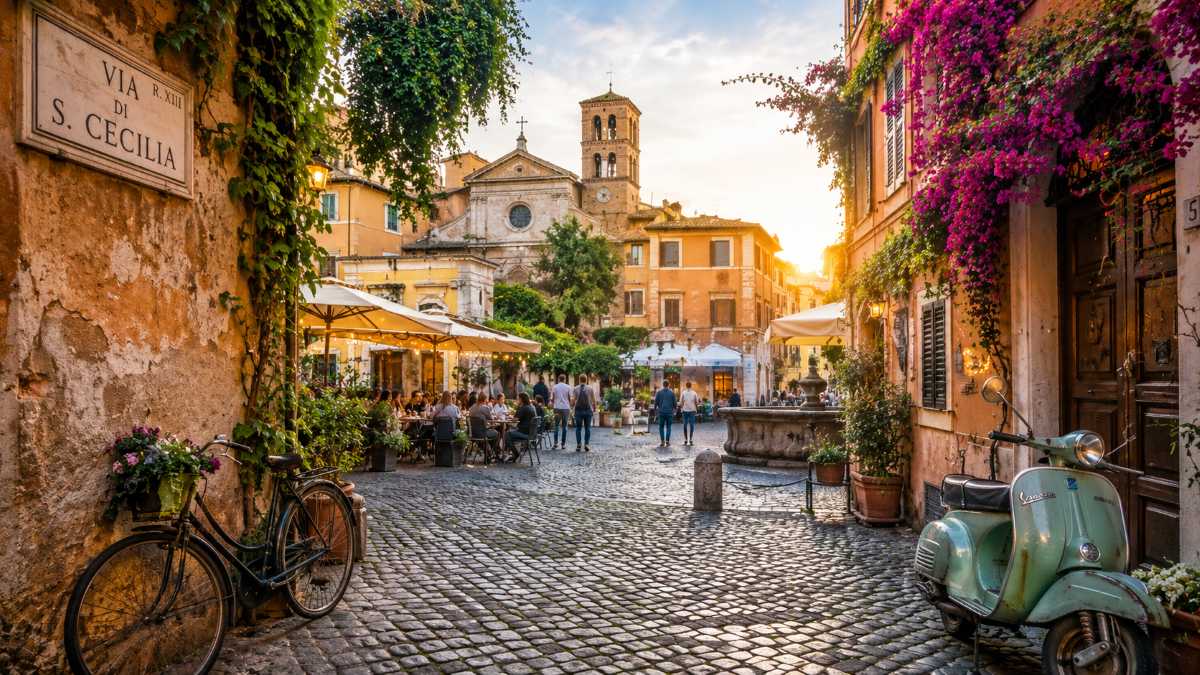
Far from the major tourist thoroughfares, it still preserves today the atmosphere of a medieval village, with narrow lanes, lively little squares, ivy-covered buildings, and artisan shops that feel like they belong to another era.
In a Team Building, every detail can become a clue.
Facades tell stories.
Fountains hide symbols.
Churches hold surprising curiosities.
This makes the neighborhood ideal for activities based on gamification, digital treasure hunts, and urban storytelling.
A journey through the alleys: a history no one expects
Imagine receiving a map.
No precise instructions.
Only a few riddles.
The team starts from Piazza Trilussa, crossing the alleys without knowing where they’ll end up.
Someone notices a small sacred shrine.
Another person spots a decorated window.
A colleague discovers an ancient inscription.
Every detail leads to the next.
Without realizing it, the group is learning to communicate better, to listen to the other people’s instincts, and to make shared decisions.
This is the magic of Trastevere: turning a simple walk into an adventure full of emotion.
The curiosities of Trastevere that few know
1. The meaning of the name Trastevere
Many don’t know that the name comes from Latin Trans Tiberim, meaning “across the Tiber.”
For ancient Romans, this neighborhood was almost a city within the city, home to eastern merchants, sailors, foreigners, and artisans from all over the Mediterranean.
This extraordinary cultural blend helped shape the unique character that still distinguishes the neighborhood today.
2. Sacred shrines tell forgotten stories
While walking through the alleys, it’s easy to notice small images of the Madonna or saints placed at the corners of buildings.
They weren’t only religious elements.
Before public lighting, they were often illuminated by lanterns that made the streets safer during the night.
Today, they are small open-air museums that tell the story of Roman popular devotion.
3. The Basilica of Santa Maria in Trastevere hides a record
Among the neighborhood’s most important monuments stands the Basilica of Santa Maria in Trastevere, considered one of the oldest churches dedicated to the Virgin Mary.
The magnificent medieval mosaics created by Pietro Cavallini are one of the most important masterpieces of Roman art.
For many teams, this stop becomes the perfect moment to observe details often invisible during a traditional visit.
4. The alleys follow no apparent logic
Anyone who looks at a map of Trastevere quickly notices that the streets seem drawn without any precise order.
In reality, they still follow the medieval urban layout that developed spontaneously over the centuries.
That’s why the neighborhood is perfect for orientation and problem-solving activities.
5. Piazza Trilussa was a harbor
Today it is one of the symbolic places of Roman nightlife.
But few know that in the past it represented one of the main entrances to the Tiber’s river port.
Merchandise from all over Europe arrived here.
Today it remains one of the city’s most iconic meeting points.
6. The houses tell stories of vanished trades
Many buildings still preserve old signs carved into the stone.
Hammers.
Anchors.
Tools.
Symbols indicating the profession of the residents.
Observing them during a Team Building means developing observation skills and collaboration among participants.
7. The Gianicolo doesn’t belong to Trastevere... but tells its story
As you head up to the Colle del Gianicolo, you’ll find one of Rome’s most spectacular panoramas.
From here, it’s possible to understand the neighborhood’s strategic position and relive some key episodes of the Roman Republic of 1849.
The famous cannon that fires the noon shot every day still continues a tradition started in the 19th century.
Unmissable places during a Team Building in Trastevere
A route through the most fascinating POIs
An experiential itinerary may include some of the neighborhood’s most iconic places:
-
Piazza Trilussa
-
Basilica of Santa Maria in Trastevere
-
Vicolo del Cinque
-
Piazza of Santa Cecilia
-
Basilica of Santa Cecilia in Trastevere
-
Tiber Island
-
Ponte Sisto
-
Colle del Gianicolo
-
Fontana dell'Acqua Paola
-
Botanical Garden of Rome
Each place offers ideas for riddles, storytelling, and collaborative activities.
What Trastevere teaches a team
Beyond mere play
A Team Building set in Trastevere develops many cross-cutting skills:
Communication
Every detail observed must be shared with the group.
Distributed leadership
The best ideas can come from anyone.
Problem Solving
Each riddle requires the contribution of the whole team.
Trust
Collaborating makes it possible to achieve results that are impossible individually.
Creativity
Interpreting clues encourages lateral thinking.
A neighborhood that excites you at every step
Trastevere is not only one of Rome’s most beautiful neighborhoods.
It’s a place that keeps surprising.
Every door can hide a legend.
Every square tells a story.
Every alley keeps a small mystery.
And it is precisely this continuous discovery that makes it one of the most engaging settings for a corporate Team Building.
When a group explores together a place so rich in history, curiosities, and symbols, it doesn’t just create memories: it builds stronger relationships, improves collaboration, and turns a simple day out of the office into an experience meant to last over time.




