




































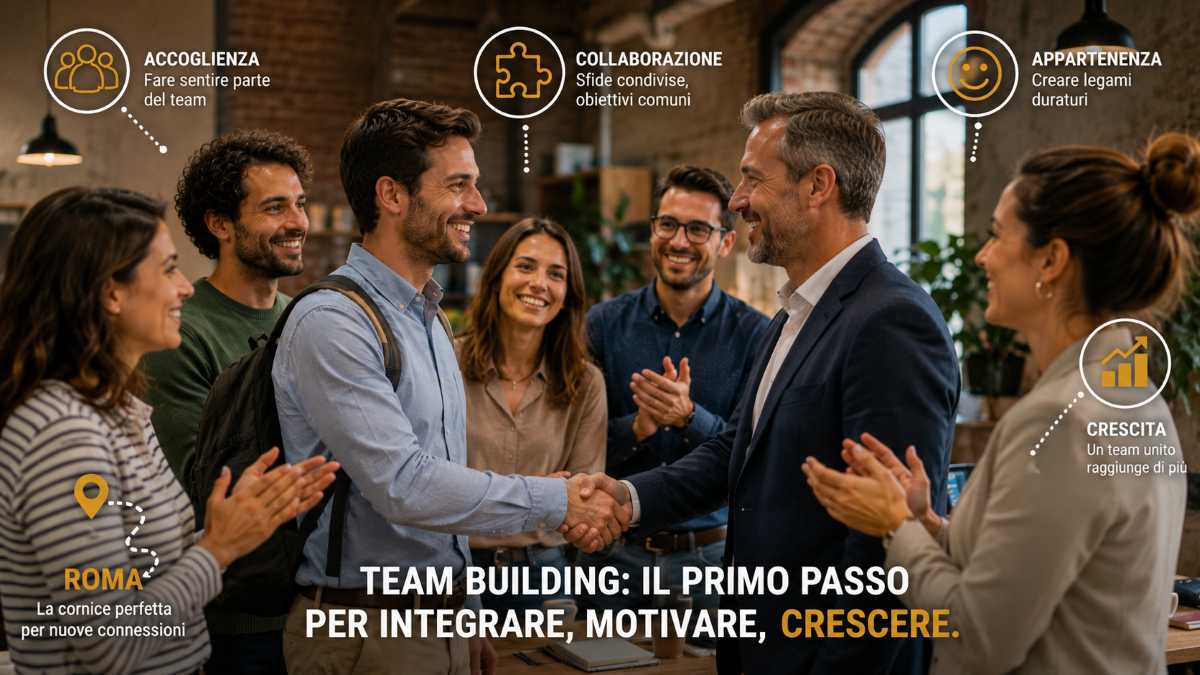
How to onboard new employees with Team Building: effective strategies to build a united team from day one
The arrival of a new team member is always an important moment for a company. It’s not just about setting up a workstation, introducing colleagues, or explaining internal procedures. The real success of onboarding depends on the ability to make every person feel like an integral part of the group.
This is where Team Building becomes a strategic tool. Through engaging experiences, collaborative activities, and moments of sharing, it’s possible to close distances, build trust, and speed up the integration process.
Rome, with its iconic landmarks, historical routes, and immersive experiences, offers the ideal setting to turn a new employee’s arrival into a memorable experience.
Why integration is essential for business success
The first days at a new company are often accompanied by enthusiasm, but also by doubts and uncertainty.
The new team member must learn about people, roles, processes, and internal dynamics, while the team must learn how to welcome a new figure and build a relationship based on trust.
When this process is managed effectively, the benefits are numerous:
-
a greater sense of belonging;
-
faster integration;
-
better workplace atmosphere;
-
increased motivation;
-
more effective collaboration;
-
reduced turnover.
Team Building naturally accelerates all of this by creating opportunities for genuine connection outside the traditional work context.
A story that begins with a simple clue
Marco starts at the company on his first Monday.
He barely knows a few faces.
During the coffee break, he receives an invitation.
No meeting.
No formal introductions.
Just one sentence:
"Your team is waiting for you in the heart of Rome."
A few hours later, he finds himself with his colleagues on a treasure hunt through the streets of the historic center.
At first, he listens.
He observes.
Then he suggests a solution.
The group follows it.
The riddle is solved.
Between one challenge and the next, the first spontaneous conversations begin.
Barriers fall away.
By the end of the day, Marco is no longer "the new guy".
He’s already part of the team.
This is the power of Team Building: turning a simple onboarding into a genuine relationship.
Team Building as an onboarding tool
Beyond traditional training
Modern onboarding is not limited to handing over the company badge or reading the internal manual.
More innovative companies include hands-on activities that allow new team members to get to know colleagues in informal, collaborative situations.
During these experiences, the following emerge naturally:
-
communication skills;
-
leadership;
-
initiative;
-
active listening;
-
empathy;
-
problem-solving.
These are essential skills that often remain hidden during normal day-to-day work activities.
Why Team Building speeds up integration
Emotions foster trust
Sharing a challenge creates connections faster than any formal presentation.
When a group tackles a common goal together, people naturally start to collaborate.
They listen.
They help.
They celebrate results.
These emotions become the foundation for stronger professional relationships.
Collaboration grows out of play
Gamification activities eliminate hierarchies.
It doesn’t matter what job role someone has.
What matters is each participant’s contribution.
Even the new arrival can propose a decisive idea to solve a challenge.
This immediately increases the sense of inclusion.
The best Team Building activities to welcome new employees
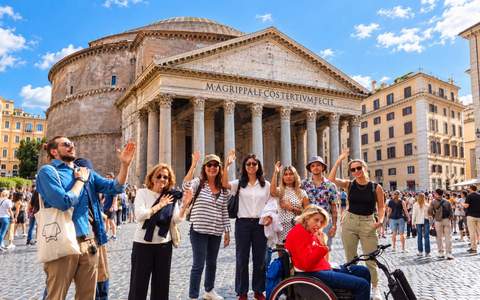
Treasure hunt in the historic center of Rome
One of the most effective activities is organizing a mission across some of the city’s landmark locations.
The route can include:
-
the Colosseum;
-
Imperial Forums;
-
Venice Square;
-
the Pantheon;
-
Piazza Navona;
-
Trevi Fountain;
-
Spanish Steps.
Each stop becomes an opportunity to work together, share information, and build trust.
Escape Game
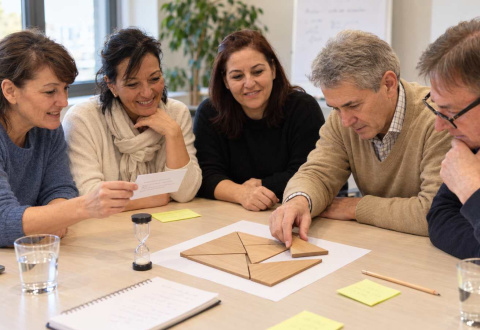
Teams must solve puzzles by using everyone’s skills.
The new team member takes part from the very beginning in the decision-making.
This encourages dialogue and values every contribution.
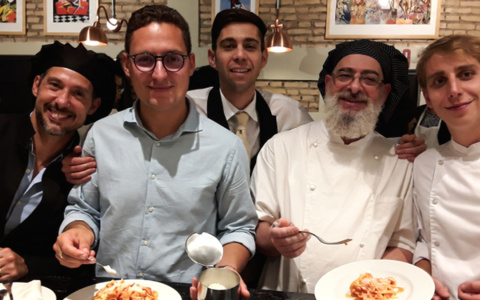
Cooking Team Building
Preparing lunch or dinner together helps you get to know each other naturally.
Cooking teams organize themselves, divide tasks, and collaborate to achieve a shared goal.
The final social moment further strengthens the group.
Music Team Building
Through rhythm and coordination, each participant contributes to creating a collective performance.
Music closes the distances and promotes inclusion.
Rome: the ideal place to create new connections
A city that supports storytelling
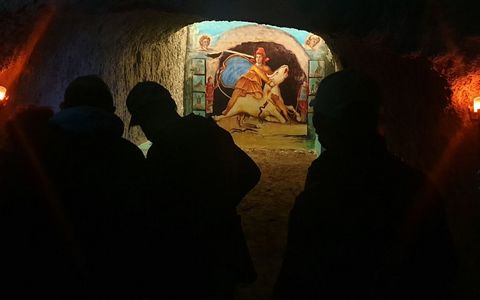
Every corner of Rome tells a story.
Walking around the Pantheon, reaching Piazza Navona, crossing Campo de' Fiori, seeing the Colosseum, or exploring Castel Sant'Angelo means immersing yourself in a cultural heritage that sparks curiosity, dialogue, and collaboration.
The locations become an integral part of the experience.
Every monument can turn into a challenge.
Every square can tell an anecdote.
Each team builds its own route.
Benefits for the company
An investment that produces results
Integrating Team Building into onboarding programs generates tangible benefits:
Faster onboarding
New team members feel like part of the group from their first days.
Higher engagement
People who experience a positive event develop a stronger connection with the company.
More effective communication
The relationships built during activities make everyday work easier.
Reduced turnover
A good onboarding process increases the sense of belonging and supports staying with the company.
Positive workplace atmosphere
Shared experiences improve organizational well-being.
The future of onboarding is through experiences
Companies that invest in people know that integration can’t be left only to administrative procedures.
You need to create opportunities in which new team members can feel welcomed, valued, and involved.
Team Building is one of the most effective tools to achieve this goal.
Through play, collaboration, and storytelling, every new hire can turn the beginning of their journey into the start of a shared path.
Because a team doesn’t form just by working together.
It forms by living experiences together.