





























The Pantheon and the genius of Roman engineering: a lesson in innovation that still inspires Team Building today
Entering the Pantheon means taking a step back of almost two thousand years and finding yourself in front of a work that continues to amaze architects, engineers, and visitors from all over the world. It is not only one of the best-preserved monuments of Ancient Rome: it is the concrete proof of how vision, collaboration, and innovation can create something destined to defy time.
Every block of stone, every proportion, and every detail tells the work of thousands of people who shared a single goal. It is precisely this ability to coordinate different skills that makes the Pantheon a perfect metaphor for modern Team Building.
To observe the Pantheon with curious eyes is to understand that great results are never the work of a single individual, but of a team capable of working in harmony.
A masterpiece born from collective ingenuity
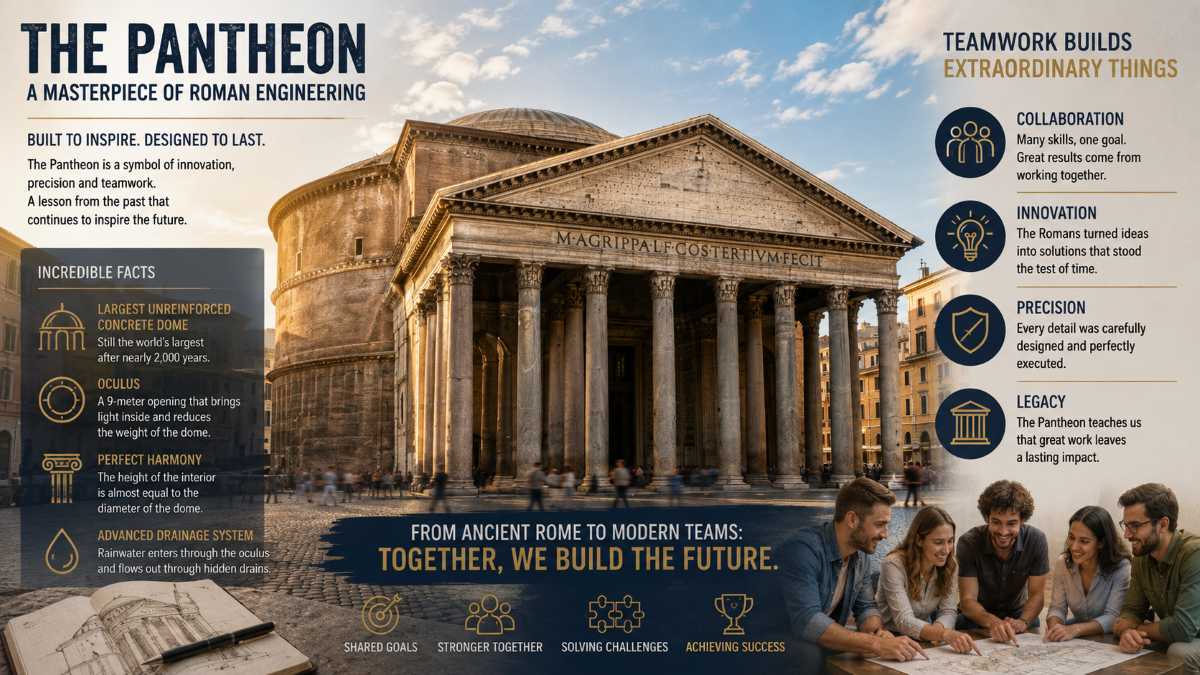
The Pantheon we can admire today was rebuilt during the reign of the emperor Hadrian, between 118 and 125 AD, on the foundations of an older building commissioned by Marcus Vipsanius Agrippa.
The decision to preserve the inscription dedicated to Agrippa is still today an extraordinary message.
Success does not always belong to the person who completes it.
Often, it comes from the work of those who started the project long before.
It is a valuable lesson also for the business world.
The strongest organizations are the ones that value the contribution of every person.
A story that begins under the oculus
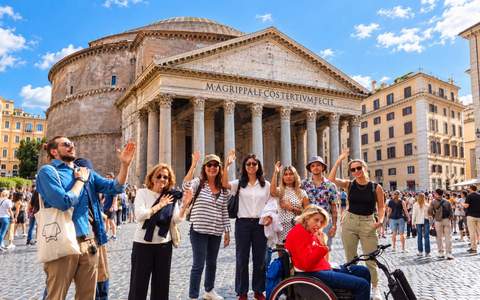
The team enters the Pantheon.
For a few moments, no one speaks.
Looks rise toward the gigantic dome.
Light passes through the central oculus.
A single beam slowly illuminates the floor.
The guide hands out a small card.
One single question.
"How did they build all of this almost two thousand years ago?"
Hypotheses multiply.
Someone observes the proportions.
Others notice the dome’s lightening techniques.
Someone imagines the tools used by ancient builders.
The answer comes only at the very end of the journey.
The real secret was not some mysterious technology.
It was the collaboration between architects, engineers, craftsmen, stonecutters, and laborers.
An extraordinary team.
Why the Pantheon is still a masterpiece of engineering
The largest dome of antiquity
The Pantheon’s dome continues to be the largest dome in unreinforced concrete ever built.
With a diameter of over 43 meters, it represents an engineering feat that still surprises specialists today.
To reduce the structure’s weight, the ancient Romans used different materials as they went up toward the top.
A simple and brilliant solution.
The oculus: a window to the sky
At the center of the dome, a perfectly circular opening is about nine meters in diameter.
The oculus serves several functions.
It naturally illuminates the interior.
It reduces the weight of the covering.
It creates a unique dramatic effect.
During rain, water enters the building but is collected and drained thanks to a sophisticated drainage system that still works perfectly.
An extraordinary example of integrated design.
Geometry, proportions, and perfection
The Pantheon is built according to rigorous geometric principles.
The internal height corresponds almost perfectly to the dome’s diameter.
This allows you to imagine a perfect sphere inscribed within the internal space.
A choice that combines aesthetics, mathematics, and functionality.
The Pantheon as a metaphor for Team Building
Every element supports the entire structure
No single block of stone holds up the monument by itself.
Each component works together with the others.
The same happens in companies.
An effective team is created when every person understands their role and contributes to the shared result.
Team Building helps develop exactly this awareness.
The skills that build a team
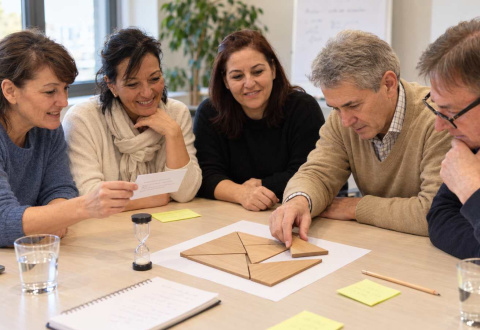
Just as the Pantheon was made possible through the collaboration of different professionals, even a modern team grows through complementary skills.
Among the most important we find:
-
collaboration;
-
leadership;
-
communication;
-
trust;
-
problem solving;
-
planning;
-
creativity;
-
adaptability.
A journey through Rome’s great masterpieces
THE POIs that tell the genius of Ancient Rome
The Pantheon can become the starting point for a Team Building experience dedicated to Roman ingenuity.
Among the most significant stops we find:
Piazza della Rotonda
The beating heart of the Pantheon, perfect for starting a narrative mission.
Piazza Navona
Built on the ancient Stadium of Domitian, it tells the city’s urban evolution.
Largo di Torre Argentina
An archaeological area that bears witness to the greatness of Republican Rome.
Imperial Fora
The political and administrative center of the Empire.
Every building tells a different approach to leadership.
Colosseum
Another great symbol of Roman engineering, still studied around the world today.
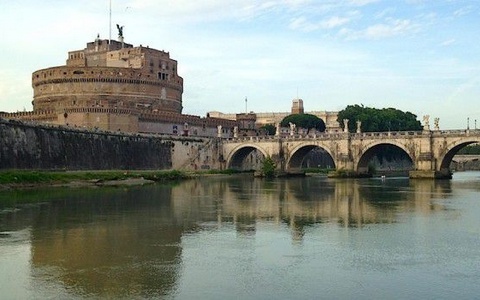
Castel Sant’Angelo
From an imperial mausoleum to a papal fortress, it represents Rome’s ability to adapt structures to the changes of history.
Gamification and storytelling among the city’s wonders
Modern Team Building activities use Rome’s historical heritage to create engaging experiences.
Tablets.
Missions.
Quizzes.
Augmented reality.
Storytelling.
Each team must interpret symbols, solve puzzles, and reconstruct historical events.
Learning happens through play.
Collaboration becomes natural.
The city itself turns into an enormous open-air classroom.
The true legacy of the Pantheon
The Pantheon continues to teach something even after almost two thousand years.
Not only to architects.
But to anyone who works in a team.
Its perfection does not come from the talent of a single person.
It comes from the ability to integrate different skills into a shared project.
It is the same philosophy that guides every Team Building experience.
Because great works, yesterday and today, are built by people who share a vision, trust one another, and collaborate to achieve an objective greater than the sum of individual contributions.
And this is exactly the most valuable lesson that the Pantheon continues to offer the modern world.