












































The Tiber: the river that built Rome
When you think of Rome, your imagination immediately runs to the Colosseum, the Imperial Forums, the Pantheon, or the Trevi Fountain. And yet there is a silent protagonist that, for over two thousand years, has accompanied the history of the Eternal City: the Tiber.
Long before the construction of the great monuments, the river was already the beating heart of Roman life. It encouraged trade, defended the city, inspired legends, and helped shape the birth of one of the most influential civilizations in history.
Today, the Tiber continues to tell the story of Rome from a different perspective. Walking along its banks means crossing centuries of history, discovering lesser-known views, monumental bridges, and tales that turn a simple stroll into a truly immersive experience.
And it’s precisely this perspective that makes the Tiber an ideal setting for Team Building activities, where collaboration, discovery, and storytelling come together in an engaging journey.
The river that gave rise to the Capital
According to tradition, everything began on the banks of the Tiber.
It was right here that the basket containing Romulus and Remus got stranded before the she-wolf found them at the foot of the Palatine Hill.
Between myth and history, the Tiber represented the first strategic element for the founding of the city.
Its waters enabled trade with the Mediterranean, provided valuable resources, and formed a natural defensive barrier.
Rome would not have become the Capital of the Empire without its river.
A walk that becomes a journey through time
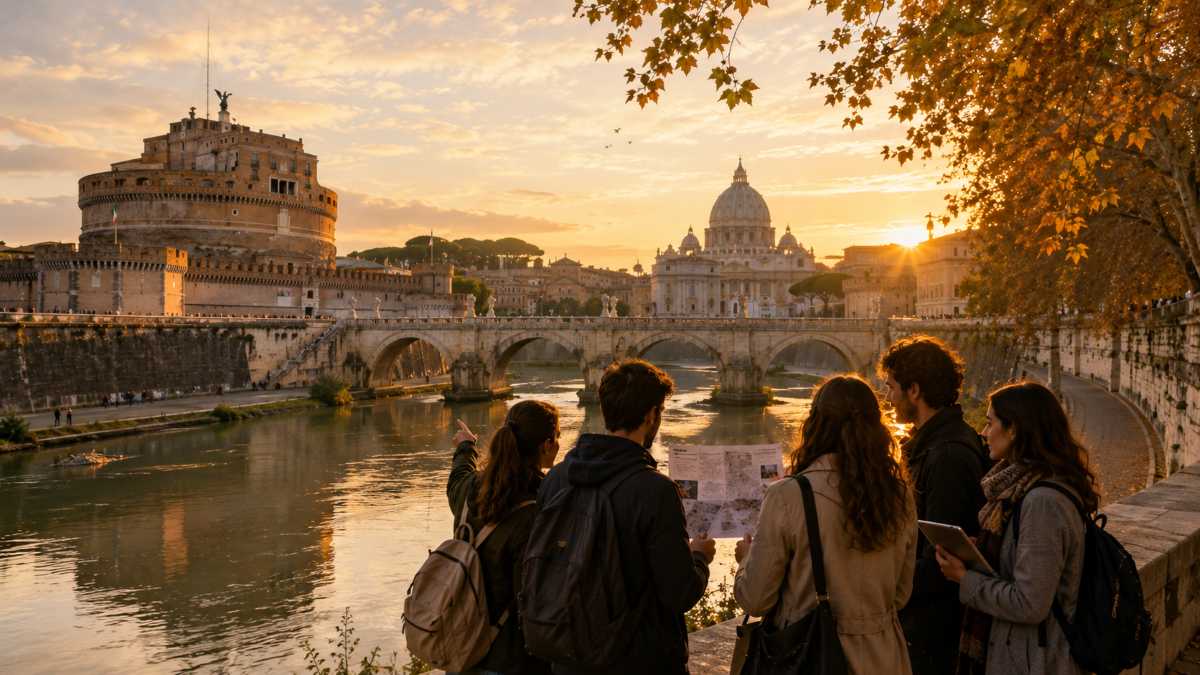
It’s an autumn morning.
The sun slowly lights up the Lungotevere.
The group receives a map.
The mission isn’t about finding a treasure.
The real goal is to reconstruct a story.
Every bridge holds a clue.
Every inscription tells an episode.
Every view of the river reveals something that only a few know.
The teams observe, discuss, photograph details, and connect the information.
Step by step, the Tiber stops being just a river.
It becomes the thread connecting more than twenty-seven centuries of history.
At the end of the experience, everyone understands a simple truth.
You can’t understand Rome without knowing its river.
The Tiber and its iconic places
Tiber Island
In the heart of the river stands the only urban island of the Tiber.
According to legend, it was formed from the sheaves of grain belonging to Tarquin the Proud.
Today it represents one of the most fascinating places in the city, connected by the historic arches of Ponte Fabricio and Ponte Cestio.
Castel Sant’Angelo
Overlooking the river, it has dominated Rome for almost two thousand years.
First the mausoleum of Emperor Hadrian, then a papal fortress, the castle controlled the main access to the city along the Tiber.
Its connection to the river is unbreakable.
Ponte Sant’Angelo
The famous angel statues by Gian Lorenzo Bernini still accompany anyone who crosses the bridge today.
It’s one of the most photographed places in the Capital and a perfect setting for storytelling activities and photo missions.
Ponte Sisto
Built in the 15th century, it connects the historic center with Trastevere.
Its distinctive “spectacles,” the large central opening, was designed to reduce water pressure during Tiber floods.
A perfect example of Renaissance engineering.
Trastevere
The neighborhood owes much of its history to the river.
Artisans, fishermen, and merchants have lived along these banks for centuries, contributing to the city’s development.
Porticus/Forum Boarium
The ancient cattle market stood next to the river port.
Merchandise arrived here from all across the Mediterranean.
Even today, it preserves remarkable traces of Republican Rome.
The Tiber as a great open-air classroom
Learning by working together
A Team Building experience along the Tiber allows you to combine culture, fun, and teamwork.
The activities can include:
Photo missions
Each team must capture hidden architectural details.
Historical quizzes
Riddles and curiosities guide the participants along the route.
Digital treasure hunt
Tablets, GPS, and augmented reality turn the Lungotevere into a big interactive game.
Urban storytelling
Each team reconstructs a historical episode by linking the clues collected along the way.
The skills that are developed
Every bridge connects people too
Experiences along the Tiber develop many soft skills.
Communication
Sharing information becomes essential.
Leadership
Each participant can lead the group at different moments.
Problem Solving
The puzzles require observation and reasoning.
Collaboration
Every clue can only be solved thanks to everyone’s contribution.
Creativity
Photo and narrative challenges spark new ideas.
The Tiber today: between sport, culture, and sustainability
In recent years, the river has returned to being a protagonist in city life.
Bike paths, cultural events, sporting events, and initiatives dedicated to enhancing its banks have given new centrality to this extraordinary urban asset.
For companies, it represents an ideal setting to organize outdoor activities that combine well-being, culture, and team spirit.
A river that continues to tell Rome
Every city has a symbol.
Rome has many.
But none matches the way the Tiber carries its story.
It has witnessed the legend of Romulus and Remus being born.
It has transported goods from all across the Mediterranean.
It has seen the passage of emperors, popes, artists, and travelers.
Today it still remains the silent witness to the life of the Capital.
Walking along its banks means crossing over two thousand years of history.
And it’s precisely this ability to connect past and present that makes it one of the most evocative settings for a Team Building.
Because just as the Tiber connects the two banks of the city, a shared experience can build bridges between people.




