













































The Importance of Nonverbal Communication in Team Games
How many times has a simple glance prevented a mistake? Or a smile reassured a colleague more than so many words? In the workplace, we’re used to placing great importance on verbal communication: meetings, emails, presentations, and phone calls structure our days. Yet there is a much older and powerful language that influences every human relationship: nonverbal communication.
According to numerous studies on interpersonal communication, posture, facial expressions, gestures, the distance between people, and tone of voice deeply affect how we interpret messages. In team games and Team Building activities, this language becomes even more evident, because it is often precisely what isn’t said that makes the difference between a winning team and one that struggles to collaborate.
Rome, with its open spaces, historic squares, and fascinating routes, is the ideal setting for experimenting with activities where observation, listening, and silent communication become the stars.
Communication Starts Before Words
Every meeting begins long before the first greeting.
A handshake.
A look.
A smile.
An open posture.
The brain interprets these signals in just a few moments, forming a first impression that influences the entire relationship that follows.
During a Team Building session, this process becomes clear: teams quickly learn to trust, understand others’ intentions, and coordinate even without constantly speaking.
A Mission at the Heart of Rome
The group gathers in Piazza Navona.
The instructor hands out a special challenge.
For a few minutes, speaking will be forbidden.
Each team must solve a series of riddles using only gestures, looks, and movements.
At first, embarrassment takes over.
Then someone points in a direction.
Another one immediately understands.
A simple nod confirms the choice.
Hands begin to map out paths.
Smiles replace words.
When the mission ends, everyone realizes they’ve communicated a lot… without saying almost anything.
That’s when a new awareness begins.
Nonverbal communication doesn’t just accompany teamwork.
It is an essential component of it.
What Is Nonverbal Communication
A Universal Language
Nonverbal communication includes all those signals that convey information without using words.
Among the main ones we find:
Facial Expressions
Convey authentic, immediate emotions.
Eye Contact
Builds trust, attention, and engagement.
Gestures
Support reasoning and make understanding easier.
Posture
Communicates openness, confidence, or closure.
Interpersonal Distance
Influences the level of comfort during the interaction.
Tone of Voice
Even when the words are correct, it is how they are pronounced that determines their effectiveness.
Why It’s Essential in Team Games
Collaborating Also Means Observing
During an experiential activity, each participant continuously sends signals to others.
A teammate in difficulty.
A solution that’s been intuitively identified.
A request for help.
A confirmation.
Very often, these messages are perceived before they are expressed verbally.
The most effective teams develop the ability to read these signals and quickly adapt their own behavior.
Rome: A Natural Gym for Communication
PLACES THAT Encourage Interaction
The Capital offers perfect settings for activities focused on communication and collaboration.
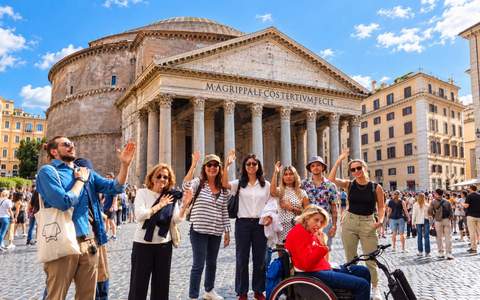
Pantheon
Its grandeur invites observation and sharing.
Colosseum
An ideal backdrop for orientation and coordination challenges.
Piazza Navona
Spacious areas encourage dynamic group activities.
Trastevere
The alleys and squares become the perfect setting for missions based on cooperation.
Campo de’ Fiori
A lively place full of stimuli, where you can train attention and observation skills.
Castel Sant’Angelo
Perfect for investigative routes and storytelling.
Isola Tiberina
A secluded environment that invites mutual listening.
The Skills That Develop
Much More Than Simple Games
Activities dedicated to nonverbal communication train essential skills.
Active Listening
Observing becomes as important as speaking.
Empathy
Understanding others’ emotional state improves collaboration.
Leadership
Leading also means conveying confidence through behavior.
Problem Solving
Quickly interpreting signals accelerates the decision-making process.
Trust
A team that learns to “read” one another develops stronger relationships.
Adaptability
Every situation requires different communication approaches.
Storytelling Makes Everything More Memorable
Team Building activities work because they turn learning into experience.
A mission.
A mystery.
A treasure hunt.
An investigation.
Every story forces the group to communicate, observe, and make decisions together.
And it’s precisely this emotional engagement that makes learning more effective.
When Silence Builds a Great Team
Words are essential.
But they aren’t everything.
The best teams learn to recognize what isn’t said too.
A look can convey trust.
A smile can reduce tension.
A simple gesture can coordinate an entire team.
Team Building offers the ideal opportunity to practice this skill in an engaging context, free from the daily pressures of the office.
Because the most effective communication isn’t always the one you hear.
More often, it’s the one you observe.
And it’s precisely in shared moments that this silent language becomes one of the most powerful tools for building authentic, lasting relationships.




