



























Why a treasure hunt is the most engaging Team Building
A map in hand, a team beside you, and a goal to reach.
Not much else is needed to turn a normal workday into an adventure.
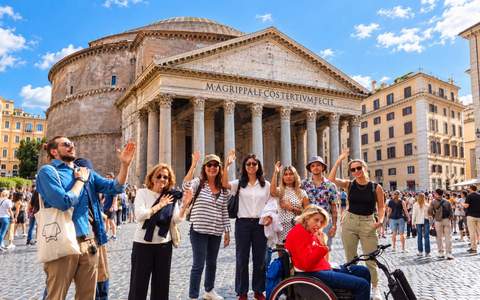
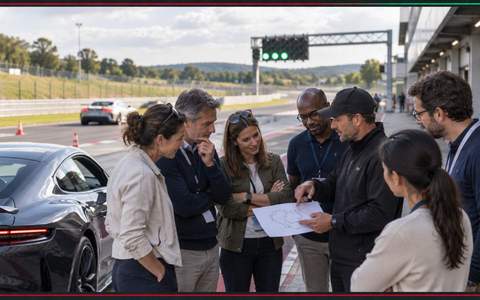
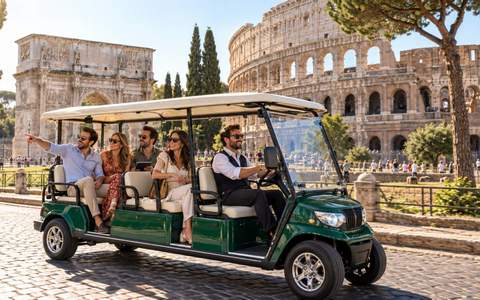
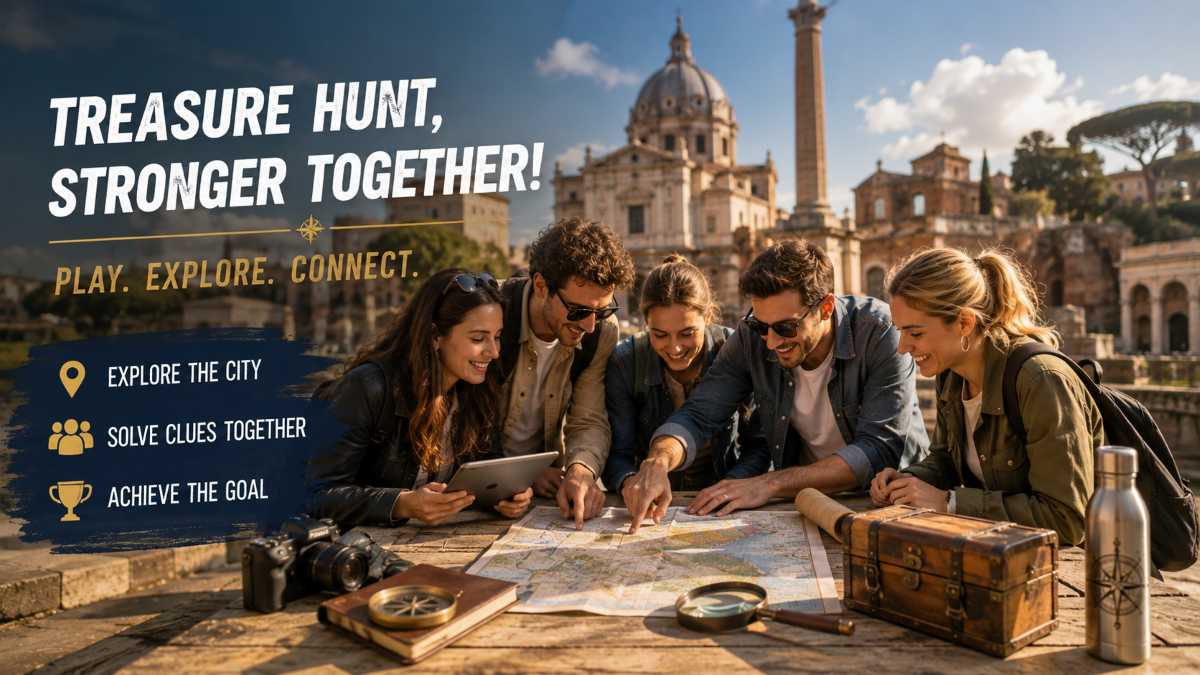
Let’s imagine a group of colleagues in the center of Rome. The first clue points to a square, but it doesn’t say which one. The team has to watch the details, compare ideas, and decide quickly which way to go.
Someone recognizes a particular architectural feature. Another finds the solution. A third proposes a strategy.
And suddenly, the group is no longer made up of individual professionals.
They’ve become a team.
That’s exactly the power of treasure hunt as Team Building: it engages body, mind, and emotions at the same time, turning collaboration into a tangible experience.
Treasure hunt and Team Building: why they work so well together
A corporate treasure hunt isn’t just a game.
When it’s designed with specific goals, it can become a real skills development experience focused on interpersonal abilities.
Participants must:
-
communicate;
-
listen;
-
make decisions;
-
delegate tasks;
-
manage time;
-
solve problems;
-
collaborate;
-
adapt to unexpected events.
The difference from a normal training activity is crucial: skills aren’t explained—they’re put into practice.
The psychology of play: why it draws us in
An objective makes the group more cohesive
When a team has to reach a shared milestone, individual differences temporarily take a back seat.
The group focuses on the mission.
It’s necessary to understand who knows how to do what, who has certain information, and how to combine the available skills.
This mechanism, in a playful way, replicates many of the dynamics you encounter every day in the professional environment.
The challenge creates emotions
A treasure hunt can generate enthusiasm, curiosity, surprise, and healthy competition.
It’s exactly these emotions that make the experience memorable.
A clue solved after several attempts.
A route chosen at the last moment.
The satisfaction of reaching the finish line before the other teams.
These are moments that stay in your memory much longer than a traditional passive activity.
Rome becomes the playing field
The value of POIs in Team Building
One of the features that makes Rome particularly suitable for a treasure hunt is the concentration of POI – Points of Interest in a relatively contained area.
Monuments, squares, fountains, alleys, and architectural details can become elements of the storyline.
The Colosseum
A spectacular starting point for a mission focused on history and strategy.
The Imperial Fora
A perfect place to tell stories about organization, leadership, and collaboration in ancient Rome.
The Pantheon
An incredible opportunity to turn architecture into a puzzle.
Piazza Navona
With the Fountain of the Four Rivers and its history, it offers plenty of ideas for photo challenges and observation tasks.
Trastevere
The neighborhood’s narrow streets are ideal for creating less predictable routes and narrative missions.
Campo de' Fiori
A dynamic setting rich in details to use for observation games and problem-solving.
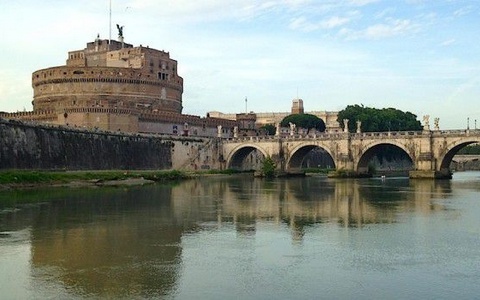
Castel Sant'Angelo
A perfect backdrop for an investigative treasure hunt.
What makes a treasure hunt truly engaging?
1. A story to live
The first element is storytelling.
It’s not enough to hand out a list of clues.
It’s much more effective to build a story.
Participants can become investigators, explorers, archaeologists, time travelers, or protagonists of a mission set in ancient Rome.
The narrative gives meaning to the challenges.
2. Clear goals
Each team must know what it needs to achieve.
Find an item.
Solve a mystery.
Complete a mission.
Reconstruct a story.
Reach a specific point.
A clear objective increases engagement and makes it easier to evaluate the final result.
3. Different types of challenges
An effective treasure hunt shouldn’t always rely on the same kind of riddle.
The challenges can alternate between:
-
quizzes;
-
photographs;
-
logic riddles;
-
observation tasks;
-
historical questions;
-
creative challenges;
-
search for details;
-
orientation tasks;
-
collaborative missions.
That way, each participant can bring different abilities into play.
The real protagonist is the group
No one can win alone
This is one of the most interesting features of a corporate treasure hunt.
The most prepared participant can know the history of Rome.
The most creative one can find an original solution.
The most organized one can manage the route.
The most communicative one can coordinate the group.
Victory comes when all these skills are combined.
And that’s exactly what should happen in the workplace as well.
Skills practiced through play
Communication
Clues must be shared and interpreted.
Incomplete communication can lead the team in the wrong direction.
Leadership
In any group, people who can naturally coordinate others can emerge.
The situation makes it possible to observe different leadership styles.
Problem Solving
The riddles require thinking, changing perspective, and finding solutions.
Time Management
Time becomes a resource.
The team must decide how much to dedicate to each challenge.
Decision Making
It’s not always possible to have all the information.
You must choose and take responsibility for the decision.
Listening
An apparently secondary intuition may be the one that helps solve the riddle.
Creativity
Some challenges don’t have an immediate solution.
The group has to think outside the box.
Digital treasure hunt: when technology meets Rome
Tablets, missions, and interaction between teams
Technology can make the experience even more dynamic.
A treasure hunt with tablets makes it possible to integrate maps, photos, questions, missions, and multimedia content.
Teams can also interact with each other, compare ideas, or compete during the route.
The result is an experience that brings together:
story + technology + games + collaboration.
This is how Rome becomes a kind of big open-air game board.
Why competition can be positive
Compete without losing the team spirit
A healthy competition can increase motivation and engagement.
Scoring introduces a concrete goal.
The leaderboard creates suspense.
The final finish line generates anticipation.
But the real objective shouldn’t simply be to come first.
Competition should become a tool to stimulate collaboration, creativity, and participation.
A treasure hunt for every type of company
Small teams
With smaller groups, it’s possible to create more tailored missions and encourage very high engagement.
Large companies
Splitting participants into teams allows you to involve dozens or hundreds of people while keeping the experience dynamic and competitive.
International teams
Rome becomes a common language.
The activities can be designed in multiple languages, using images, symbols, and challenges that are easy to understand even for people who don’t know Italian perfectly.
New teams
A treasure hunt is particularly effective for helping people who have recently started working together get to know each other.
The value of the final debriefing
The game ends, learning continues
After the finish line comes a phase that’s often underestimated: the final discussion.
Which strategy worked?
Who took on leadership?
How were decisions made?
How were mistakes handled?
Which behaviors helped the group?
The debriefing connects the fun experience to the professional reality.
This is where a simple treasure hunt can turn into a real Team Building tool.
Why we remember a treasure hunt
A meeting can be forgotten.
An experience shared together is much less likely to be forgotten.
The reason is simple: a treasure hunt engages attention, emotions, movement, and relationships all at the same time.
Participants aren’t spectators.
They’re protagonists.
And when a team manages to solve a riddle together, that success becomes a shared memory.
A memory that can resurface months later, maybe during a meeting:
"Do you remember when we took the wrong turn in Trastevere?"
And it’s exactly at that moment that you realize the Team Building worked.
Treasure hunt in Rome: much more than a game
The strength of this activity lies in its simplicity.
A map can become a collaboration tool.
A monument can become a clue.
A riddle can become a problem-solving exercise.
A competition can become an opportunity to get to know each other better.
And Rome can turn into the biggest possible open-air playing field.
From the Imperial Fora to the Pantheon, from Piazza Navona to Trastevere, every corner can become part of a story.
That’s why a well-designed treasure hunt isn’t just the most fun Team Building.
It’s one of the most natural ways to learn how to work together through play.