




























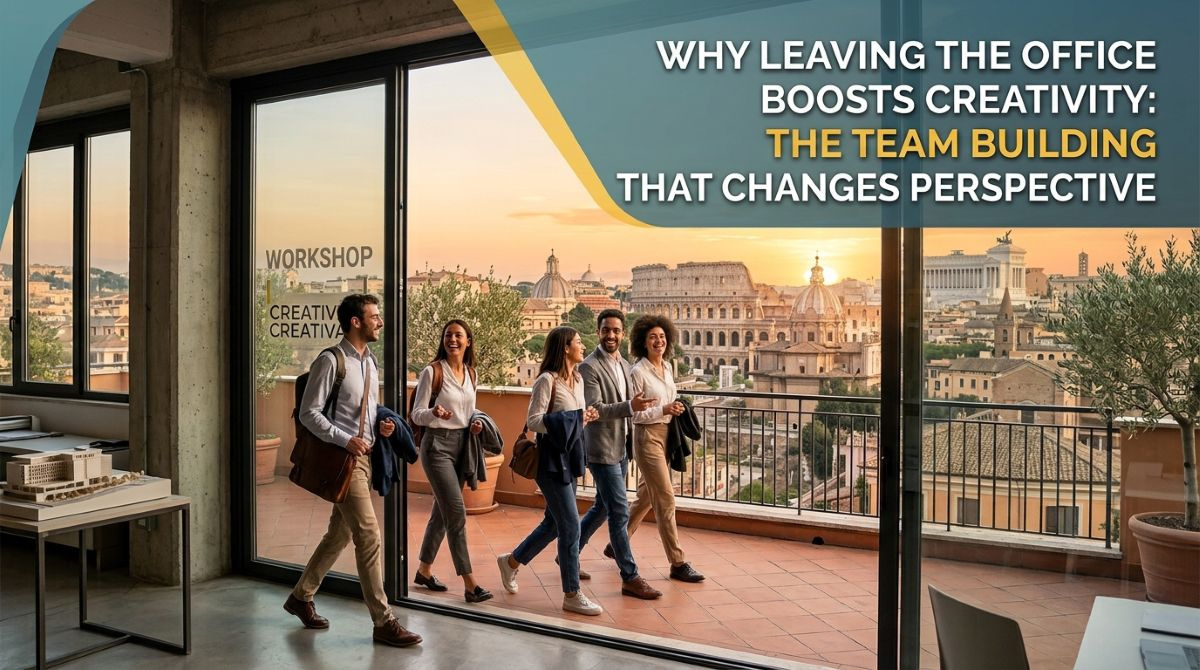
Why leaving the office boosts creativity: team building that changes perspectives
There are meetings that seem never to end, brainstorming sessions where all the ideas sound alike, and days spent in front of the same monitor where even the simplest problem starts to feel complicated.
Then something happens: the team leaves the office.
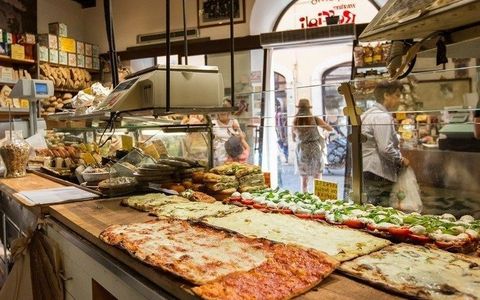
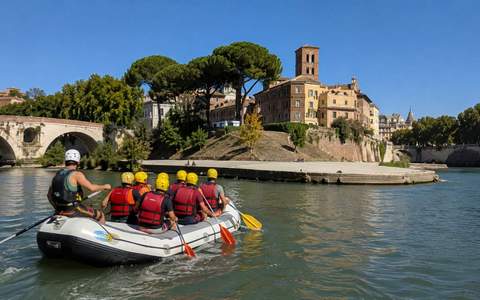
It doesn’t necessarily mean going far. It may be enough to walk through the alleys of Trastevere, to look at Rome from the gardens of the Aventine, to solve a challenge in front of the Roman Forums, or to collaborate during an outdoor activity.
Suddenly the stimuli change, the way of communicating changes, and often, the way of thinking changes too.
It’s precisely from this simple observation that an important question arises for companies: why can leaving the office foster creativity and make team building more effective?
The answer isn’t just about having fun. An experience outside the usual context can reshape dynamics, perspectives, and collaboration methods—turning a different day from the norm into a real tool for team development.
Creativity needs new stimuli
Let’s imagine a team gathered in the same meeting room as always.
The table is the one used every week. The projector is on. People sit more or less in the same places. Another presentation appears on the screen.
The question is: "How can we find a new solution?"
It’s not impossible to come up with great ideas in the office. But when the brain keeps receiving the same stimuli, it’s natural for mental pathways to become predictable.
Leaving that space means introducing new elements: sounds, images, movement, people, architecture, nature, and surprises.
A different environment changes the way you observe
A new context forces you to pay attention.
During a treasure hunt in Rome, for example, an architectural detail that would normally go unnoticed can become the key to solving a challenge.
A seemingly insignificant clue can turn into essential information.
A square becomes a map. A monument becomes a clue. A group of colleagues becomes an investigative team.
The context is no longer just the backdrop of the activity: it becomes part of the experience.
From everyday work to lateral thinking
Business creativity doesn’t simply mean “having lots of ideas.”
It also means being able to look at a problem from different angles, questioning a usual solution, and connecting information that seems far apart.
That’s what happens when you introduce an element of play or exploration.
Play breaks the pattern
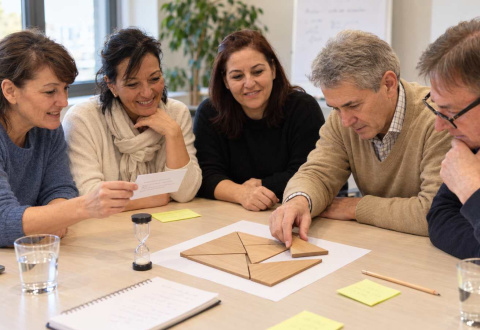
A well-designed team building activity can put people in situations that don’t resemble what they normally face in the office.
A team must:
-
find a solution;
-
divide tasks;
-
listen to different points of view;
-
make decisions;
-
manage time;
-
respond to unexpected events;
-
use available resources;
-
find a common language.
These dynamics are very close to what every organization faces every day.
The difference is that, during the game, people can try them out in a less formal environment with more freedom in how they behave.
Rome as an open-air creative lab
Few cities are as suitable for this type of experience as Rome.
The city lets you alternate history, art, nature, food, and movement within relatively short distances.
Roman Forums: observing the past to find new solutions
The Roman Forums are a perfect example of an environment capable of sparking curiosity.
Walking through this area means crossing centuries of history, but in a team building, the historical heritage can also become a narrative tool.
A challenge may ask participants to observe a specific detail, reconstruct a sequence, interpret a clue, or collaborate to reach a goal.
The group stops being just a collection of individual participants and becomes a team that must observe, interpret, and decide together.
Villa Borghese: when movement frees new ideas
Villa Borghese also offers a completely different setting from a corporate meeting room.
The greenery, open spaces, and the ability to alternate movement and discussion make the environment particularly well-suited for hands-on activities.
Here, team building can take different forms: squad challenges, routes, orientation games, creative activities, or formats that combine movement with problem solving.
Trastevere: creativity among alleys, stories, and details
Trastevere is ideal for those who want to turn the city into a real playground.
The neighborhood offers views, squares, fountains, alleys, and details capable of fueling a narrative.
A treasure hunt or a gamified experience makes it possible to discover Rome with different eyes.
And that’s one of the most interesting aspects: when a person has to search for something, they begin to see what they normally wouldn’t notice.
Leaving the office also changes relationships
Creativity doesn’t come only from the relationship between a person and an environment.
It also comes from relationships among people.
In the office, there are roles, hierarchies, and well-established habits. During an off-site experience, some of these dynamics can temporarily shift.
The manager may become someone who has to follow others.
The quieter colleague may have the decisive intuition.
The person who’s usually very organized may discover they’re especially effective at handling unexpected events.
New roles, new skills
One of the benefits of experiential team building is exactly the opportunity to see people in different situations.
An activity can bring out:
-
leadership ability;
-
active listening;
-
delegation ability;
-
creative thinking;
-
problem solving;
-
time management;
-
mediation skills;
-
non-verbal communication;
-
decision-making ability.
The value isn’t in determining who is “the best.”
It lies in making skills visible that in day-to-day work may remain hidden.
Creativity grows when collaboration increases
One of the most common beliefs is that creativity is mainly individual.
In reality, within a company, many of the most interesting ideas come from combining different points of view.
One person suggests an insight.
Another modifies it.
A third identifies a problem.
A fourth finds a solution.
Creativity therefore becomes a collective process.
Team building as a workshop for collaboration
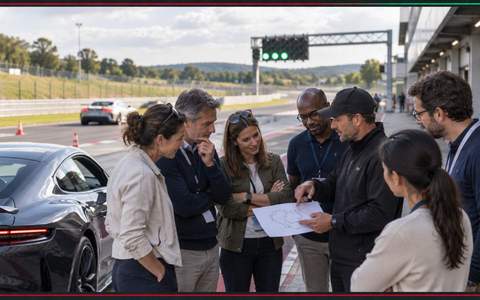
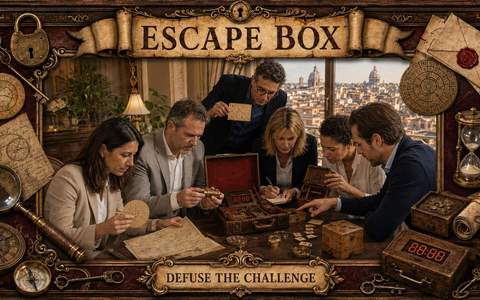
Let’s imagine a team working on a challenge during a treasure hunt.
Time is running out.
One person wants to follow a direction.
Another suggests going back.
Another still notices a detail no one had considered.
If the group manages to listen to all the information, it can reach the solution.
It’s a small simulation of what happens continuously in organizations.
The best idea isn’t necessarily the one from the most authoritative person, but the one the team can recognize, develop, and turn into action.
Why movement can encourage a new way of thinking
Leaving the office also means moving.
Walking, exploring, changing position, and physically interacting with the environment add a dynamic component that a day spent in front of a screen inevitably reduces.
This doesn’t mean every team building must be sporty.
On the contrary, the choice of activity should depend on the company’s goals and the group’s characteristics.
Outdoor doesn’t necessarily mean extreme activities
A common mistake is thinking that an outdoor team building must necessarily involve demanding physical challenges.
That’s not true.
An outdoor experience can be:
-
cultural;
-
creative;
-
food-focused;
-
investigative;
-
photography-based;
-
nature-oriented;
-
focused on problem solving;
-
based on gamification.
The real differentiating factor is the change of context.
From monument to metaphor: learning through experience
Rome also offers a special opportunity: turning its places into organizational metaphors.
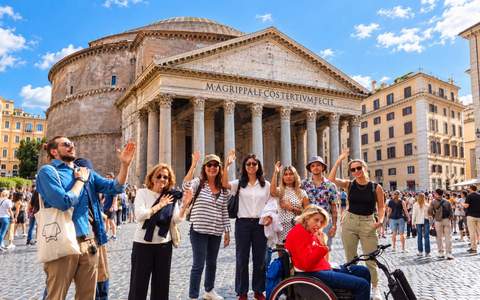
The Pantheon can become a story about engineering and the ability to build something meant to last.
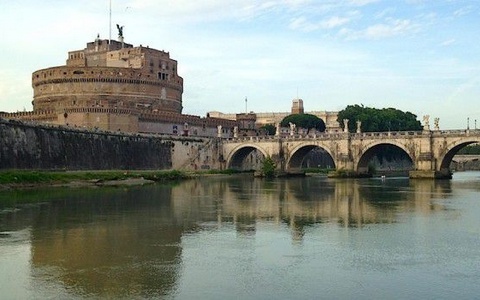
Castel Sant’Angelo can tell stories of transformation and adaptation: from a mausoleum to a fortified structure, the monument changed function over the centuries.
The Tiber can instead become the metaphor for an element that crosses the city and accompanies its history.
These places can become the starting point for activities in which history and training come together.
How to design a truly creative team building
It’s not enough to take a group out of the office to automatically get more creativity.
The location matters, but even more important is the way the experience is designed.
Start from the company goal
Before choosing the activity, ask:
What do we want to achieve?
The goal may be to improve communication, integrate new collaborators, strengthen trust, develop problem solving, or simply create an opportunity for socializing.
The answer determines the best format.
Build a story
A memorable team building shouldn’t be just a sequence of games.
It should have a narrative.
A mission.
A challenge.
A final goal.
When people feel like they’re protagonists in a story, the experience becomes more engaging.
And this is where Rome can make the difference: the city already has an extraordinary amount of stories, characters, legends, and places that can be transformed into experiential scenarios.
Leave room for the unexpected
Creativity also needs freedom.
If every step of the activity is completely predictable, the group will have fewer opportunities to experiment.
A good format must therefore have a clear structure, but leave space for participants’ decisions.
What does an off-site experience bring to the company?
The real value of a team building isn’t measured only during the activity.
The most important moment comes afterward.
When the group goes back to work, some dynamics can change.
A colleague may be perceived differently.
A skill may have been discovered.
A conflict may have been addressed from a new perspective.
A person may have shown abilities that previously hadn’t emerged.
From experience to everyday work
To turn an experience into learning, it’s also useful to plan a final discussion moment.
Simple questions can be very effective:
-
What helped us reach the goal?
-
Where did we waste time?
-
Who had the decisive idea?
-
Did we listen to everyone?
-
How did we handle disagreement?
-
What can we bring into our everyday work?
In this way, the game stops being only a pleasant moment and becomes a tool for organizational reflection.
Off-site team building isn’t an escape from work
So the real question isn’t whether leaving the office is good in absolute terms.
The correct question is: how can we use a different environment to help people think, communicate, and collaborate differently?
A team building designed with this objective can become a lab where you practice behaviors that are difficult to observe during a normal workday.
Rome offers an additional advantage: it allows you to turn the city itself into a training environment.
Between a challenge at the Roman Forums, a route through the alleys of Trastevere, an activity at Villa Borghese, or a mission in the historic center, the team doesn’t just “do something together.”
They share an experience.
And often it’s precisely from a different experience that a different idea arises.
FAQ: leaving the office and creativity in team building
Why can a different environment stimulate creativity?
Because it introduces new visual, sensory, and social stimuli and can promote interaction methods different from work routine.
Does an outdoor team building have to be sporty?
No. It can include treasure hunts, cultural activities, gamification, food-based experiences, photography routes, creative activities, and many other formats.
Why is Rome a good city to organize a team building?
For the extraordinary variety of scenarios: monuments, squares, historic neighborhoods, parks, museums, archaeological areas, and dedicated locations for corporate activities.
Can team building also help with communication?
Yes. Many activities require listening, sharing information, coordinating, and being able to make decisions together.
How do you measure the results of a team building?
It’s useful to define the objectives before the event and plan a final debriefing, connecting what happened during the experience to the dynamics of everyday work.
What is the most suitable team building for a company?
There’s no universal format. The choice depends on the number of participants, the objectives, the available time, the season, the budget, and the type of group.
Conclusion: changing place to change perspective
The next time a creative meeting seems to go nowhere, perhaps you don’t need to add another slide to the presentation.
Maybe you simply need to change your perspective.
Leaving the office means entering an environment where people can observe, move, experiment, make mistakes, laugh, compare ideas, and find solutions together.
And when the context changes, relationships can change too.
That’s why a team building in Rome can become much more than an off-site day: it can be a concrete opportunity to train creativity, collaboration, and the ability to handle the unexpected.
If you want to experience this or similar activities, click here; you’ll find our proposals:
Request a free quote and receive all the information about your team building experience.
You can [request a quote] directly to get information and design the experience best suited to your group. Request a quote