












































The Appian Way Beyond the Clichés: The Ever-Changing Wonders and Secrets of the Regina Viarum for an Excellence Team Building
There are places where history doesn’t just remain locked away in books, but breathes beneath the steps of those who cross it. The Via Appia Antica, celebrated for millennia as the Regina Viarum, is an iconic example of this magic suspended in time. Yet even those who live in Rome—or think they know every corner of it—still end up discovering details that are completely unexpected when they walk along its basalt paved stones covered with domestic pine and surrounded by the Roman countryside.
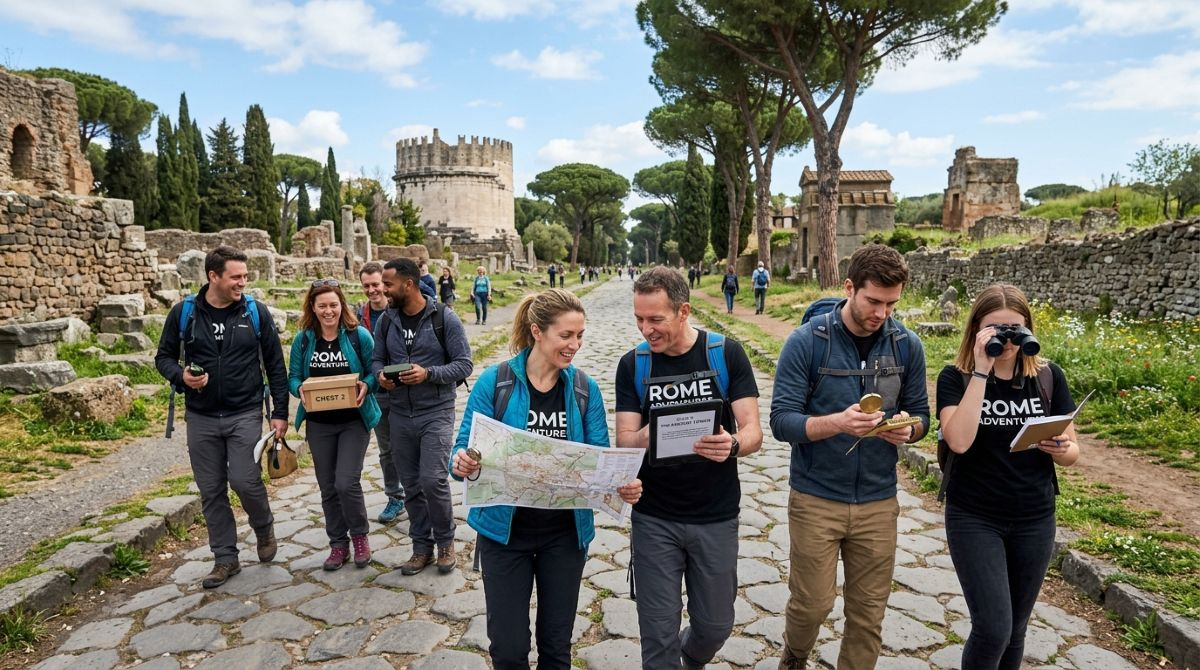
For modern companies, the Appia Antica is not only an unforgettable archaeological backdrop: it is a true open-air laboratory for experiential learning, leadership, and group cohesion. Let’s explore together some of the most fascinating curiosities of this millennia-old artery that continue to surprise even the tightest teams.
1. The Genesis of the Regina Viarum: A Millennia-Old Engineering of Precision
The First Great “Network” of Antiquity
Founded in 312 BC by the censor Appius Claudius the Blind, the Via Appia was not conceived simply as a road, but as the first real communication and logistics infrastructure of the Roman-centered empire. Connecting Rome to Capua—and later to Brindisi—meant linking cultures, goods, and military strategies.
In a business setting, this translates into an immediate parallel: just as the Romans invented the statio system (messenger stations for changing horses) to speed up information flow, today corporate teams must build smooth, frictionless communication channels.
Roman Paving Stones: The Secret of Longevity
Under visitors’ feet lie blocks of lava stone (the so-called basoli), fitted together without mortar, with such a high level of engineering that they have resisted for over twenty-three centuries of use. Each stone has an irregular shape, yet it fits perfectly with the surrounding ones: an effective visual metaphor for integrating different skills within a successful team.
2. Unknown Points of Interest (POIs) and Unique Appia Curiosities
The Tomb of Cecilia Metella and the Head of Bove: A Contrast of Power
One of the most famous Points of Interest along the Appia Antica is the Mausoleum of Cecilia Metella. Many know its majestic cylindrical shape, but few know that in the Middle Ages it was transformed into the central keep of a fortified castle (the Castrum Caetani).
A short distance away is the site of Capo di Bove, an ancient private thermal facility belonging to an aristocratic Roman residence. Here it is possible to observe perfectly preserved mosaics and understand how wellness (wellness) was a central pillar in the organizational routine more than two thousand years ago.
The Massenzio Complex: Between Chariot Racing and Competitive Dynamics
the Circus of Maxentius is one of Rome’s best-preserved archaeological complexes. With a capacity of over 10,000 spectators, this is where chariot races were held at the very limits. During our team-building sessions, this place offers inspiration to explore:
-
Managing stress under pressure;
-
Delegation and mutual trust (as between the charioteer and his team);
-
Focusing on the common strategic objective.
The Park of the Tombs of the Via Latina and the “Domine Quo Vadis?” Church
As you move toward the urban center, the Appia meets the well-known church of Santa Maria in Palmis, known to most as Domine Quo Vadis. According to tradition, here Saint Peter would have encountered Jesus in a vision that overturned his decisions. A little farther on, within the archaeological park, lie the Tombs of the Via Latina, where frescoes with incredibly vivid colors are preserved, protected for centuries beneath the ground.
3. From Myth to Strategy: Why the Appia Antica Surprises Your Colleagues
The Surprise Effect as a Motivational Lever
In the modern work environment, routine and conventional settings can flatten innovation and critical thinking. Taking a team to the Appia Antica— not just for a simple tourist stroll, but within an Urban Orienteering experience or an interactive treasure hunt based on storytelling—sparks the surprise effect.
Revealing a secret passage near the Caffarella, deciphering hidden codes on a third-century inscription, or tackling problem-solving challenges in the shadow of the Claudian Aqueduct allows you to:
-
Break traditional communication patterns;
-
Bring out unexpected talents among colleagues;
-
Strengthen corporate belonging in a memorable setting.




