



























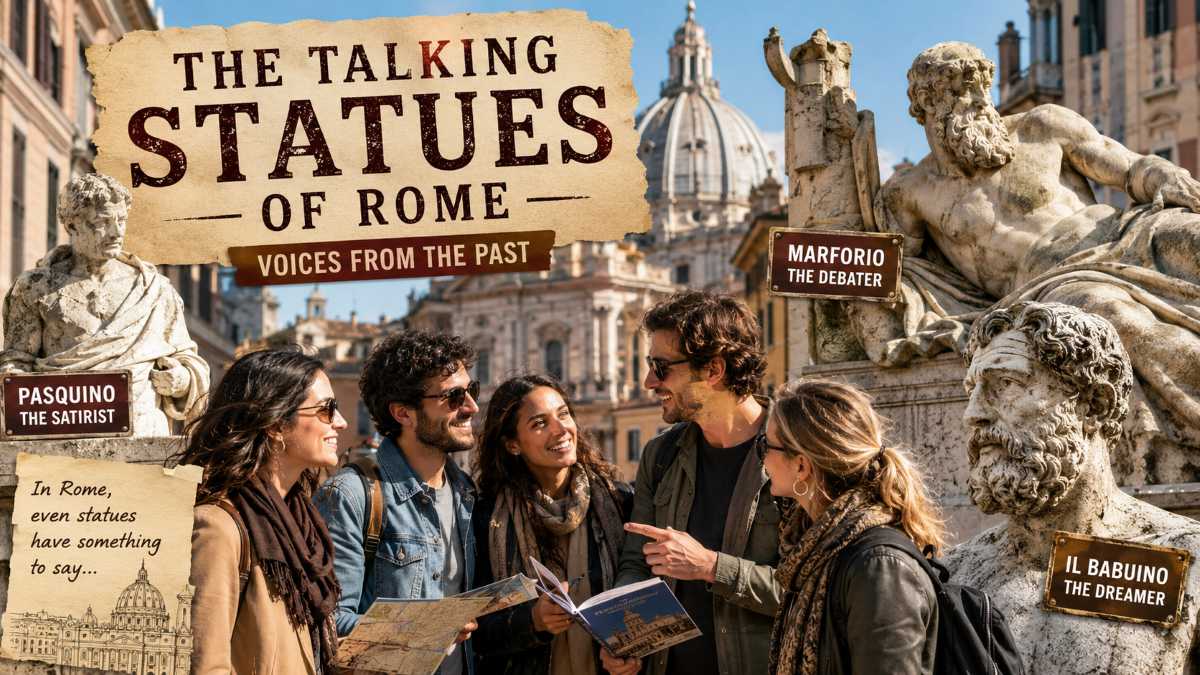
The Talking Statues of Rome: when the city gave voice to its citizens
There is a Rome that everyone knows: the one of the Colosseum, the Pantheon, monumental fountains, and the great Baroque squares.
And then there is a more secret, ironic, and irreverent Rome. A Rome that for centuries found a way to speak through stone.
These are the talking statues of Rome, the stars of one of the most curious traditions of the Capital. Often anonymous or forgotten statues, they have instead become a point of reference for a particular form of popular communication: on their pedestals, Romans would leave messages, poems, satire, critiques, and direct jokes aimed at those in power.
In an era when expressing one’s disagreement openly could be risky, a statue could become the voice of those who had none.
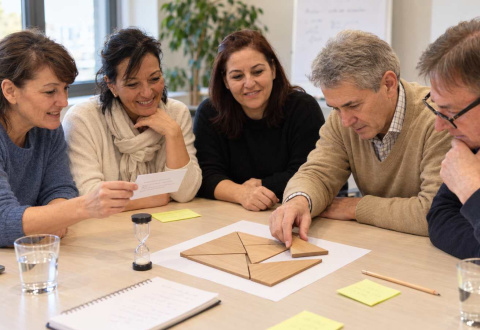
Today, these statues represent a surprising historical and cultural heritage, and they can also become a starting point for an original Team Building in Rome experience, made of riddles, storytelling, observation, and discovery of the city.
What are the talking statues of Rome?
The talking statues are a group of ancient sculptures scattered throughout the historic center of Rome which, especially between the 16th and the 19th centuries, were used by citizens to spread satirical messages.
Their name comes precisely from the metaphorical ability to “speak.”
Of course, the statues did not utter words.
It was the Romans who made them “speak.”
During the night, small written texts—often anonymous—were attached to their bases or in the immediate vicinity. They commented on political events, decisions by the authorities, the behavior of public figures, and the day-to-day happenings of city life.
These messages were known as pasquinades.
A form of communication ahead of its time
Before social media, newspapers, and modern communication tools, a sentence placed in the right spot could quickly reach countless people.
Talking statues worked almost like a public bulletin board.
The next day, passersby would stop, read, and comment.
So satire became a way to tell the story of the city from the perspective of its inhabitants.
That very element is what makes the history of the talking statues particularly fascinating even today: behind a simple sculpture, there is a story of communication, creativity, and collective participation.
Pasquino: the most famous of the talking statues
Among all the talking statues of Rome, Pasquino is certainly the most famous.
It is located near Piazza Navona, at the corner between Piazza di Pasquino and Via di Pasquino.
The statue, very deteriorated, probably represents a Hellenistic group and was found in the 16th century during some works in the area.
But its fame comes not only from its antiquity.
Why is it called Pasquino?
The origin of the name is wrapped in tradition.
One of the best-known stories tells of a certain Pasquino, perhaps a tailor, a schoolmaster, or a local figure particularly inclined to satire.
According to legend, it was his sharp-tongued character that gave the statue its name.
From that moment on, Pasquino became the main recipient of the pasquinades, compositions often anonymous and sarcastic.
The tradition was so deeply rooted that even today the expression “pasquinade” is used to indicate a satirical critique—often biting and ironic.
Pasquino and freedom of speech
The power of Pasquino did not lie in the beauty of the statue.
It lay in its meaning.
Anyone who left a message could speak to the city without exposing themselves directly.
It was a form of anonymous communication that allowed people to challenge power and tell what normally could not be said openly.
In this sense, Pasquino can be considered one of the most curious places in the history of communication in Rome.
Marforio: Pasquino’s dialogue partner
If Pasquino is the most famous protagonist, Marforio is his ideal counterpart.
The large statue is located today at the Museo del Campidoglio, within the complex of the Capitoline Museums.
Marforio was an ancient Roman statue depicting a reclining male figure, probably associated with a river divinity.
But over the centuries, he too took on a new identity.
The dialogue between the statues
The tradition says that Pasquino and Marforio were the protagonists of real satirical dialogues.
A question was attributed to one of the statues.
The answer arrived from the other.
In this way, Romans built quick give-and-take exchanges capable of commenting on the city’s political and social life.
It’s a surprisingly modern narrative mechanism.
Two “characters” that talk across distance, an audience following the conversation, and a final line meant to make people reflect.
The six talking statues of Rome
The tradition of talking statues is not only about Pasquino and Marforio.
The so-called Congress of the Witty traditionally includes six statues.
They are:
-
Pasquino
-
Marforio
-
Madama Lucrezia
-
Abate Luigi
-
Il Facchino
-
Il Babuino
Each one has its own story and its own location in the city.
Together, they form a kind of itinerary of an even more ironic and popular Rome.
Madama Lucrezia: the group’s female voice
Among the talking statues, Madama Lucrezia is especially interesting because she represents a female figure.
The statue is located near Piazza San Marco, close to Piazza Venezia.
It is a large ancient sculpture, probably depicting an Egyptian divinity or a figure connected to the cult of Isis.
A statue with a mysterious character
The name “Madama Lucrezia” does not come from its archaeological identification, but from popular tradition.
Like the other talking statues, she also became a recognizable presence in the urban fabric and a point of reference for Roman satire.
Her location, in the heart of the city, also places her within a route rich in important POIs, including Piazza Venezia, Palazzo Venezia, the Capitoline Hill, and the area of the Imperial Fora.
Abate Luigi: the statue that changed identity
Another protagonist is Abate Luigi, located in the area of Corso Vittorio Emanuele II, near the Church of the Most Holy Shroud.
This statue, too, has ancient origins, but the name comes from popular identification with a religious figure who, according to tradition, resembled the sculpture to some extent.
A voice often targeted
Abate Luigi became one of the reference points for Roman satire.
His story shows how the statues could progressively acquire a new identity, completely different from the original one.
They were no longer simply archaeological finds.
They became characters.
And, above all, they became part of the city’s everyday life.
Il Facchino: a very special statue
The Facchino is located on Via Lata, along the current Via del Corso.
It is one of the most distinctive statues in the group because it depicts a man intent on carrying a small barrel.
For a long time, the figure was associated with the trade of porters who transported water and wine.
When a profession becomes a symbol
Choosing to depict an ordinary worker is significant.
The talking statues did not belong only to Rome’s great official history.
They were also tied to everyday city life, professions, ordinary people, and popular culture.
So Il Facchino represents another perspective on the Capital: that of those who lived and worked on its streets.
Il Babuino: the statue that gave its name to a street
The Babuino is located along Via del Babuino, one of the streets that connects Piazza del Popolo to Piazza di Spagna.
The statue depicts a reclining male figure, traditionally identified as Silenus, a character from Greek mythology associated with Dionysus.
Why is it called Babuino?
Its appearance, not particularly elegant, impressed the Romans, who began to call it “er Babuino.”
The nickname was so successful that it ended up identifying the entire street.
It’s a perfect example of how popular language can change the perception of a place.
A statue gives a street its name.
The street becomes a point of reference.
The nickname enters the collective memory.
And the city changes again, through the words of its inhabitants.
The talking statues and Rome of the alleyways
To truly understand the phenomenon of the talking statues, you have to imagine Rome a few centuries ago.
A city very different from the one we know today.
The streets were narrower, communication took place mostly orally, and squares were important places to meet.
In this setting, a statue placed in a public space could become a gathering point.
People would pass by.
Someone would read.
Someone would laugh.
Someone would tell the content to those who couldn’t read.
The news would spread.
Satire became conversation.
The city as a big social network
It’s interesting to observe this phenomenon with the eyes of the present.
Talking statues can be considered, with all due historical differences, a kind of early urban social network.
A message was born anonymously, placed in a public space, and became the subject of discussion.
The difference is that back then, you couldn’t just press a button.
You had to leave home and go look for it.
An itinerary among the talking statues
The story of the statues can also become an original way to explore Rome.
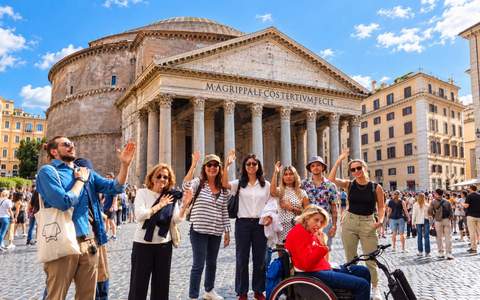
An itinerary dedicated to the talking statues, in fact, lets you cross different areas of the historic center and meet some of the main POIs of Rome.
The route can be built, for example, by linking:
-
Pasquino and Piazza Navona;
-
the Pantheon and the streets in the center;
-
Il Babuino and Piazza di Spagna;
-
Madama Lucrezia and Piazza Venezia;
-
Abate Luigi and Corso Vittorio Emanuele II;
-
Marforio and the Capitoline Hill.
In this way, the story of the statues turns into a walk through centuries of Roman history.
Talking statues as Team Building
And it is precisely here that this curious story can become a business experience.
A Team Building around the talking statues of Rome can turn the visit into an investigative and narrative game.
Participants can be divided into teams and given a series of clues.
The goal?
To identify the statues, reconstruct their story, locate the POIs along the route, and decipher messages inspired by the tradition of pasquinades.
The challenge of the pasquinades
One of the most interesting activities could be creating a modern company “pasquinade.”
Each team receives a theme and must develop a satirical, creative, and naturally respectful sentence.
In this way, you work on the ability to synthesize, on creativity, and on communication.
Guess the statue
Another test can start from a description.
“My statue depicts a man with a barrel.”
“My nickname gave its name to a street.”
“For centuries it has ideally been in dialogue with another statue.”
Teams must figure out which statue it is and reach the correct location.
Rome as a playground
The real protagonist becomes the city.
Participants do not simply follow a guide; they observe the environment, collaborate, discuss, and make decisions.
The result is a kind of urban Team Building that combines culture, storytelling, gamification, and discovery of the area.
What skills does a Team Building around the talking statues develop?
An activity like this can be designed to stimulate different cross-cutting skills.
Communication
Teams must share information, listen to others’ ideas, and reach a common decision.
Problem solving
Clues may require reasoning, logical connections, and interpretation skills.
Creativity
The tradition of the pasquinades offers an ideal ground for stimulating imagination.
Collaboration
No one necessarily has all the information: the solution emerges from the comparison among participants.
Observation
Rome is full of details. Learning to notice them means looking at the city with different eyes.
Leadership
Team activities can naturally bring out coordination and group-management abilities.
Why tell Rome through its curiosities?
Rome’s cultural heritage is so vast that people often tend to focus exclusively on the most famous monuments.
But the city’s true richness also lies in less well-known stories.
Talking statues are an extraordinary example.
They tell of an ironic, popular, creative, and sometimes irreverent Rome.
A Rome in which even a forgotten statue could become a protagonist in public life.
And it is precisely this lesser-known dimension that makes an itinerary like this particularly suited to experiential Team Building.
The talking statues of Rome: heritage to rediscover
Today, as we walk through the center of Rome, we can pass by one of the talking statues without realizing the number of stories it carries with it.
Pasquino continues to remind us of a city capable of mocking power.
Marforio preserves the memory of ancient dialogues.
Il Babuino shows how a nickname can change the name of a street.
Il Facchino tells the world of work and everyday life.
Madama Lucrezia and Abate Luigi complete this extraordinary group of “voices of stone.”
They are immobile statues, but they tell a city in constant motion.
And perhaps this is exactly what makes them most fascinating.
Rome is not made only of monuments to look at. It is made of stories to listen to.
The talking statues are one of the most original testimonies of this.
Discovering them means getting to know a different Capital—more ironic and more human.
Turning them into a Team Building route, however, means taking one more step: allowing a group to experience the city, play with its history, and build together a new experience.