































Underground Rome: a hidden journey beneath the city
There is a Rome we know by looking up: domes, bell towers, columns, Renaissance palaces and monuments that have made the Capital one of the most fascinating cities in the world.
But there is another Rome, too.
It is the one that lies beneath our feet.
All it takes is to descend a staircase, cross a dark corridor or go through an apparently ordinary door to find yourself face to face with ancient streets, Roman domus, places of worship, aqueducts, frescoes and entire spaces that have remained hidden for centuries.
This is underground Rome, a layered city that tells the story of the Capital from a completely different perspective.
Here, time does not flow only forwards: you literally descend through the centuries.
And this is precisely what makes Rome’s underground an extraordinary setting for a Team Building experience, too: a journey into the past that becomes an opportunity to collaborate, observe, solve puzzles and discover together a city that is often hidden right beneath the streets we walk every day.
Underground Rome: why is the city on different levels?
One of the most fascinating aspects of Rome is its layers.
Over the centuries, fires, earthquakes, abandonment, demolitions and new construction have continually changed the level of the city.
The oldest buildings were often abandoned or demolished, and their remains became the foundations for new structures.
The result is a kind of giant vertical archaeological archive.
Descending below modern street level, it is therefore possible to encounter evidence from completely different periods.
A city built on top of itself
An extraordinary example is the Basilica of San Clemente, a few minutes from the Colosseum.
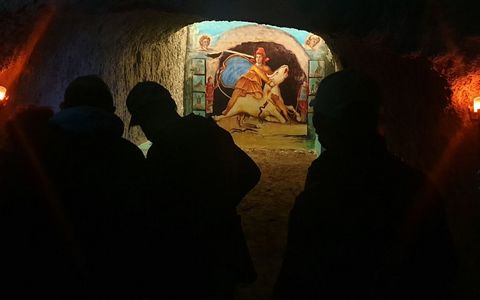
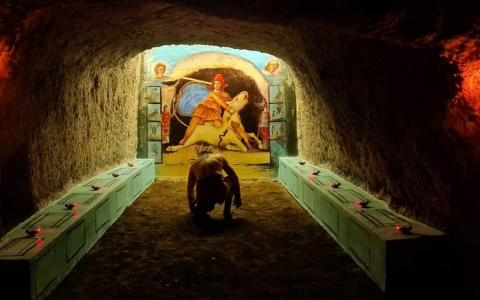
Here, a visit takes you through different layers of history: from the present-day 12th-century basilica, you descend to the 4th-century lower basilica and, even further below, to 1st-century Roman buildings, including a mithraeum. (Basilica of San Clemente)
It is difficult to find a better illustration of what “underground Rome” means.
You are not simply visiting an archaeological site.
You are descending through history.
Basilica of San Clemente: three eras beneath a single church
The Basilica of San Clemente is one of the most evocative places for understanding Rome’s urban layers.
Imagine entering the basilica.
Visitors see mosaics, columns and medieval decorations.
Then they find a staircase.
They descend.
The light changes.
The walls become older.
The spaces tell the story of another era.
Descend further, and medieval Rome gives way to imperial Rome.
The early Christian basilica level
The lower level preserves a 4th-century basilica, later abandoned and buried when the upper basilica was built.
The spaces preserve important medieval frescoes, dating from between the 8th and 11th centuries, including the famous depiction of the Legend of Sisinnius, an important testament to the history of the Italian language. (Basilica of San Clemente)
The mithraeum and 1st-century Rome
Descending further takes you to an even older level.
Here you will find Roman-era structures and a mithraeum, established in a semi-underground area of a Roman domus.
The site helps us understand just how different religious practices were in imperial Rome and how culturally complex the city was. (Basilica of San Clemente)
The feeling is like stepping into a story in which every room adds a new chapter.
Vicus Caprarius: the city of water beneath the Trevi Fountain
Just a few steps from one of Rome’s most photographed landmarks, another world lies hidden.
It is the Vicus Caprarius – The City of Water, an underground archaeological area in the Trevi district.
While thousands of visitors toss a coin into the Trevi Fountain above ground, an archaeological complex beneath street level bears witness to the area’s long history. (vicuscaprarius.com)
A Rome hidden nine metres underground
Excavations have brought to light, more than nine metres below today’s street level, imperial-era structures, a domus and the castellum aquae connected to the Aqua Virgo aqueduct. (vicuscaprarius.com)
It is a perfect example of how Rome can surprise us even in its best-known places.
The Trevi Fountain is famous around the world.
But a much older history is preserved beneath the district.
The charm of the Aqua Virgo
Water is one of the great protagonists in Rome’s history.
Aqueducts enabled the development of the ancient city and supplied baths, fountains and homes.
At Vicus Caprarius, this relationship becomes physically visible.
Visitors can observe the archaeological structures and understand how water helped shape everyday life in ancient Rome.
The Roman Houses on the Caelian: life in hidden Rome
Another extraordinary site is the Roman Houses on the Caelian, beneath the Basilica of Saints John and Paul.
The complex includes around twenty underground rooms decorated with frescoes and tells more than four centuries of history, from the 1st to the 4th century. (Turismo Roma)
Here, the surprise is not only archaeological.
It is architectural, too.
From workshops to domus
Over time, the rooms served different purposes.
The complex includes traces of workshops and warehouses, homes and domus, before the area was transformed into a place associated with Christian worship. (Turismo Roma)
This continual change tells us something fundamental about Rome: nothing remains exactly the same.
The city transforms, repurposes, incorporates and layers.
A journey between paganism and Christianity
The Roman Houses on the Caelian also bear witness to the transition and coexistence of paganism and Christianity.
This is precisely what makes them particularly interesting for a cultural tour or Team Building activity.
You are not simply looking at artefacts.
You are piecing together stories.
You are looking for connections.
You are trying to imagine what life might have been like for the people who lived in these spaces.
The Quarries of the Temple of Claudius: an even more mysterious Rome
For those who want to venture into an even more unusual world, the Caelian Hill is also home to the Quarries of the Temple of Claudius.
These are large underground galleries associated with tufa extraction, with shafts and pools extending beneath the area of the Basilica of Saints John and Paul. They can be visited on guided tours. (Turismo Roma)
Here, the experience changes completely.
You are not facing a neatly arranged archaeological site that is easy to interpret.
Visitors enter a more enigmatic space, almost like an exploration.
And it is precisely this atmosphere that makes it perfect for an experiential activity.
The Colosseum’s underground: the machinery behind the spectacles
When talking about underground Rome, we cannot forget the Colosseum.
Beneath the arena lies one of the most spectacular features of the entire amphitheatre: the hypogeum.
This complex network of corridors and rooms was connected to the logistical operation of the spectacles.
Men, animals, scenery and equipment that were to appear suddenly in the arena were prepared here.
The invisible machinery of the spectacle
The audience saw the gladiator enter the arena.
They did not see what was happening below.
The underground, however, housed a complex system of corridors, lifts and service areas.
The Colosseum Archaeological Park describes the hypogeum as a system of numerous corridors arranged on either side of a large central corridor, with operating chambers for the large lifts. (Colosseum Archaeological Park)
The visit therefore allows you to see the Colosseum from a completely different perspective.
No longer just the monument.
But its hidden stage machinery.
Domus Aurea: when the underground preserves an imperial palace
Another unmissable site is the Domus Aurea, the gigantic residence built by Nero after the fire of 64 AD.
Today, the parts open to visitors are located on the Oppian Hill and consist of rooms that were later buried and incorporated into the structures built above them. (Colosseum Archaeological Park)
The “caves” that captivated Renaissance artists
The fate of the Domus Aurea is particularly curious.
After Nero’s death, his successors tried to erase his memory, and the rooms were gradually stripped of their decorations and filled with earth.
Centuries later, during the Renaissance, some artists lowered themselves from above into what appeared to be real “caves”.
Among them were artists such as Raphael, who were captivated by the ancient decorations.
The term grotesques, used to describe a type of decoration inspired by the motifs discovered in the underground rooms of the Domus Aurea, also derives from this unusual experience. (Colosseum Archaeological Park)
Underground Rome and the thrill of discovery
What makes an experience underground so special?
Perhaps it is the fact that, when we descend beneath Rome, the way we observe changes.
Above ground, we are used to looking.
Underground, we have to learn to listen.
A wall tells of a transformation.
A floor reveals an era.
A fresco hints at a story.
A passage shows how the city worked.
Darkness becomes part of the experience.
A city to piece together
Underground Rome is not always immediately clear.
Often, what we see are fragments.
And that is precisely what makes it fascinating.
You have to connect the clues to reconstruct the place in your mind.
In a sense, visiting Rome’s underground sites means becoming an archaeologist for a little while.
Underground Rome as Team Building
And this is where the Capital’s underground heritage can become a truly original corporate experience.
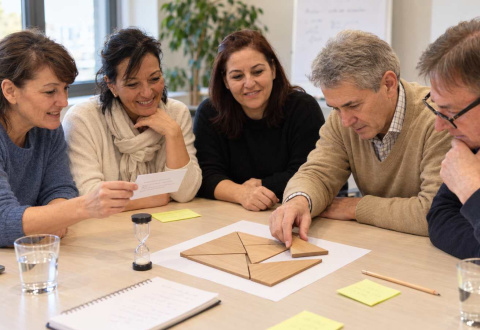
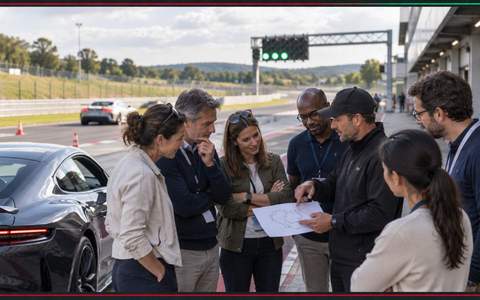
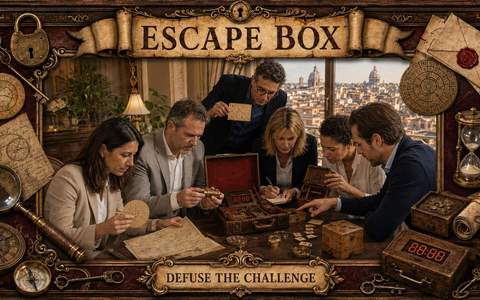
A Team Building experience in underground Rome can be designed as an investigative mission.
Teams receive a map, a series of clues and a story to piece together.
Each stop adds a new element.
Each place hides an answer.
Every challenge requires collaboration.
Hunting for the layers of history
A particularly effective activity could involve linking several underground POIs.
A team might have to find:
-
an ancient domus;
-
a place of worship;
-
a structure connected to water;
-
a room with frescoes;
-
evidence of imperial Rome;
-
a place linked to the city’s transformation over the centuries.
The goal is not simply to reach the destination.
It is to understand the route.
Archaeological puzzles
Clues can be created using dates, symbols, floor plans, inscriptions and architectural details.
A feature observed in one room can become the key to solving the next puzzle.
This way, the visit is not passive.
Participants have to observe their surroundings carefully and discuss them with their teammates.
What skills does Team Building in underground Rome develop?
An activity of this kind can be designed to develop a range of transferable skills.
Problem-solving
Archaeological puzzles require reasoning, analysis and the ability to connect different pieces of information.
Communication
To find the solution, every participant has to share what they have observed.
Collaboration
The information is distributed among team members, and only by putting it together can they find the answer.
Leadership
The challenges reveal how different leadership styles emerge naturally.
Observation skills
Underground, even a small detail can be of fundamental importance.
Adapting to the unexpected
An experiential route can include changes in strategy, surprise challenges and new information to interpret.
Team Building among history, mystery and culture
The great strength of underground Rome lies in its ability to bring together very different elements.
There is history.
There is archaeology.
There is mystery.
There is architecture.
There is storytelling.
And above all, there is the chance to turn all of this into a shared experience.
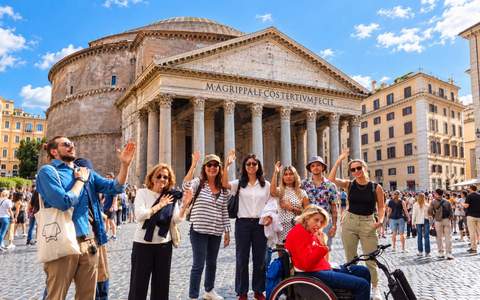
For a corporate group, it can be an original alternative to a classic guided tour.
Not just a lesson about the history of Rome, but a journey in which participants are invited to live history.
POIs to connect on an underground itinerary
A Team Building itinerary focused on underground Rome can be designed by choosing different points of interest according to the duration of the activity and the group’s goals.
Some of the main POIs to consider include:
-
Basilica of San Clemente, near the Colosseum;
-
Colosseum and its underground;
-
Domus Aurea, on the Oppian Hill;
-
Vicus Caprarius, near the Trevi Fountain;
-
Roman Houses on the Caelian;
-
Quarries of the Temple of Claudius;
-
Roman Forum and Palatine Hill, as historical context for understanding the city’s layers.
The route should naturally take into account access arrangements and any bookings required by the individual sites.
For example, the Colosseum’s hypogeum can be visited through specific ticket options and guided tours, while visits to the Domus Aurea are subject to visitor limits. (Colosseum Archaeological Park)
Why choose underground Rome for a corporate event?
An effective Team Building experience should leave participants with something that lasts beyond the end of the activity.
Underground Rome has precisely that ability.
It is difficult to forget the feeling of walking through a basilica and then descending, level by level, until you come across a Roman domus and an ancient mithraeum.
It is difficult to forget the thought of walking just a few metres from the Trevi Fountain, knowing that a completely different city lies beneath the street.
And it is difficult to forget an experience shared with colleagues who, faced with a puzzle, had to combine their insights and skills.
The real Rome is also beneath our feet
Rome is often described as an open-air museum.
But perhaps that definition tells only half its story.
The other half is hidden below street level.
It is in the corridors of the Basilica of San Clemente.
In the domus on the Caelian.
In the Colosseum’s hypogeum.
In the remains of Vicus Caprarius.
In the rooms of the Domus Aurea.
It is a city made up of layers, overlapping structures and memories.
A city in which every era has left something behind, and the next has built over what came before.
Descending into underground Rome therefore means descending into the city’s very memory.
And turning this journey into a Team Building experience means adding another layer to history: that of the people who today explore these places together, collaborate, play and discover Rome through a shared experience.
Because the Capital does not have just one story.
It has countless stories.
Some are written on monuments.
Others are painted on walls.
And the most surprising ones, sometimes, lie right beneath our feet.