












































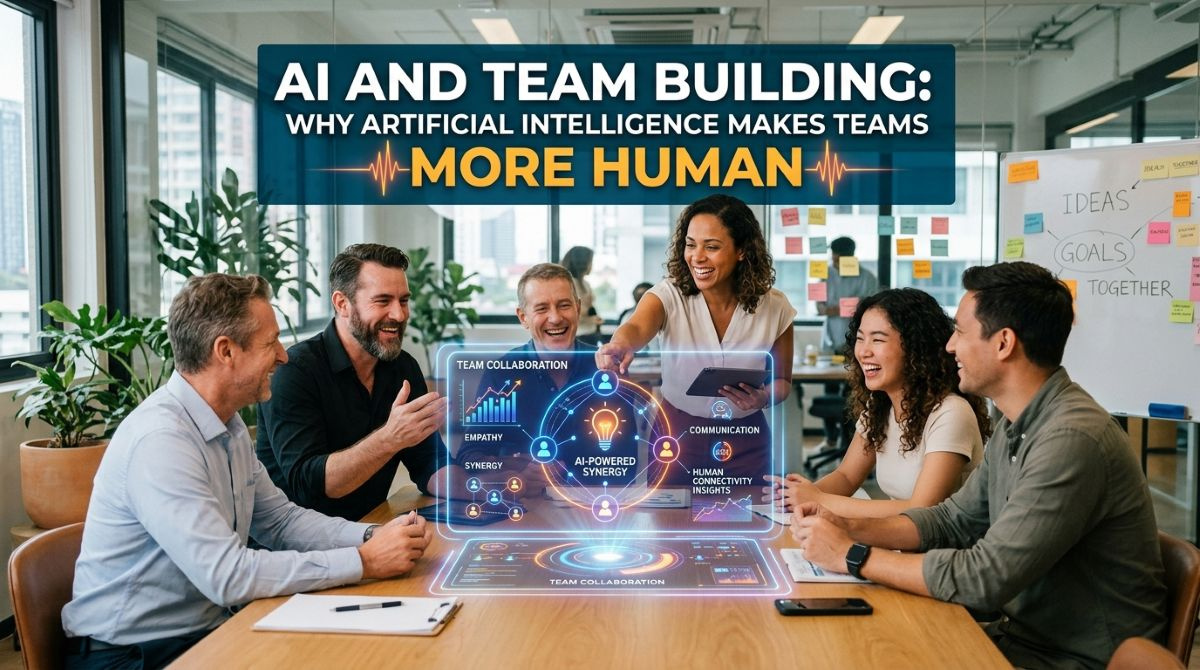
AI and Team Building: why Artificial Intelligence can make teams more human
Let’s imagine a scene.
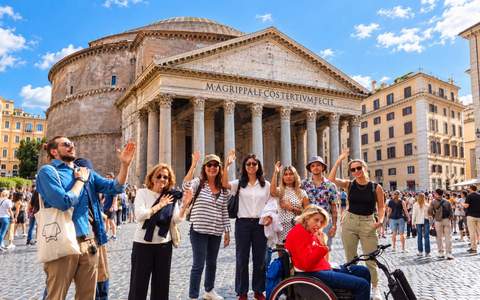
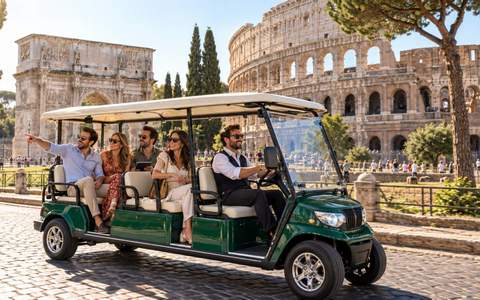
A group of colleagues is in the center of Rome. In front of them, there isn’t a classic meeting agenda, nor a long presentation full of slides. There is a challenge.
A tablet offers a clue. Artificial Intelligence analyzes the answers, adjusts the difficulty level, introduces new scenarios, and tests the team’s ability to make decisions.
One team chooses the fastest route. Another decides to stop, discuss, and gather more information. Someone proposes a solution that seems completely absurd that, a few minutes later, turns out to be the right one.
All around, Rome continues to tell its story.
The Pantheon. Piazza Navona. Capitoline Hill. The Imperial Forums.
Technology and history seem like they belong to two far-apart worlds. Yet, at that moment, they coexist in the same experience.
On one side, one of the tools destined to transform contemporary work the most. On the other, a city built thanks to the ability of different people to organize, communicate, and collaborate.
Perhaps that’s exactly where the most interesting point in the relationship between AI and Team Building lies.
Artificial Intelligence can help us work better.
But it can also remind us how important the skills are that no technology can completely replace: trust, listening, empathy, creativity, leadership, and collaboration.
AI and Team Building: a new frontier for businesses
Artificial Intelligence is progressively entering businesses and changing the way activities, processes, and decisions are organized.
Automation, data analysis, digital assistants, and generative systems are changing many professions. But every technological transformation brings with it a fundamental question.
How will the way people work together change?
Because a company isn’t made only of software, procedures, and tools.
It’s made of people.
And when the work context changes, the skills needed to collaborate also change.
That’s why Team Building can take on an even more interesting role in the AI era.
Not as a simple recreational moment, but as a space where you can experiment with new dynamics, face uncertainty, and develop those human skills that become even more important just as technology increases its capabilities.
AI doesn’t replace the team: it changes how the team works
One of the most common mistakes is imagining Artificial Intelligence as something separate from teamwork.
In reality, the real transformation happens when people and tools learn to work together.
AI can provide information.
It can process large amounts of data.
It can suggest possibilities.
It can help build scenarios.
But someone must still:
-
formulate the right questions;
-
evaluate the information;
-
make decisions;
-
compare different points of view;
-
take responsibility for a choice;
-
communicate a decision to others.
These are all dynamics that can be developed through Team Building experiences designed with care.
Why talk about Artificial Intelligence during a Team Building?
A Team Building dedicated to AI doesn’t necessarily have to turn into a technical lesson.
Not all participants need to learn to code.
Not everyone needs to understand how an algorithm works.
The goal can be much more interesting: learning to work in a world where Artificial Intelligence is increasingly present.
This means engaging with new questions.
When can we trust a suggestion provided by a system?
When is it necessary to stop and verify?
How can we use AI without giving up critical thinking?
How does leadership change when information is immediately available?
And above all: if a machine can produce an answer quickly, are we sure that answer is always the best one?
The value of doubt
A Team Building experience can be designed precisely around this idea.
A team receives information.
AI suggests a solution.
Everyone seems ready to follow it.
But one participant notices a detail.
Another suggests verifying.
A third proposes a completely different path.
This is where the game becomes interesting.
Because the challenge isn’t just about finding the fastest answer.
It’s about understanding how a group makes a decision.
And this is a fundamental skill in business life as well.
AI and gamification: when technology makes the experience more dynamic
One of the most interesting potential developments involves the meeting between Artificial Intelligence and gamification.
Let’s imagine a team game that isn’t completely rigid.
An experience capable of adapting to the participants.
If a team moves too quickly, it may receive a more complex challenge.
If it encounters difficulties, the system can introduce new clues.
If the group chooses a particular strategy, the experience can evolve differently.
In this case, AI can help make the activity more personalized and dynamic.
It doesn’t replace the game.
It potentially makes it more interactive.
Every team can experience a different story
Let’s think of an urban treasure hunt in Rome.
One team starts at the Pantheon and receives a series of clues related to the monument’s history.
Another group is near Capitoline Hill.
The choices made by participants change the route.
A correctly solved clue opens up a new possibility.
A wrong decision forces the group to find an alternative solution.
The experience isn’t just a predetermined sequence of challenges anymore.
It becomes a narrative that moves forward.
And Rome, with its extraordinary number of stories, monuments, and curiosities, is an ideal setting for this type of format.
Rome, an ancient city to talk about the future
It may seem like a paradox.
Talking about Artificial Intelligence in front of monuments built thousands of years ago.
And yet, this contrast can become one of the most fascinating elements of the experience.
The Pantheon continues to amaze even today with its architectural solutions.
The Imperial Forums tell the complexity of a city that had to manage commerce, politics, the army, and public life.
Capitoline Hill represents a place where decisions and power were concentrated for centuries.
In the end, Rome is a gigantic collection of problems solved over time.
Some solutions worked.
Others were surpassed.
Still others became part of history.
AI can be integrated into a Roman Team Building precisely through this dialogue between past and future.
From Roman problem solving to contemporary problem solving
Each team can be asked to solve a mission.
But the answer doesn’t necessarily have to be immediate.
It may be necessary to gather information, compare sources, discuss, and choose a strategy.
In other words, doing what business teams do every day.
The difference is that during an experiential activity, dynamics become more visible.
Who takes the initiative?
Who listens?
Who tends to follow the first available solution?
Who challenges decisions?
Who manages to involve the quieter people?
A well-designed Team Building allows you to observe these dynamics in a context different from everyday life.
Human skills become even more important
The more AI becomes present in everyday activities, the more value everything gains that relates to the ability to work with others.
It’s an apparent paradox.
The more technology, the more we need human skills.
A Team Building focused on the relationship between AI and people can help work on:
Communication
Having access to a lot of information doesn’t automatically mean communicating well.
A team must learn to share what’s useful, explain its ideas, and verify that everyone has understood.
Critical thinking
Not all information has to be accepted immediately.
Learning to verify, compare, and ask questions becomes essential.
Creativity
AI can generate many possibilities.
But choosing which path to take still requires imagination, sensitivity, and the ability to understand the context.
Leadership
The leadership of the future may be less and less tied to simply possessing information and more to the ability to guide a group among information, possibilities, and changes.
Collaboration
Technology can accelerate many processes.
But no system can automatically create trust between people.
That’s built through shared experiences.
A Team Building with AI doesn’t mean staying in front of a screen
This is a fundamental point.
When we talk about technology, there’s a risk of imagining people sitting in front of a computer right away.
But a Team Building experience can use AI to take participants out of their routine as well.
Out of the office.
Out of the meeting room.
Out of the usual patterns.
A tablet can become only a tool.
The real experience continues to happen among people.
A group walking through the historic center of Rome.
A team that must solve a mission.
A participant who proposes a solution.
Another who doesn’t agree.
A discussion.
A decision.
A mistake.
A laugh.
And then a new challenge.
Technology can accompany the journey, but the heart of the experience remains human.
From AI to collaboration: a possible format for companies
A corporate event dedicated to Artificial Intelligence can be built in many ways.
One possibility could be to divide the experience into several phases.
The first phase: the challenge
Participants receive a mission.
They must tackle a problem using the available information and collaborating with their team.
The second phase: the AI suggestion
At a certain point, an external element is introduced.
A suggestion.
An analysis.
A possible solution.
The team must decide whether to follow it, modify it, or ignore it.
The third phase: verification
The team discovers the consequences of their choice.
Did it follow the suggestion too quickly?
Did it spend too much time debating?
Did it find a better solution?
The fourth phase: discussion
At the end of the activity, the teams share their path.
And this is where the game can turn into a real opportunity for reflection.
Because different teams, facing the same problem, can reach completely different results.
AI and Team Building: the value of shared experience
One of the risks of digital work is fragmentation.
People collaborating from different cities.
Teams communicating through platforms.
Decisions made in a video call.
Messages replacing conversations.
Artificial Intelligence will probably make many processes even faster.
But precisely for this reason, in-person experiences can gain even more value.
A Team Building allows people to see each other in a different context.
To observe colleagues outside their usual roles.
To discover skills that, at the office, might remain hidden.
Someone who talks little during meetings may turn out to be an excellent observer.
Someone who normally leads the group might discover that, in an unexpected situation, it’s necessary to make room for others.
Someone considered not very creative might find a solution that no one had imagined.
And no Artificial Intelligence can completely replace this kind of mutual discovery.
The future of Team Building will be more technological, but also more personalized
In the coming years, the integration of AI, gamification, digital tools, and experiential activities could make Team Building increasingly customizable.
The challenges will be able to adapt to the participants.
The stories can evolve.
Experiences can be designed around specific goals.
But technology alone won’t be enough.
An effective Team Building will continue to start from a very simple question:
What do we want people to experience together?
If the goal is only to use a new tool, the element of surprise may not last long.
If, instead, technology is used to improve collaboration, spark curiosity, and create a more engaging experience, then it can truly become interesting.
True intelligence remains that of the group
Perhaps the future of Team Building won’t be a choice between Artificial Intelligence and people.
It will be the ability to find a balance.
Use technology to do better what technology knows how to do.
And leave people with what makes a group something more than the simple sum of its parts.
Listening.
Interpreting.
Creating.
Trusting.
Changing your mind.
Building a solution together.
Maybe this is the most important challenge.
Because in a world where a machine can generate an answer in a few seconds, the real difference might not be who finds the fastest answer.
But who can ask the right question.
And above all, who can find that answer together with others.




